
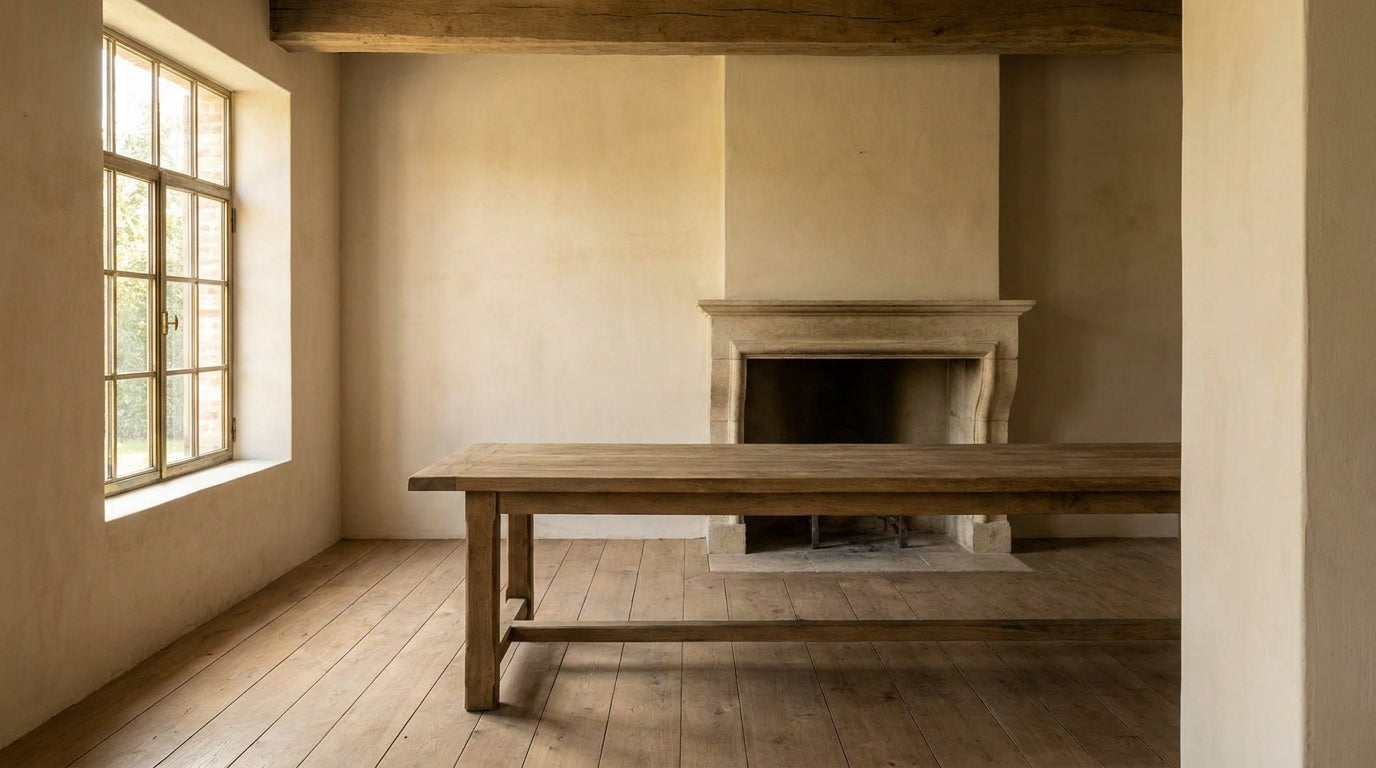
The French Country Dining Table Antique Grey is reclaimed oak built on the same trestle-and-pegged-joinery logic that Provençal and Burgundian farmhouse tables used from the late 1700s through the early 1900s. Most tables sold as "French country" at this price point are new pine stained grey with bolted leg connections and an MDF substrate under the breadboard ends. The difference is mechanical, and a buyer can check it in under five minutes if they know where to look.
What 'French Country' Actually Refers To — Region, Period, and Construction
French country is a regional building tradition before it is a paint color. The pieces that defined the look came out of farmhouses in Provence, Burgundy, and the Dordogne between roughly 1780 and 1910, built by village joiners working in oak, chestnut, walnut, and occasionally fruitwood for smaller pieces. The tables were long because the families and the field hands ate at the same one. They were trestle or turned-leg because a trestle clears legroom for a bench, and a turned leg uses less wood than a square box base. The tops were planked in two or three wide boards because the trees were old enough to mill that way.
The grey-wash finish so many buyers now associate with the style is not original to the period. Farmhouse tables in southern France were typically left unfinished or rubbed with linseed oil, and the colors went grey on their own over fifty to a hundred years of sun, smoke, and weekly scrubbing with lye soap. The chalky pale finish a buyer sees on a reproduction today is a coat of paint imitating a century of wear. That is not a disqualifier on its own. A genuine reclaimed-oak top can be wire-brushed and washed grey to match the era it came from, but it does mean the finish is the easiest part of the style to fake. The construction underneath is the part that has to be right.
Sizing, pairing and spotting veneer
| Question | Answer |
|---|---|
| What room does a 60-inch round need? | At least 11 feet in the shorter dimension, which leaves 36 inches of pull-out clearance behind each chair. It seats six. |
| Where do trestle bases work best? | At 72 and 84 inches, where diners on the long sides get unbroken legroom. |
| What is the most flexible format? | An extendable table moving between 72 and 96 inches, for a house that hosts holidays but eats family dinner at six. |
| What chair pairs with a 30-inch table? | A dining chair with a seat height of 18 to 19 inches. |
| How do you spot veneer? | It runs roughly 0.6mm on a budget piece, usually under 1mm, with a horizontal seam line where it wraps the edge. |
The Four Construction Details That Separate Authentic French Country Tables From Reproductions
When we look at a table to decide whether it belongs in the category, we check four things in this order:

Breadboard ends. The two short cap pieces at either end of the top should run perpendicular to the long planks. On a real farmhouse table they are pegged into the top with three or four square wooden pegs you can see on the surface, and the joint shows a thin seasonal gap in winter because the planks move and the breadboard does not. On a reproduction the breadboard is usually glued and bisquit-joined with no pegs, or pegs that are decorative dowels glued in flush. If you can scratch the peg with a fingernail and it feels like the same wood as the surrounding board with a slight grain mismatch, it's structural. If it feels like a smooth plug, it's decoration.
Trestle or turned-leg joinery. A trestle base on a real piece is connected to the top by sliding dovetail or pegged through-tenon, and the stretcher between the two trestles is pegged in turn. A turned-leg table from the same era uses mortise-and-tenon at the apron with pegs driven through the face of the leg. Bolted metal hardware under the apron is the modern tell.
Pegged mortise-and-tenon, visible. This is the same point from a different angle, but it bears repeating: on a genuine piece the pegs are visible from the outside of the leg, not hidden. Joiners in 1850 weren't trying to disguise their joinery. The pegs were the joinery. A table that hides every fastener under the apron is using fasteners that wouldn't survive the inspection.
No MDF anywhere. Tap the underside of the top and the underside of the breadboard with a knuckle. Solid hardwood gives a low, dense thunk. MDF gives a dead, slightly higher tap with no resonance. Veneer over MDF will look right from the top and fail this test instantly. On this dining table the top is solid reclaimed oak through the full thickness, breadboards included, and the base is pegged where the joinery shows.
How to Read the Wood: Reclaimed Oak and Chestnut vs. New Pine Stained to Look Old
Reclaimed European oak and chestnut are heavier, denser, and darker in the end grain than new pine, and they show three signals a buyer can read without removing the finish.

The first is oxidation. Hardwood that has been exposed to air for eighty or a hundred years develops a soft brown-grey cast in the cell walls themselves, not just on the surface. When the board is wire-brushed for finishing, the low grain reveals that aged color underneath. New pine stained grey shows a uniform color top to bottom because the stain is the color. Sand it lightly and you get fresh white pine.
The second is the milling pattern. Boards milled before about 1920 carry circular or straight saw marks from water-powered or early steam mills, often visible across the bottom face of the top where no one bothered to plane them out. Modern lumber shows a uniform planer pattern of tight parallel lines.
The third is the nail and fastener evidence. A reclaimed top frequently has filled or open holes from its previous life as flooring, framing, or a barn door. Those holes are part of the piece. A reproduction with "distressed" holes drilled by a CNC pattern shows identical spacing and identical depth across the surface, because the machine doesn't know how to be inconsistent.
Pine has its own honest place in this category. The parquet-top baluster table uses genuine reclaimed pine planks set in a parquet pattern, and the wood is doing what it actually is rather than pretending to be oak. The problem isn't pine. The problem is new pine stained to imitate aged oak. Pine that has lived fifty years in a building has stopped most of its movement and developed real patina. New pine straight off the kiln has neither.
Why a Genuine French Country Table Outlasts a Reproduction and What That Means for Refinishing
A solid reclaimed oak top with pegged joinery has two structural advantages that compound over decades. The pegs allow the wood to move seasonally without splitting the joint, because a peg flexes where a screw shears. And the top, being one piece of solid wood per plank, can be sanded down to bare wood and re-oiled an effectively unlimited number of times over the table's life. We have seen 1860 farmhouse tables refinished four or five times across 165 years and still sitting on the same trestle.
A reproduction with veneer over MDF cannot be refinished at all. The veneer is roughly 0.6mm thick on a budget piece. One pass with a random-orbit sander goes through it, and now there is a permanent pale patch over a brown composite core. A reproduction with solid pine and bolted hardware can in theory be sanded, but the bolts loosen across years of seasonal movement, and the leg-to-apron joint develops a wobble that no amount of refinishing fixes.
For a buyer thinking about resale: a genuine reclaimed-hardwood table with documented provenance holds roughly 60–70% of its purchase price at ten years, sometimes more if the era and region are clean. A reproduction loses most of its value the moment it leaves the showroom, the same way veneer case goods do. We keep the dining pieces that pass these tests under the French country furniture collection, each one signed off by one person before it ships.
Round vs. Rectangular vs. Extendable: Which Table Format Fits the Room You Actually Have
A 60-inch round table seats six and needs a room at least 11 feet in the shorter dimension to leave 36 inches of pull-out clearance behind each chair. Round works in a square-ish room and forces the table to be the center of gravity, which suits open-plan layouts. The drawback is that you cannot scale up. Once six is seated, the seventh person is in the kitchen.
A 72-inch fixed rectangle seats six comfortably and eight at a squeeze, and it needs roughly 12 feet of room length and 9 feet of width. An 84-inch fixed rectangle seats eight without squeezing, and it needs 13.5 feet of length. Trestle bases work especially well at 72 and 84 inches because the diners on the long sides have unbroken legroom. Turned-leg tables put a leg at roughly every chair position, which can crowd the end seats.
An extendable table with one or two leaves can move between 72 and 96 inches, which is the most flexible format for a house that hosts holidays but eats family dinner at six. The compromise is that the leaf seam shows on a genuine table. There is no way to make a working leaf invisible without modern hardware that doesn't belong on the piece.
For chairs: the seat height on most reclaimed-oak tables sits at 30 inches, which pairs with a dining chair seat height of 18–19 inches. The Edna side chair sits at 18.5 and clears most apron heights without binding the thighs. Upholstered chairs work with this style, but the chair should be French in proportion (lower back, tapered leg) rather than a wing-back, which fights the table visually.
How to Care for a French Country Dining Table: Oil and Wax Cadence, Spill Protocol, and What to Avoid
A reclaimed hardwood top wants oil twice a year and wax once. We use a pure tung oil or a 50/50 tung-and-citrus-solvent mix, applied with a cotton rag in the direction of the grain, left for thirty minutes, then wiped back hard until the surface is dry to the touch. Six months later, repeat. Once a year, after the second oil application has cured for a week, apply a thin coat of neutral paste wax (Briwax clear or Howard Citrus Shield) with a cotton cloth, let it haze, buff it off with a clean cloth. That cadence keeps the surface fed without building up a film.
For spills: blot, don't wipe. Wiping pushes liquid into the grain. A watermark from a cold glass usually lifts with a light pass of #0000 steel wool dipped in mineral oil, rubbed with the grain, then re-oiled. A heat ring from a hot dish is harder and sometimes requires a light sand of the affected area and a re-oil of the whole top to even the color back out. This is the upside of an oil finish: every repair is local, and you never have to refinish the whole top to fix one mark.
What to avoid: polyurethane, lacquer, and any "one-coat-and-done" topcoat marketed as kitchen-table-proof. A polyurethane finish on a French country table disqualifies it from the category, because the whole point of the style is that the wood is exposed to oil, food, sun, and elbows directly, and develops patina because of it. Polyurethane gives you a plastic-bag-over-the-wood result that scratches white, can't be spot-repaired, and traps moisture underneath when the inevitable chip opens up. We extend the same oil-and-wax care across the reclaimed pine furniture range. Pine takes oil slightly differently than oak (it absorbs faster, so apply less per coat), but the cadence is identical.
The Antique Grey table is built to be used the way these tables were used in 1880: hard, daily, with kids and dogs and gravy, and re-oiled when it looks thirsty. That is the case for owning one.
Common questions
What wood is a French country dining table traditionally made from?
European oak is the most common, followed by chestnut in the southwest of France and walnut in finer pieces from Burgundy. Fruitwood (cherry, pear) shows up in smaller side tables but rarely in dining tables of size, because the trees don't yield wide enough boards. Pine was used in the very poorest regions and for utility pieces but was not the dominant material for a farmhouse dining table. If a piece is labeled French country and the wood is identified as new pine, the label is describing the style of the finish, not the wood tradition.
How can you tell if a French country table is solid wood or veneer?
Look at the edge of the top where it meets the breadboard end. Solid wood shows continuous grain running through the full thickness. The same grain pattern on the face continues down the edge. Veneer shows a thin top layer (under 1mm usually) with a different-colored substrate beneath, and the edge often has a horizontal seam line where the veneer wraps. Knock the underside of the top with a knuckle: solid hardwood sounds dense and low, MDF sounds dull and slightly higher. If a seller cannot tell you the thickness of the top in inches, that's an answer in itself.
What size French country dining table seats 8 comfortably?
A fixed rectangle at 84 inches long by 38–40 inches wide seats eight without crowding: three on each long side and one at each end. If you want eight without anyone at the ends, go to 90 inches. An extendable starting at 72 and opening to 96 also seats eight, with the bonus of dropping back to six for daily use. Allow 36 inches of clearance behind each chair for pull-out room, which means the surrounding room wants to be at least 13.5 feet long by 10 feet wide.
Does a round or rectangular table work better in a French country dining room?
Rectangular is more historically accurate. Farmhouse tables in Provence and Burgundy were almost universally long rectangles to accommodate field hands and large families on benches. Round became more common in urban French dining rooms of the 19th century and reads slightly more formal. In a modern open-plan space, round at 60 inches anchors a room well and feels less hallway-like than a long rectangle. In a dedicated dining room with a wall on either side of the table, the rectangle is the right call.
Can a French country dining table be used with upholstered chairs?
Yes, and it's a common pairing. The thing to match is proportion, not material. A French country table sits visually low and grounded, so the chair should too: a lower back (38–42 inches tall), tapered or turned legs, and a seat height of 18–19 inches. Linen or natural leather upholstery in a stone or oatmeal tone reads correctly. A tall wing-back or a tufted parsons chair in a dark velvet fights the table's informality. Two armchairs at the ends with side chairs on the long sides is a comfortable arrangement for a fixed 84-inch rectangle.
How often does a reclaimed hardwood dining table need to be oiled or waxed?
Oil twice a year, wax once. We do oil applications in early spring and early fall, when the seasonal humidity is shifting and the wood is most receptive. Wax goes on after the fall oil has cured for a week or so, usually in late October. If the table is in a hot, dry house with forced-air heat, you may want a third oil pass mid-winter when the surface starts looking matte and feels chalky to the hand. The wood tells you when it's thirsty. Once you know the cadence in your specific room, it becomes routine.


