
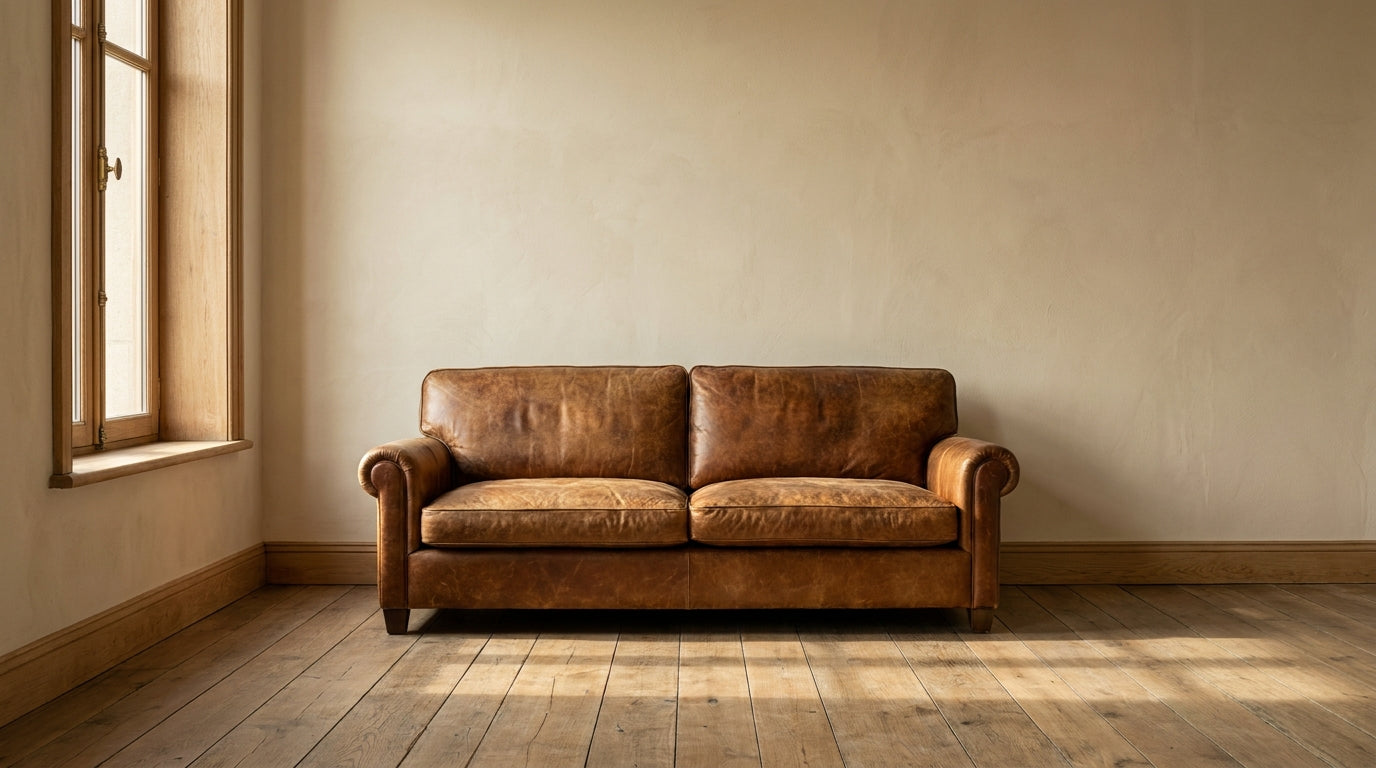
The Newport Chesterfield Sofa in Antique Buffalo is upholstered in a full-grain water buffalo hide that's been dyed twice at the tannery: a base coat, then a hand-applied highlight pass that pulls darker tones into the low points of the grain. That two-step finish is what "antique" means in this category. It's a tannery treatment on new leather, not a description of the hide's age, and it's the single biggest reason a buffalo leather sofa from us looks different in person than a pigment-coated cowhide sofa at the same price point.
Buffalo Leather vs. Cowhide: Fiber Density, Weight, and What Both Mean for a Sofa Frame
Water buffalo hide runs thicker than most cowhide used in upholstery, roughly 2.2mm to 3.5mm on the panels we spec, against 1.0mm to 1.4mm for a standard top-grain cow upholstery split. The fiber structure is also denser and more interlocked, which is why a buffalo hide holds its shape across the arm rolls and back panels of a chesterfield without the soft-collapse you see on thinner leather after a year of daily sitting.

The trade-off is weight. A three-seater wrapped in buffalo hide comes in noticeably heavier than the same frame in cowhide, sometimes 40 to 60 pounds heavier across the full piece. That matters for the frame underneath. Kiln-dried hardwood with mortise-and-tenon joinery handles the load without complaint. A softwood or plywood-and-staple frame does not, which is one of the reasons buffalo leather rarely shows up on sub-$1,500 sofas: the construction underneath can't carry it for thirty years.
The Newport Chesterfield sits on the heavier end of our range because the diamond-tufted back and rolled arms use more leather per panel than a tight-back design. If you want the same hide on a lighter silhouette, the tight-back models in the lineup get you there.
Water buffalo hide against standard cowhide upholstery
| Water buffalo, the panels we spec | Standard top-grain cowhide split | |
|---|---|---|
| Thickness | 2.2mm to 3.5mm | 1.0mm to 1.4mm |
| Weight across a three-seater | 40 to 60 pounds heavier across the full piece | The baseline |
What "Antique" Means in Leather Finishing — and What It Does Not
The antique step is a tannery process, not an authentication. Hides come off the vegetable-tan drum a uniform mid-tone brown. A finisher then applies a darker glaze by hand and wipes it back across the surface so the pigment settles into the grain valleys and the high points stay lighter. The result is the two-tone depth you see on our pieces: darker in the recessed grain, lighter across the raised surfaces, with the variation running unevenly from panel to panel because no two hides take the glaze the same way.

This is worth saying plainly: the leather on the Keswick three-seater is new. The hide is new, the tanning is current, the finish was applied in the last twelve months. What's "antique" is the look the finishing step produces, a hide that reads like leather that's been broken in for a decade on day one.
That distinction matters because it tells you what to expect on delivery. The arms won't match the back panel exactly. The seat cushions will be a shade darker or lighter than the side panels depending on how the glaze settled. None of that is a defect. A hide that arrives perfectly uniform across every surface has been pigment-sprayed to cover the grain, which is a different product category at a different price.
How We Source and Specify Buffalo Hides for Our Sofa Frames
We work from a hide spec, not a hide catalog. The cutoff is 2.2mm minimum thickness across the panel, full-grain (no buffed surface, no corrected grain), vegetable-tanned through the drum stage, and free of barbed-wire scarring across the cuts that face out on the sofa. Barbed-wire scars take the antique glaze unevenly: the scar tissue resists the pigment, so a finished panel with a scar line reads as a defect even though the leather underneath is sound. We reject those hides at the tannery before they reach the cutting table.
Branding marks, fly bites, and minor range scars are different. Those carry into the finished panel as part of the hide's history and we use them. They're the marks that prove the leather is full-grain: a corrected hide has none of them because the surface has been sanded down and re-sprayed. If you sit on our buffalo leather sofa range in person, you can usually find a brand or a bite on at least one panel of every piece. That's the spec working.
The vetting cost is real. We turn away roughly one in three hides offered to us at the tannery level on a typical run, which is why lead times on these sofas sit at six to nine months rather than four to six. We'd rather hold the order than ship a piece with a hide we wouldn't put in our own house.
How Buffalo Leather Changes Over the First Five Years of Use
The patina story on antique buffalo is different from cowhide because the starting surface is different. Full-grain hide, vegetable-tanned, with the antique glaze sitting on top of intact grain — that surface oxidizes and absorbs body oils rather than wearing through a pigment coat.
At six months, you'll see the seat cushion deck and the inside arm rolls darken first. These are the contact points, and the oils from skin and clothing pull through the surface glaze and into the leather. The color goes deeper, not lighter. Cowhide with a pigment finish does the opposite at this stage: the coating wears off the contact points and the lighter base underneath shows through as scuffing.
At two years, the seat front edge softens and develops a slight roll where it meets the floor. The leather across the Broadford three-seater seat panels will read noticeably darker than the back panels by this point, with the contrast between contact and non-contact areas running maybe two or three shades.
At five years, the hide has settled into a uniform working color across the high-use surfaces and the original antique glaze still reads in the protected areas: under the cushions, along the back panel, on the outside arm faces. Pulling a seat cushion off a five-year-old buffalo sofa is the easiest way to see the change. The hide underneath looks like the day it arrived. The hide on top looks like a sofa someone has actually lived with.
Why Antique-Finished Buffalo Leather Has a Higher Refinishability Floor Than Top-Grain or Corrected Cowhide
A worn cowhide sofa with a pigment-sprayed finish has one path forward when the coating fails: re-spray. The original surface is sanded grain underneath a pigment layer, and once that pigment cracks or flakes, you can't oil it back to health because there's nothing for the oil to penetrate. The fix is cosmetic, a new coat sprayed over the old one, and it lasts a few years before failing again.
Full-grain buffalo with an antique glaze can be reconditioned at the leather, not at the surface. A neutral leather oil applied with a cotton cloth penetrates the grain and rehydrates the hide from underneath. Spot-retouching a worn area is also possible because the dye chemistry of the original glaze is compatible with hand-applied dye matched at a leather refinisher. The Keswick club chair is the easiest piece in our range to demonstrate this on: single seat, single set of arms, smaller surface area to match if a refinisher gets called in after a decade of hard use.
What you're paying for, in part, when you buy at this price point is the refinishability floor. A pigment-coated cowhide sofa hits a wall at year ten or twelve. A full-grain buffalo sofa with an antique finish has a reconditioning path well past that. That's the longevity case for the hide. The frame underneath has to last the same distance: kiln-dried hardwood does, plywood-and-staple doesn't, and the two questions need to be answered together when you're comparing prices across the category.
Routine Care for an Antique Buffalo Leather Sofa: Schedule, Products, and What to Skip
The cadence is short. Every four to six months, a pH-neutral leather conditioner applied with a cotton cloth in a thin pass across the cushions and arm rolls. Leather Honey, Bick 4, or any conditioner from a tannery supplier without silicone in the formula will do the job. Apply, let it sit twenty minutes, buff off the residue with a clean cloth. That's the whole routine.
Skip silicone sprays. Skip leather "protectants" that promise a sealing finish. Skip saddle soap on furniture leather: it's formulated for tack and it strips the antique glaze. Anything that puts a barrier on the surface blocks the oxidation and oil-absorption process that the tannery designed the hide to continue through its working life. A silicone-sealed buffalo sofa stops developing patina and starts looking plasticized at the contact points within a year.
Direct sun is the other thing to watch. UV will fade the lighter highlights of the antique finish faster than the darker base, which flattens the two-tone depth that made the hide worth buying. If a sofa sits in a south-facing window, rotate the cushions monthly and consider a sheer to break the direct line in summer. The same advice holds across the armchair lineup: smaller pieces show fade unevenness more visibly because the panels are smaller.
For everyday care, a dry cloth handles dust. Spills wipe up with a damp cloth and air-dry. Don't chase a water mark with heat or a hair dryer. Buffalo hide takes a few hours to even out on its own and forcing it leaves a stiff patch that takes longer to recover.
Common questions
Is buffalo leather stronger than cowhide leather?
For furniture upholstery, yes, in the ways that matter. Water buffalo hide has a denser interlocked fiber structure and a thicker cross-section than most cowhide used in sofas, which means it resists stretching across high-tension areas like arm rolls and seat fronts. Tensile strength tests show buffalo hide breaking at higher load points than equivalent-thickness cowhide, but the more practical measure is what happens after five years of sitting. Buffalo holds shape. Thinner cowhide softens and sags at the cushion edges. Both will outlast a fabric sofa if the frame underneath is built right.
What does "antique finish" mean on a leather sofa?
It's a two-stage tannery process applied to new hide. A base dye colors the leather through the drum, then a darker glaze is hand-applied and wiped back across the surface so the pigment settles into the grain valleys while the raised points stay lighter. The result reads as a broken-in, tonally varied surface on day one. It's not a description of the hide's age, and it's not a claim about the sofa being vintage. The leather is new. The finishing technique produces the antique look.
Does buffalo leather crack over time?
Full-grain buffalo leather that's conditioned every four to six months does not crack. Cracking happens when the hide dries out and the surface loses elasticity, which is a moisture problem solved by routine conditioning. The pieces that crack are typically pigment-coated leathers where the coating fails before the hide underneath has had a chance to dry: the cracking is in the finish layer, not the leather itself. On full-grain buffalo with an oil-friendly antique finish, the conditioning cadence keeps the hide supple for decades.
Can you condition buffalo leather with regular leather conditioner?
Use a pH-neutral conditioner without silicone. Most leather conditioners sold for furniture are fine: Leather Honey, Bick 4, Cadillac Leather Conditioner, anything from a saddlery supplier that lists its ingredients. Avoid anything labeled as a "protectant," "sealer," or "shine spray," and avoid saddle soap, which is too aggressive for furniture leather and strips the antique glaze. The goal is to add moisture, not to coat the surface.
How thick is buffalo leather compared to cowhide?
Our buffalo spec runs 2.2mm to 3.5mm depending on the panel. Standard top-grain cowhide for upholstery typically falls between 1.0mm and 1.4mm. That's roughly two to three times the cross-section, which is why buffalo holds nailhead trim flush without puckering and why the arm rolls on a buffalo sofa hold their shape across decades. The thickness also affects the hand of the leather: it feels firmer under the palm, less papery, more like a saddle than a jacket.
Why does buffalo leather look different from panel to panel on the same sofa?
Two reasons. First, no two hides take the antique glaze the same way. The hand-applied highlight coat settles into the grain differently depending on the hide's natural texture, so a seat cushion cut from one hide will read slightly different in tone from a back panel cut from another. Second, full-grain leather carries the natural variation of the animal: branding marks, range scars, grain density shifts across the cuts. We use that variation deliberately. A sofa with perfectly uniform panels has been pigment-sprayed to hide the grain, which is a different product at a different price. The variation is the proof that the hide is what we say it is.


