
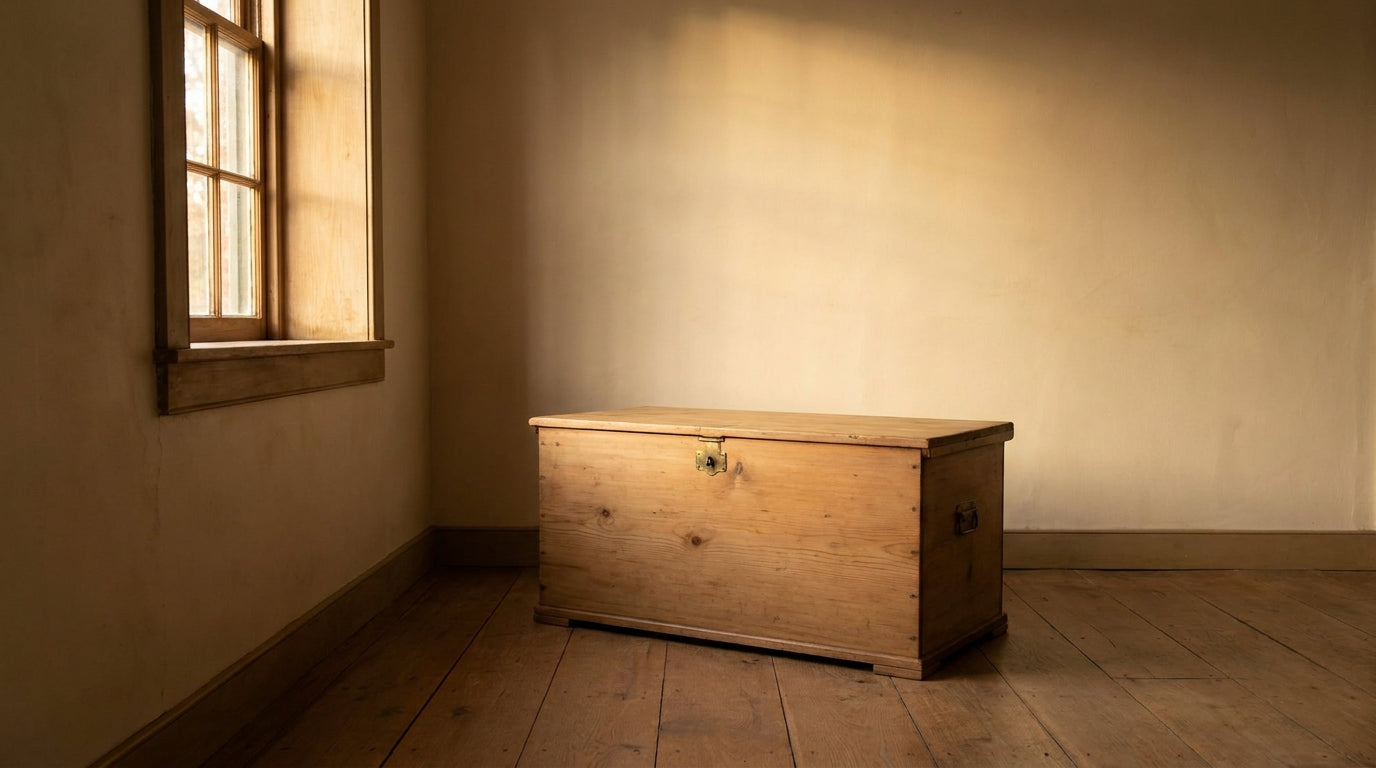
The Pine 4 Drawer Bowfront with Natural Wax Seal is built from boards that spent fifty-plus years inside a building before we ever saw them, joined with dovetailed drawers and a waxed top you can spot-repair with a rag. Most chests sold in the $1,500–$3,500 band at this aesthetic are either new pine put through a distress pass or veneer over MDF dressed to read like an heirloom. This guide is how to tell the difference before you spend the money, and what the construction details on our chests actually mean once the piece is in your room.
What Reclaimed Pine Is and Where Ours Comes From
Reclaimed pine is structural softwood that already lived a life as joists, beams, sheathing, or floor planks, pulled out of buildings before demolition and milled flat again for furniture. The pine in our reclaimed pine furniture comes out of old mill buildings, barns, and warehouses where the boards spent decades drying in place. That matters because by the time we cut into them, the wood has already done most of the moving it's going to do. New kiln-dried pine is stable on the day it ships and then keeps adjusting to whatever house it lands in for the next two winters.
There is a category of furniture sold as "reclaimed pine" that is actually new lumber run through a wire brush, a chain flail, and a tinted wax to mimic old surfaces. That's a finish decision, not a sourcing one. The way to tell on a product page: real reclaimed boards have nail holes from old fasteners (square-cut, round-wire, sometimes both on the same board because the building was repaired across eras) and the holes show up in odd places because the boards weren't laid out to be furniture. A factory distress pass puts the marks in pretty places.
Solid reclaimed pine against new pine and veneer over MDF
| What you are buying | Growth rings per inch | Sanding a worn spot | Resale at ten years |
|---|---|---|---|
| Solid reclaimed pine | 20 to 30 on old boards | Sands and re-waxes. It is wood all the way through | Roughly 40 to 60% of the purchase price |
| Solid new pine | 4 to 8 | Sands, though the wood is younger and softer | Holds better than veneer, being real wood |
| Veneer over MDF | Not applicable, the face is a sheet | Sand through the 1mm veneer and you are into MDF, which will not take stain | Typically 10 to 20%, if it sells at all |
How Reclaimed Pine Boards Differ From New Pine and MDF Veneer
Three things separate the materials, and all three show up in the photos if you know where to look.

Grain density. Old-growth pine, the kind that came out of forests before mid-century plantation replanting, grew slowly, sometimes 20–30 rings per inch. New plantation pine grows fast and shows 4–8 rings per inch. Slower growth means denser wood, harder surface, and screws that hold their bite. On a chest like a natural pine chest, you can count the rings on the end grain of the top if a photo shows it.
Knot pattern. Reclaimed boards from old buildings tend to have tight, dark knots that have already shrunk and locked in place. New pine has larger, lighter knots that can loosen and pop as the board dries further. MDF "pine" has no knots at all because it isn't pine. It's a printed paper or thin veneer layer over compressed sawdust and resin. The giveaway on MDF veneer: the grain pattern repeats every few feet because the print does, and the edges of a panel will be a slightly different color than the face.
Dimensional stability. Reclaimed pine moves less seasonally than new pine because it shed most of its moisture decades ago in a building's attic or wall cavity. MDF doesn't move at all until it gets wet, and then it swells and stays swollen. A reclaimed pine drawer will tighten a touch in August and loosen in February. An MDF drawer will run smoothly until the day a glass of water tips over in it, and then the bottom sags permanently.
The Joinery We Use and Why It Holds Longer Than Staple Construction
Open the top drawer of any chest you're considering and look at the front corner where the drawer face meets the side. If you see interlocking fingers cut into the wood, fan-shaped or square, that's dovetail joinery. If you see a butt joint with staples or a single nail driven through, that's flatpack construction with a furniture finish.

The chests we sell use dovetailed drawer boxes. Dovetails resist the one force a drawer takes every day for thirty years: pulling. Every time someone yanks a drawer open, the joint between the face and the side is the part that wants to fail. A dovetail can't pull apart along the grain because the geometry locks it. A staple joint relies on the staple's grip in softwood, and softwood gives up that grip the first time the drawer gets overloaded.
The carcass (the box the drawers slide into) is joined with mortise-and-tenon at the corners on most of our pieces, with tongue-and-groove back panels rather than a stapled hardboard back. The serpentine chest is built this way: solid pine carcass, solid back, dovetailed drawers, with a blue stone top set into a routed rabbet on the case so it sits flush. None of those choices are visible at thumbnail scale, which is part of why this category gets faked so often.
The functional reason it matters: a chest built this way can be taken apart, repaired, and reassembled in 2055. A staple-and-glue chest can't. When the glue fails (and the glue always fails) the joint is gone, because there is no mechanical interlock holding the wood together.
Why Reclaimed Pine Holds Up Better Over Time Than You Might Expect
Pine has a reputation as a soft, dent-prone wood, and new plantation pine deserves that reputation. Old-growth reclaimed pine doesn't, and it's worth saying why directly because the buyer benefits stack up.
Density. Slow-grown old-growth pine is measurably harder than new pine, closer to soft maple than to the spongy lumber-yard 2x4 most people picture when they hear "pine." A reclaimed pine chest takes the same kind of life a hardwood chest takes: kids, dogs, a lamp dragged across the top once a month for ten years. It will dent. It will not gouge or crush the way new pine does.
Refinishability. This is the real long-term value. A solid pine chest with a wax or oil finish can be cleaned up with steel wool and re-waxed in an afternoon, or sanded back to bare wood and refinished entirely. The piece you buy at 35 is the piece your kid takes to college at 53. A veneer chest can't be refinished. Sand through the 1mm veneer layer and you're into MDF, which doesn't take stain because it isn't wood.
Resale floor. Solid-wood heritage pieces hold roughly 40–60% of their purchase price on the secondhand market a decade in. Veneer-over-MDF case goods typically clear 10–20% if they sell at all, because resale buyers can spot the construction. You're not buying a chest as an investment, but the floor matters when you eventually move or change rooms.
One-of-one character. No two reclaimed boards are alike, which means no two of our chests are alike. The nail holes, the saw marks, the tonal range from board to board — that's the piece. It's not a defect to apologize for and it's not a story we invented.
The Three Finish Options on Our Pine Chests and What Each One Does to the Wood
Most of our pine chests come in one of three finish profiles. The choice matters because it determines how the chest looks in two years and how you fix it when something happens.
Natural wax seal. A paste wax, usually a beeswax-and-carnauba blend, buffed into bare wood. Low sheen, soft hand, warm color. The bowfront chest is finished this way. Wax sits on the surface rather than penetrating deep, which means spot repairs are simple: rub the damaged area with #0000 steel wool, wipe, re-wax. It also means the finish needs reapplication once or twice a year. Wax does not protect against standing water. A wet glass left overnight will leave a white ring you'll have to buff out.
Oil finish. A penetrating oil, typically a hardening oil like tung or a tung-linseed blend, soaks into the wood and cures hard inside the grain. Slightly more sheen than wax, slightly more water resistance, much harder to strip if you ever want to change the look. Spot repairs are still doable but you have to feather the oil into the surrounding area or you'll see a halo.
Hard-wax oil. A modern hybrid: penetrating oil with a wax topcoat that cures harder than a paste wax alone. Best water resistance of the three without going to a film finish like polyurethane. Looks closer to oil than to wax. Spot repairs are possible but more involved. This is the finish to ask for if the chest is going somewhere it'll see splashes, like a bathroom vanity or an entryway with wet boots.
We do not use polyurethane or lacquer on reclaimed pine. Film finishes hide the wood and turn yellow over a decade in sunlight, and the only way to fix a damaged film finish is to strip the whole piece.
How to Care for a Waxed or Oiled Pine Chest: Seasonal Routine and Products
The cadence on a waxed chest is twice a year. Once in early autumn before the heat comes on and the air dries out, once in spring after the humid months. Use a neutral paste wax (Howard Feed-N-Wax, Briwax clear, and Liberon black bison clear are all fine) applied with a cotton cloth in the direction of the grain, left to haze for ten minutes, then buffed off with a clean cloth. The whole job takes twenty minutes for a chest the size of the Lori chest.
For an oiled chest, the cadence is closer to once a year and only on the top. Wipe a thin coat of the same oil the maker used (tung or hardening oil, ask if it's not on the product page), let it sit fifteen minutes, wipe off everything that hasn't soaked in. Skipping this step won't ruin the chest. It just lets the surface dry out and chalk over time.
What to avoid:
- Silicone furniture sprays. Pledge and similar products leave a residue that wax and oil won't bond to, so the next time you try to refinish you'll need to strip with mineral spirits first.
- Steam cleaners. Steam drives water into the grain and lifts the finish.
- Wet rags left on the surface. Water rings happen fast on waxed pine.
What neglect looks like versus normal patina: a neglected chest goes chalky and gray on the top, with the grain feeling rough to the hand. A chest that's just aging (patina) darkens slightly, picks up small scratches that catch the light, and stays smooth. If your chest feels rough, it needs wax. If it just looks lived-in, it's doing what it's supposed to do.
Questions to Ask Before You Buy Any Reclaimed Pine Chest
When you're looking at our pine storage pieces or anyone else's, these are the five questions that separate a solid-wood heritage piece from a dressed-up flatpack. A retailer who can answer them plainly is selling what they say they're selling. A retailer who can't, isn't.
- Where do the boards come from? "Reclaimed pine" should have a source: old mill buildings, barns, warehouses, a specific region. A vague answer or a story about "vintage character" usually means new lumber with a distress finish.
- How are the drawers joined? Dovetails, front and back of the drawer box, not just the face. Staples or a single nail through a butt joint is the failure point.
- What's the finish, and can it be repaired? Wax, oil, or hard-wax oil are all refinishable. Polyurethane and lacquer are not, in any practical sense, in a home.
- How is the drawer hardware attached? Screws into solid wood from the back of the drawer face hold for decades. A bolt through a pre-drilled hole in MDF will eventually pull through.
- What's the lead time on a custom size, and can you do one? A maker working with real boards can usually adapt a width or height. A reseller flipping warehouse inventory can't.
The answers tell you what kind of company is on the other end of the order, which at this price point is most of what you're paying for.
Common questions
Is reclaimed pine stronger than new pine?
Old-growth reclaimed pine is denser than new plantation pine because it grew slower. You'll see 20–30 growth rings per inch on old boards versus 4–8 on new ones. Denser wood means a harder surface and screws that hold their bite longer. It's not as hard as oak or maple, but it's measurably harder than the new pine sold at a lumberyard today, and it behaves more like a hardwood in daily use.
Will a reclaimed pine chest warp in a humid room?
Less than a new pine chest would. Boards that spent fifty years in a building have already shed most of their moisture and done most of their moving. You'll see small seasonal changes (drawers a touch tighter in August, a hair looser in February) which is normal and self-correcting. True warping, like a cupped top or a twisted side panel, is rare in reclaimed boards and is usually a sign of MDF underneath a veneer, not real solid pine.
How often does a waxed pine chest need to be re-waxed?
Twice a year is the standard cadence: once in early autumn before heating-season dryness sets in, once in spring after the humid months. Use a neutral paste wax, apply a thin coat with a cotton cloth in the direction of the grain, let it haze for ten minutes, then buff off. The job takes about twenty minutes. If the chest sits in direct sun or in a heavily used space, a third application mid-summer is worth considering.
Can you paint or strip a reclaimed pine chest later if you change your mind?
Yes. That's one of the long-term advantages of solid wood with a wax or oil finish. To paint, strip the wax with mineral spirits, sand lightly, prime with a shellac-based primer like Zinsser BIN (so the knots don't bleed through), and paint. To strip back to bare wood, sand from 80 grit up to 220 and refinish with wax or oil. Neither is possible with a veneered chest because the veneer layer is too thin to sand without going through.
What does dovetail joinery actually look like on a chest drawer?
Pull the drawer out and look at the front corner where the drawer face meets the side. You'll see interlocking wedge-shaped fingers cut into both pieces of wood: they look like a row of fans or trapezoids locked together. Hand-cut dovetails are slightly irregular in spacing. Machine-cut dovetails are evenly spaced and uniform. Both are mechanically sound. What you don't want to see is a flat butt joint with a staple or nail driven through it.
How can you tell reclaimed pine from a pine veneer over MDF in a product photo?
Look at three things. First, the edges of the case where panels meet: real solid pine shows end grain, a different pattern than the face, while veneer shows a thin strip of a different material or a folded-over veneer band. Second, knot patterns: if the grain looks like it repeats every few feet across the piece, it's printed veneer. Third, nail holes and saw marks: real reclaimed boards have them in odd, asymmetric places because the wood wasn't originally cut for furniture. If the marks all sit prettily within the visible field, it's a distress pass, not history.


