
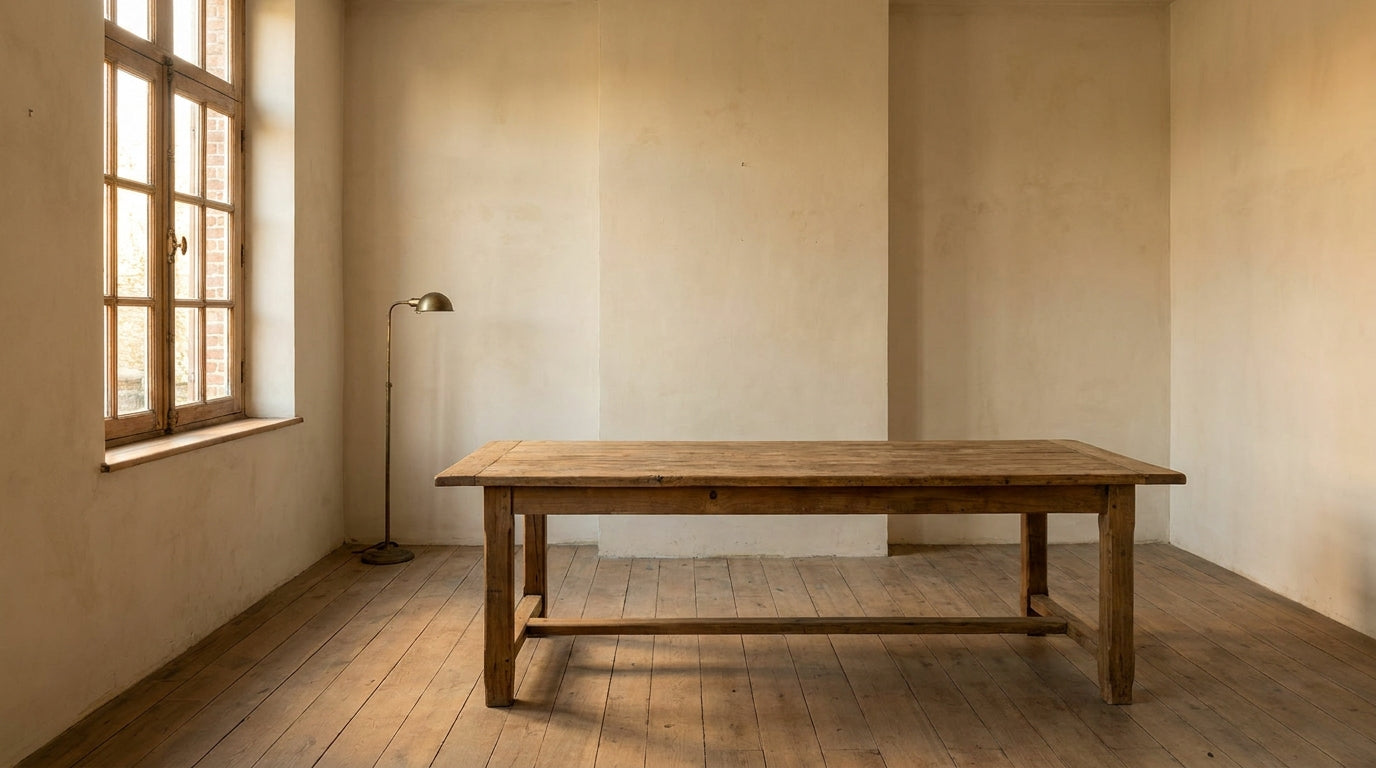
The reclaimed pine parquet baluster table is built from structural pine pulled out of buildings older than the people selling it. Old-growth timber milled flat, parquet-set across the top, and stood on a turned baluster base. Most of what's tagged "reclaimed pine" in this price band is new lumber put through a wire-brush distress pass and a grey wash. This guide is how we tell the two apart, why the real version costs what it costs, and what to ask before you spend $2,000+ on a piece you can't put your hands on.
What Reclaimed Pine Actually Is (and What It Is Not)
Reclaimed pine is structural timber salvaged from a building that came down, usually a barn, a mill, a tobacco warehouse, or a factory floor framed before roughly 1920. The boards started as old-growth Southern yellow pine or longleaf pine, milled when those trees were still standing in volume, then spent fifty to a hundred and twenty years holding up a roof. When the building is taken down, the timber is denailed, inspected, kiln-dried again to drive out moisture picked up over a century, and remilled into furniture stock.
That is not the same thing as:
- New pine stained to look old. Kiln-dried plantation pine, two to four years from seed to mill, run through a wire brush or a chain-flail to fake wear, then washed with a pigment stain. The wood is soft, the grain is wide and pale, the "distress" repeats in a pattern.
- Reclaimed-veneer over MDF. A thin slice of real reclaimed timber laminated over a particleboard core. The face reads correctly in photos. The edges and the underside give it away.
- "Heritage pine" or "vintage pine" with no provenance claim. Marketing words. They don't mean the wood came out of an old building.
The shorthand we use: if the seller can't tell you what kind of building the wood came out of and roughly when, it isn't reclaimed.
Reclaimed pine against new plantation pine
| Reclaimed pine | New plantation pine | |
|---|---|---|
| Growth rings per inch | Twenty to thirty in heart pine | Four to eight |
| Usable furniture stock from the timber | 40 to 60% once you mill around the nail holes and defects | Closer to 85% |
| Before joinery | Kiln-dried back down to roughly 6 to 8% moisture, which takes weeks and energy | Dried once, straight off the line |
Reclaimed Pine vs. New Pine: Does the Wood Actually Get Stronger With Age?
Yes, with a caveat. The wood doesn't get stronger because it aged on a shelf. It was stronger to begin with, and the aging is what proved it.

Old-growth Southern yellow pine and longleaf pine grew slowly in dense forests, which means the annual rings are tight, often twenty to thirty rings per inch in heart pine versus four to eight in modern plantation pine. Tighter rings mean more latewood per inch, which is the dense, dark band in the grain. More latewood means a harder, heavier board. Heart pine pulled from a pre-1900 mill can come in around 1,200–1,400 on the Janka hardness scale. New plantation pine runs roughly half that.
The second thing is resin. Old-growth pine is loaded with resin that, over a century, has partially crystallized inside the wood fibers. The result is a board that resists denting, dings, and seasonal movement better than fresh kiln-dried pine of the same species name. Reclaimed pine also moves less in winter than new pine because the wood already gave up most of its movement during fifty years of life in a building. The fiber has settled.
The caveat: reclaimed pine is harder than new pine. It is not as hard as oak or walnut. A dropped cast-iron pan will still leave a mark. The wood patinas instead of looking damaged, which is the point, but go in eyes open.
How to Tell Reclaimed Pine From New Pine Stained to Look Old
Five tells, in order of how hard they are to fake:

- Nail holes that don't line up. A genuine reclaimed board has square nail holes from cut nails (pre-1890s), round holes from wire nails (post-1890s), or both, scattered without pattern. Distressed new pine has either no nail holes or evenly-spaced fake ones from a CNC pass.
- Saw marks that match the era. Pre-1850s timber shows straight up-and-down pit-saw or sash-saw marks. Mid-to-late 1800s timber shows circular saw arcs from a water-powered mill, wide sweeping curves across the face. Post-1920s timber shows band-saw lines, much finer and straighter. New "distressed" pine almost always shows modern planer marks under the wash, if you look at a raw edge.
- Grain count. Eyeball the end grain. Tight, dark, closely-spaced rings mean old-growth. Wide, pale, soft rings mean plantation pine. You can see this on the underside of a drawer or the back of a panel.
- Color differential on a fresh cut. This is the one that ends the argument. Genuine reclaimed pine has a deep amber-to-honey patina across the surface from a century of oxidation and resin migration. Sand a small spot on the underside and the fresh wood underneath comes back pale yellow, a sharp color line between the patinated face and the interior. Stained new pine sands back to the same color it shows on top, because the color is just pigment.
- Weight per cubic foot. Old-growth heart pine is dense. Pick up the piece. If a six-foot console feels light enough to lift one-handed, the wood isn't what the tag says it is.
The reclaimed pine parquet baluster table is a useful piece to study because the parquet top exposes a lot of edge grain. Every block in the pattern shows its rings, and you can see the variation in patina from board to board. No two blocks are the same color. That's the wood, not the finish.
Why Reclaimed Pine Furniture Costs More at the Supplier Level
The raw material is more expensive per board foot than new pine, and the yield is worse. Here is roughly where the money goes:
- Sourcing. A reclaimed timber broker takes down a building, pays the labor to dismantle it without splintering the beams, trucks the timber to a yard, and stores it long enough to dry and stabilize. New pine comes off a plantation in twenty-foot lengths on a flatbed with no labor in between.
- Denailing. Every board has to be metal-detected and hand-pulled before it can touch a mill blade. A nail left in a beam destroys a $400 planer knife in one pass. This is slow labor and it isn't optional.
- Yield loss. A reclaimed beam comes out of a building with checks, splits, and bolt holes left over from its original framing. After milling around the defects, you may get 40–60% usable furniture stock out of the original timber. New pine yields closer to 85%.
- Re-kilning. Old timber sitting in a building for a century is at whatever moisture content the local climate gave it. Before it can be milled into furniture that won't move in a heated room, it has to be kiln-dried back down to roughly 6–8% moisture, which takes weeks and energy.
- Smaller production runs. A new-pine factory can run a hundred identical tables in a week. A reclaimed shop is hand-selecting boards for grain match and length, working around the bolt holes that survived the milling.
Browse the dining table range and you can read this in the price ladder. Reclaimed pieces sit two to three times the price of new pine of equivalent dimensions, and the reason is the inputs, not the markup.
Why Reclaimed Pine Gets Sticky When Sanded and What That Tells You About the Wood
If you sand a piece of reclaimed heart pine and the sandpaper gums up after thirty seconds, that's resin. The friction from the sander heats the wood, the crystallized resin liquefies, and it loads up the abrasive. New plantation pine almost never does this. It doesn't have enough resin to gum a belt.
Sticky-when-sanded is one of the cleanest evidence tests for old-growth pine. It is also a headache for the finisher, because if you apply a waterborne topcoat directly over resin-rich pine, the resin will bleed through over the next six to twelve months and yellow the finish from underneath.
The way around it is a shellac-based primer, typically Zinsser BIN, applied as a sealing coat before any topcoat goes on. Shellac is solvent-based and locks the resin in. Once that primer is down, you can apply wax, oil, lacquer, or paint over it without worrying about bleed-through. On the reclaimed pine console, the painted base is finished this way. The resin is sealed before the paint goes on, which is why the color sits flat instead of yellowing along the knots.
A finisher who hasn't worked with reclaimed pine before will skip this step and the piece will look fine for a year. Then the knots start ghosting amber through the paint. Ask before you buy.
How Reclaimed Pine Holds Up Over Time: Refinishing, Humidity, and Daily Use
Here is the long-term ownership case, which is the part that justifies the price over a ten-year horizon:
Refinishing. A surface scratch in reclaimed pine sands back to wood that looks like the rest of the piece, because the patina is in the wood, not on it. Sand a scratch out of a stained new-pine table and the spot comes back pale yellow against a brown surface. You've exposed the interior. Reclaimed pine sands back amber. You can re-wax the spot and walk away. We tell customers to keep a small tin of paste wax in the dining-room drawer and touch up scratches as they happen.
Humidity. Wood moves with the seasons. New pine moves a lot. A wide new-pine tabletop will gap at the breadboard ends in January and tighten back in July. Reclaimed pine moves measurably less, because the wood already lost most of its movement during a century in a building. Pieces like the French country dining table are built with breadboard ends and elongated screw slots so the top can still move what little it wants to, without splitting.
Daily use. Reclaimed pine patinas the way leather does. A water ring darkens and blends in. A dropped fork leaves a dent that reads as use, not as damage. After three years a reclaimed pine table looks better than it did the day it arrived. New pine with a polyurethane topcoat scratches white through the finish and looks worse with every year.
Refinish interval. A waxed reclaimed pine top wants a thin coat of paste wax once or twice a year. Howard Feed-N-Wax or a neutral beeswax-and-carnauba blend, applied with a cotton cloth in the direction of the grain, buffed back after twenty minutes. A full refinish (sand, re-seal, re-wax) is usually a fifteen-to-twenty-year question, not a five-year one. You don't refinish reclaimed pine on a schedule. You refinish it when you actually need to.
What to Ask Before Buying Reclaimed Pine Furniture
Five questions for any retailer at this price point:
- Where did the wood come from? A specific answer is "structural pine from pre-1940 mill and barn buildings, denailed and re-kilned before milling." A vague answer is "ethically sourced reclaimed timber." Vague means they don't know.
- What's the moisture content at time of milling? Should be 6–8% for indoor furniture. If they can't answer or say "kiln-dried" without a number, the piece may move in your house.
- How are the drawers joined? Dovetails (front and back) are the standard for furniture meant to last. Pocket screws and staple-and-glue are not, regardless of what the rest of the piece looks like.
- What's the finish? Wax, oil, lacquer, or paint over shellac primer are all acceptable for reclaimed pine. A waterborne topcoat applied directly to raw reclaimed pine, with no shellac sealing coat, will bleed amber. Ask specifically about resin sealing.
- What's the lead time, and is it made to order? A genuine reclaimed piece is often built to order because the shop can't stockpile identical boards. A two-week ship time on a reclaimed dining table usually means the table isn't reclaimed, or the shop is sitting on a warehouse of new-pine pieces with reclaimed-style finishes.
The reclaimed pine furniture collection is where to start if you want to see how these answers look on actual pieces. Every listing names the wood, the construction, the finish, and the ship window honestly, including the ones with a December lead time. The lead time is the wood telling you it's real.
Common questions
Is reclaimed pine actually stronger than new pine?
Yes, meaningfully so, but only the old-growth varieties — heart pine and longleaf pine pulled from pre-1920s buildings. Tight annual rings (twenty to thirty per inch versus four to eight in modern plantation pine) mean more dense latewood per board, which translates to a Janka hardness around 1,200–1,400 versus roughly 600–700 for new plantation pine. Reclaimed pine also moves less seasonally, because the wood already finished most of its movement during a century in a building.
Why does reclaimed pine get sticky when sanded?
Resin. Old-growth pine is heavily resin-saturated, and a century of slow crystallization concentrated it inside the wood fibers. When a sander heats the surface, the resin liquefies and gums up the abrasive. New plantation pine almost never does this because it doesn't carry enough resin. Sticky-when-sanded is one of the cleanest evidence tests for genuine old-growth reclaimed pine, and it's also why a reclaimed piece needs a shellac primer (typically Zinsser BIN) under any topcoat to prevent amber bleed-through later.
How can you tell if pine furniture is genuinely reclaimed or just stained to look old?
Sand a small spot on the underside or back of the piece. Genuine reclaimed pine shows a sharp color line — amber patina on the surface, pale yellow wood underneath — because the color is in the wood from oxidation, not from pigment. Stained new pine sands back to the same brown it shows on top because the color is dye. Other tells: random non-patterned nail holes, era-appropriate saw marks (circular arcs for late-1800s, band-saw lines for early-1900s), and a board weight that matches old-growth density.
Does reclaimed pine furniture warp or crack in humid rooms?
It moves less than new pine, but it does still move. A well-built reclaimed pine table is constructed with that movement engineered in: breadboard ends on elongated screw slots, floating panels in case construction, and tops finished with wax or oil rather than a rigid film that can crack. If a piece is built without movement allowances, any wood will eventually split. Ask about construction before you buy.
Can reclaimed pine furniture be refinished if it gets scratched?
Yes, and this is the strongest part of the ownership case. Because the amber patina is in the wood (not painted on), sanding out a scratch exposes wood that matches the surrounding surface. Re-wax the spot with a neutral paste wax (Howard Feed-N-Wax works well), buff it back, and the repair disappears. A full refinish is usually a fifteen-to-twenty-year question rather than a five-year one. Keep a small tin of wax in a drawer and touch up scratches as they happen.
Why does reclaimed pine cost more than new pine furniture?
The inputs are more expensive and the yield is worse. Reclaimed timber has to be sourced from a dismantled building, denailed by hand (a single missed nail destroys a planer knife), re-kilned to indoor moisture, and milled around checks, splits, and bolt holes, leaving 40–60% usable stock versus around 85% from new pine. Add hand-selection for grain match and the smaller production runs the material allows, and the per-piece cost lands two to three times above an equivalent new-pine table. The price is the inputs, not the markup.


