
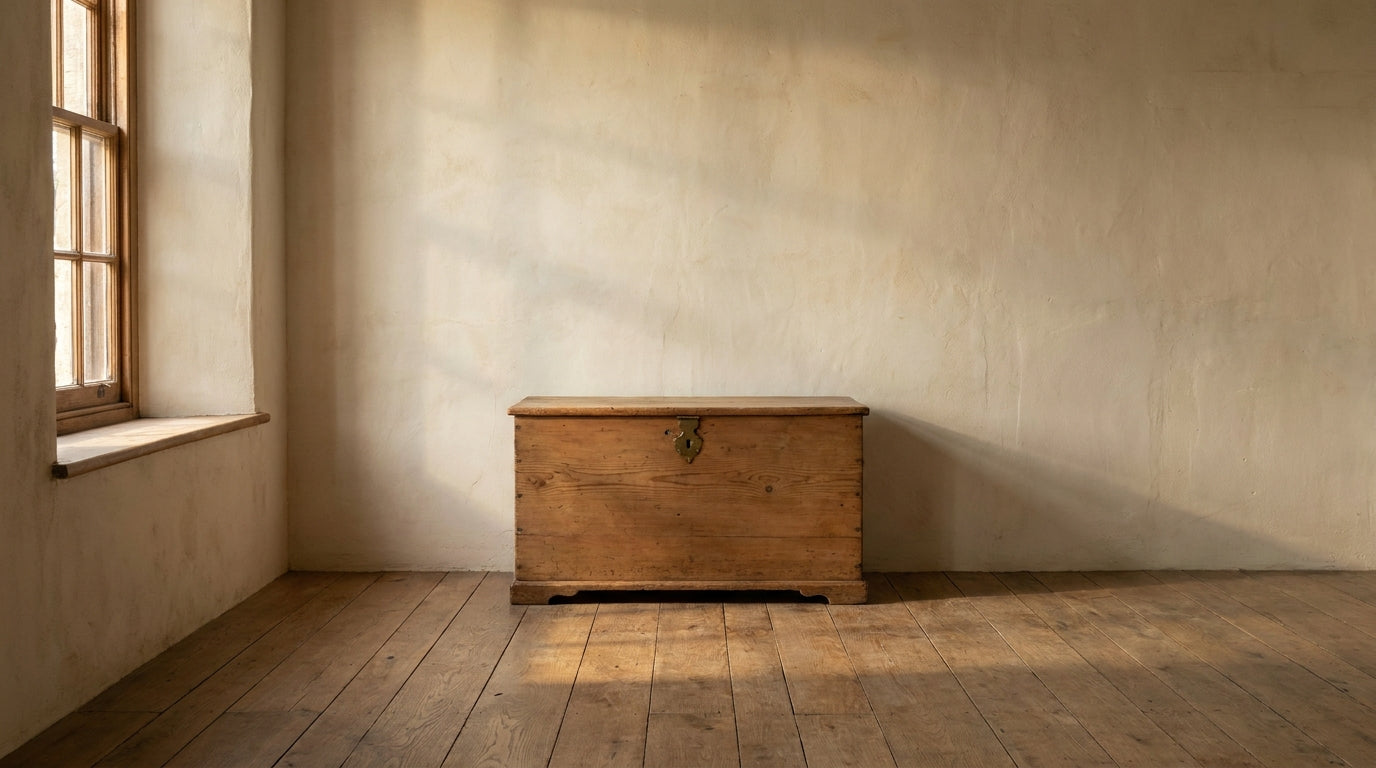
The Pine 4 Drawer Bowfront with Natural Wax Seal is finished with a soft paste wax over reclaimed pine. No polyurethane, no lacquer, no hard film between you and the wood. That changes everything about how you take care of it. Most online advice for "wood furniture" assumes a polyurethane top coat that you basically can't damage with a damp cloth, and that advice will fog a waxed pine surface inside six months.
This is the care cadence we give every customer who takes home a waxed or oiled pine chest from us: what to do, what to never do, and what's normal seasonal movement versus a real problem.
What Finish Is Already on Your Reclaimed Pine Chest
Before you put any product on a chest, find out what's already on it. The three finishes you'll encounter on reclaimed pine are paste wax, penetrating oil (usually a hardwax oil or tung oil blend), and a hard-film finish like polyurethane or lacquer. Each one takes a different cleaner and a different refresh product, and the wrong combination causes lifting, clouding, or a sticky surface that never fully cures.

The water-bead test takes ten seconds. Put a single drop of water on an inconspicuous spot, like the back top edge, or inside the apron on a chest. If the drop beads up tight and stays beaded for a few minutes, you have a hard-film finish. If it beads loosely and slowly flattens within a minute or two, you have a wax finish. If it absorbs into the wood within thirty seconds and leaves a dark spot that lightens as it dries, you have an oil finish with the wax mostly worn off, or an unsealed area that needs attention.
For most EGH pieces, including the bowfront chest with a natural wax seal, the answer is paste wax. That means a neutral paste wax (Howard Citrus-Shield, Briwax clear, or a similar carnauba-beeswax blend) is what you refresh with. Never use a silicone-based spray polish. Pledge and similar products leave a residue that prevents future waxing from bonding.
Indoor humidity and what it does to aged pine
| Relative humidity | Why it matters | |
|---|---|---|
| The target, year-round | 40 to 50% | Where aged pine sits stable |
| What forced-air heat does | Drops the room into 20 to 30% | This is what cracks aged pine |
| The line not to cross | Below 30% | The dangerous zone. Run a humidifier in the room |
Why Reclaimed Pine Moves More Than New Pine in Changing Humidity
Here's the counterintuitive part. Reclaimed pine has spent fifty to a hundred years in a building, drying down to whatever the average indoor humidity of that building was, so it's done most of the dramatic shrinking and warping new pine still has ahead of it. That's why we build with it. But pine is still pine. It's a softwood, the cell walls are relatively open, and it will expand in summer humidity and contract in winter heat regardless of how old it is.
What that looks like in practice: a drawer that slides freely in March will get tighter in July, then loosen back up in October. A small gap that opens between two boards on the top in February will close again by May. We've sold a natural pine chest to a customer in coastal Carolina and one in Denver — same chest, same wood, completely different seasonal behavior in each house.
Normal seasonal movement: drawer fronts that catch slightly in humid months, hairline gaps that open and close between top boards, hardware that needs a quarter-turn tightening twice a year. Not normal: a crack that runs across the grain (across, not along), a drawer that won't open at all, or a sudden warp in a single panel. Across-grain cracks usually mean the chest sat next to a heat source (a radiator, a south-facing window, a fireplace) and dried unevenly. Move the piece first, then call us before doing anything else.
The fix for almost all seasonal stickiness is patience. Don't sand a drawer that's tight in July. It'll be loose again in October, and the wood you removed isn't coming back.
The Seasonal Maintenance Schedule: What to Do in Spring, Summer, Autumn, and Winter
A waxed pine chest needs real attention twice a year and a light touch the other two seasons. Here's the cadence we hand out with our reclaimed pine furniture:

Spring (March–April). Full wax refresh. Wipe the chest down with a barely-damp cotton cloth, let it fully dry for an hour, then apply a thin coat of neutral paste wax with a soft cloth in the direction of the grain. Wait fifteen to twenty minutes until the wax hazes, then buff with a clean cloth. One coat is enough. Two coats is wasteful and gummy.
Summer (June–August). Light maintenance only. Dust weekly with a dry cotton or microfiber cloth. If a drawer sticks, run a candle stub or a block of paraffin along the runners. Never sand. Keep the chest at least two feet from any window that gets direct afternoon sun.
Autumn (October–November). The second wax refresh of the year. Same procedure as spring. This is also when you check every screw on every piece of hardware and give it a quarter-turn snug, not a full tightening, because aged pine threads strip easily. Look for the start of any heat-related drying if you've turned the heat on early.
Winter (December–February). Humidity is the issue, not dust. Forced-air heat drops indoor humidity into the 20–30% range, which is what cracks aged pine. Run a humidifier in the room and aim for 40–50% relative humidity. A $40 hygrometer pays for itself the first winter. Skip the wax this season, because wax doesn't bond well in cold, dry air.
The once-a-year task that nobody does and everyone should: pull the drawers all the way out and wipe down the runners and the inside of the case with a dry cloth. Pine dust accumulates on the runners and is what makes a drawer feel gritty over time.
How to Clean Reclaimed Pine Without Lifting the Finish
For routine cleaning of a waxed surface, a barely-damp cotton cloth is the entire toolkit. Wring it out until it feels almost dry to the back of your hand. Wipe with the grain. Follow immediately with a dry cloth. That's it.
For a sticky spot (a spilled drink, a child's handprint, a dried food smear), use a 50/50 mix of distilled water and white vinegar on a cloth, wiped on, wiped off within thirty seconds. Vinegar is mild enough that it won't strip wax in a single application but will cut through most household residue.
Three things to never use on a waxed pine chest:
- Ammonia-based cleaners (Windex, most all-purpose sprays). Ammonia cuts through wax and leaves the underlying wood exposed and blotchy.
- Bleach or any chlorine-based cleaner. Pine bleaches unevenly and the spot won't take wax again without a full refinish.
- Silicone furniture sprays. Pledge and similar products leave a residue that contaminates the surface. Future wax coats won't bond, and a refinisher will charge you extra to strip it.
For oiled pine (less common in our catalog but worth knowing), the same rules apply, with one addition: a yearly thin coat of the same oil the chest was finished with. If you don't know what oil was used, a neutral hardwax oil like Osmo Polyx is a safe bet on most reclaimed pine.
Repairing Surface Dents and Scratches on a Waxed Pine Chest
Shallow dents, the kind from a dropped book or a corner knock, usually come out with steam. Place a damp cotton cloth over the dent, set a clothes iron on medium heat (no steam setting) on top of the cloth for five to ten seconds at a time, lifting to check. The water turns to steam, the compressed wood fibers swell back, and the dent rises. Repeat until flush, let dry overnight, then re-wax that spot. This works on softwood like pine specifically because the dent is compression, not lost material.
Shallow scratches that haven't broken through the wax layer often disappear with a fresh coat of paste wax buffed firmly into the scratch with a cotton cloth. Deeper scratches that show raw wood need a tinted wax stick (Mohawk and Liberon both make pine-toned ones) worked into the scratch with a fingernail, wiped flush, then sealed with a coat of paste wax over the whole top.
When to stop and call a refinisher: any scratch deeper than 1/16 inch that exposes long stretches of raw wood, any water ring that won't lift with re-waxing, or any area where the original wax has gone milky-white from prolonged moisture. A chest like the Lori chest with a colored wash finish is also one to leave to a professional. Matching the wash tone on a repair is not a DIY job, and an attempted touch-up almost always shows.
Hardware and Hinge Care: Iron, Brass, and Hand-Forged Fittings
Most of the chests in the storage collection carry one of three hardware types: solid brass, hand-forged iron (often blackened or oil-rubbed), or steel with a patinated finish. Each one takes different care.
Solid brass develops a warm patina over years that most buyers want. It's part of what makes the piece read as aged rather than new. If you want to keep that patina, leave the brass alone and just wipe with a dry cloth. If you prefer bright brass, a yearly polish with a non-abrasive brass cream (Brasso or Wright's) on a cotton swab, kept off the surrounding wood, will keep it bright. Don't polish hand-forged iron. The dark finish is intentional, often a wax or oil over the raw metal, and a polish will strip it down to bare steel that then rusts.
For loose hinges and pulls, never just retighten harder. Aged pine threads strip the second time. The fix is a wooden matchstick or a sliver of toothpick coated in wood glue, pressed into the stripped hole, snapped off flush, and left to dry for an hour. Drive the original screw back into the repaired hole and it'll hold for another generation.
A piece like the bowfront chest with a natural wax seal is built to be maintained, not replaced. Twice-yearly wax, a humidifier in winter, and the right cloth instead of the wrong spray is the whole job.
Common questions
Can a beeswax polish be used on a reclaimed pine chest?
Yes, on a waxed finish. A pure beeswax polish or a carnauba-beeswax blend is the correct refresh product for almost every waxed pine chest we sell. Apply a thin coat with a cotton cloth in the direction of the grain, wait fifteen minutes for it to haze, then buff. Avoid spray-on "beeswax" products that list silicone or petroleum distillates in the ingredients. Those are spray polishes with a beeswax marketing label, and they leave residue.
How often should a waxed pine chest be re-waxed?
Twice a year is the standard cadence, once in spring and once in autumn. A chest in a high-traffic room (an entry, a mudroom) might need a third coat in mid-summer on the top surface only. A chest in a guest bedroom that rarely gets touched can stretch to once a year. The signal that it's time: the surface looks dry and slightly chalky, and a drop of water absorbs into the wood within thirty seconds instead of beading loosely.
What humidity level should the room be kept at to prevent cracking?
Aim for 40–50% relative humidity year-round. The dangerous zone for aged pine is below 30%, which is where forced-air winter heat will push most American homes without a humidifier. A small console humidifier in the room is enough for most spaces. A whole-house humidifier on the furnace is the better long-term answer if you have multiple pieces of antique or reclaimed wood furniture.
Is it normal for a reclaimed pine chest to swell in summer and stick at the drawer?
Yes. Reclaimed pine still moves seasonally even after decades of stabilization, and a drawer that's tight in July and loose in October is normal behavior, not a defect. The wrong response is to sand the drawer when it's tight. The wood you remove is gone, and in winter that same drawer will rattle. The right response is a rub of paraffin or candle wax on the drawer runners and patience until the season turns.
Can reclaimed pine be refinished if the surface gets badly scratched?
Yes, but think of it as a once-in-a-generation event, not routine maintenance. Reclaimed pine takes refinishing well because the wood itself is stable and the saw marks, nail holes, and patina that make the piece valuable are usually deeper than any refinish goes. A good refinisher will hand-sand only the top layer, preserve the character marks, and re-wax to match. Budget $400–$900 for a chest depending on size and finish complexity. Stripping and re-waxing yourself is possible but tends to flatten the character that made the piece worth buying.
What is the safest way to clean inside the chest without damaging the wood?
A dry cotton cloth or a vacuum with a soft brush attachment for routine dust. For a musty smell that sometimes comes with reclaimed wood that sat in storage, place an open box of baking soda inside each drawer for a week, then remove. Avoid spraying anything inside. Interior pine is usually unfinished or lightly waxed, and a wet cleaner will raise the grain and leave a watermark that's harder to repair than one on the top because nobody refinishes drawer interiors.


