
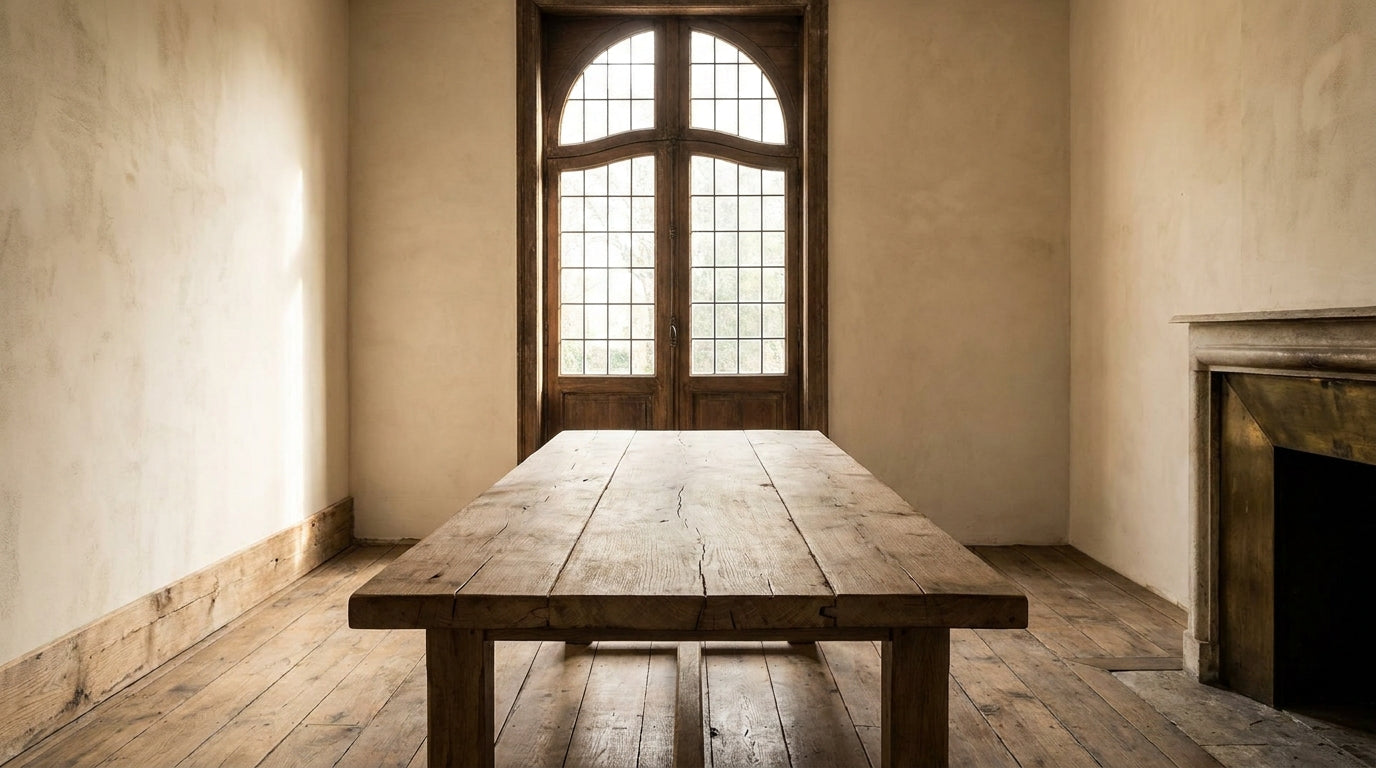
The Reclaimed Pine Parquet Top Baluster Tbl is a working example of why this comparison matters: a parquet-pattern top built from old pine boards on a turned baluster base, priced where a new oak farmhouse table sits. Most buyers cross-shopping pine and oak in the $1,500–$4,000 range assume oak is the safer call because it's harder. That's true on a hardness chart and only partly true at a dinner table, and the rest of this guide is how we explain the difference to anyone who calls and asks.
What 'Reclaimed' Actually Means for Pine vs Oak
Reclaimed pine and reclaimed oak come out of different buildings, and the building decides what you get.
Most reclaimed pine in this price range comes from barn siding, attic joists, and floor boards pulled from houses and outbuildings built before 1940. The boards are wide, the grain is open, and the nail holes are frequent because pine was the cheap framing wood for fifty years before kiln-dried lumber took over. Patina sits in the surface, sun-darkened on one face and raw on the other.
Reclaimed oak more often comes out of old factory flooring and warehouse joists. It was the workhorse hardwood, used where things rolled across the floor or where a beam carried weight. So reclaimed oak boards tend to be narrower and denser, and show wear in different places: bolt holes from machinery, dark stains from oil, and rounded edges from foot traffic instead of weather.
That source difference matters more than the species difference once a board is in your kitchen. A pine board from a 1910 barn and an oak board from a 1920 factory floor have both already done seventy or eighty years of moving. They have lost most of the seasonal expansion they're going to lose. New kiln-dried pine and new kiln-dried oak still have that movement ahead of them, which is why a reclaimed table in a dry-heated room in February does not split the way a new table sometimes does.
Reclaimed oak against reclaimed pine
| Reclaimed oak | Reclaimed pine | |
|---|---|---|
| Janka hardness | White oak around 1,360, red oak around 1,290 | 380 for Eastern white up to 1,225 for heart pine. Most sold as reclaimed pine sits at 870 to 1,000 |
| A dropped fork | Nothing visible | A small bright crescent that darkens with the wax over a few months |
| How it ages | Colour settles in the first year or two, then holds | Keeps moving on the surface. A faint washboard texture along the grain after five years |
| Taking a finish | Takes oil, wax or polyurethane evenly | Resin can bleed through water-based polyurethane and lift it within a year |
| Price at the same size and builder | Roughly a 20 to 35% premium | The baseline |
How to Tell Reclaimed Pine From Reclaimed Oak on Sight
Pine reads warm and oak reads cool, and once you've held both you stop confusing them. A few honest signals:

Pine has wide, soft grain rings, sometimes a quarter inch apart on old-growth boards, with a yellow-cream heartwood that ambers over the years. You'll see resin pockets and small dark knots, often with pitch streaks running off them. Old pine dents under a thumbnail with real pressure. New pine dents under a thumbnail without trying.
Oak has tight, interlocked grain with visible pores running along the board. Quartersawn oak shows ray flecks (short, lighter dashes running across the grain), and that's the easiest tell, because pine doesn't have them. Oak color runs from pale tan to deep brown depending on age and finish, and the surface feels harder under a fingernail.
The reclaimed pine parquet baluster table is a useful sight-test piece because the parquet pattern puts twelve or sixteen small pine boards next to each other on the top, each one from a slightly different source board. You can see the color range pine actually has, side by side, instead of guessing from a single photograph.
One more sight test that works on a showroom floor: pick up a board sample if there is one. Pine of the same dimensions weighs roughly two-thirds what oak weighs. If you can't tell from looking, you can tell from lifting.
Hardness, Denting, and What That Means at a Dining Table
Janka hardness is the test where a steel ball gets pressed into a wood sample and the force is measured. White oak comes in around 1,360, red oak around 1,290. Reclaimed pine, depending on whether it's Eastern white, Southern yellow, or heart pine, runs from about 380 (Eastern white) up to 1,225 (heart pine). Most of what gets sold as "reclaimed pine" in furniture is in the 870–1,000 range.
So oak is meaningfully harder. What does that mean across a meal?
A dropped fork off oak: nothing visible. A dropped fork off pine: a small bright crescent in the surface that darkens with the wax over a few months. A pushed-in chair leg on oak: maybe a faint scuff. A pushed-in chair leg on pine: a real dent if the leg has a metal foot.
This is where buyer preference splits cleanly. If you want a table that looks the same in year ten as it looks the day it arrives, oak is the better wood. If you want a table that records the meals (kids learning to eat with forks, the cast-iron pan that came off the stove too fast), pine does that more honestly. Neither one is wrong. The mistake is buying pine and being upset when it dents.
We keep both species on the dining table collection page and we mark which is which on every listing, because this is the single most common question that comes through the phone.
Why Reclaimed Pine Ages Differently Than Reclaimed Oak
Pine keeps moving on the surface long after it's stopped moving structurally. The amber deepens, the grain darkens where hands rest, and the soft summer-growth bands compress under everyday weight while the harder winter bands stay proud. You can feel this with a palm after five years; the top develops a faint washboard texture along the grain. That's pine doing what pine does.
Oak stabilizes earlier. The color settles within the first year or two and then holds. White oak greys slightly in direct sun, red oak warms slightly under wax, and beyond that the surface stays roughly where it started. Wear shows up at the edges and corners, rounded and softened, rather than across the field of the top.
The French country dining table is a useful example of the second path: an antique grey finish on a hardwood base, built to hold its appearance through the changes a kitchen puts a table through. Pine in a grey wash doesn't do this the same way, because the soft grain takes the pigment unevenly, and the wash deepens in the dents.
If you want consistent appearance, oak is built for that. If you want the table to look like it has fed your family, pine gets there faster.
Finishing and Refinishing: Oil, Wax, and Polyurethane on Each Wood
Oak takes finish evenly. Danish oil, hard-wax oil, tung oil, polyurethane — all of them sit down on oak without fighting the wood. The pores accept the oil, the grain stays visible, and a re-coat every three to five years restores the surface without sanding.

Pine is harder to finish well. The resin pockets in old pine can bleed through water-based polyurethane and cause adhesion failure, where the finish lifts in small spots over the resin, usually within a year. Oil-based finishes handle this better. Hard-wax oil and pure paste wax both work, and so does shellac as a sealer coat under a topcoat (Zinsser BIN is the standard shellac primer for sealing pine resin). What does not work: rolling water-based poly straight onto raw old pine and hoping.
For most pine tables we recommend hard-wax oil applied in two thin coats and waxed once a year afterward. The surface stays soft to the touch, takes water rings that buff out, and accepts touchups in a single board without re-doing the whole top.
Across the reclaimed pine furniture collection, the finishes are oil and wax, not polyurethane, for the reason above. If you've been told a pine table is "easier to care for because it's poly-sealed," ask which poly and whether the maker sealed the resin first. Most haven't.
Keeping a Reclaimed Pine or Oak Dining Table in Good Condition
Both woods want annual maintenance. Pine wants it twice a year if the room runs dry.
The cadence we tell buyers:
For oak: wipe the top with a barely damp cloth weekly, dry it immediately, and re-oil with the same finish the maker used once a year. Howard Feed-N-Wax over a hard-wax oil finish is a safe annual coat, applied with a cotton rag in the direction of the grain, buffed off after twenty minutes. Water rings on oak usually wipe away with the next oil coat.
For pine: same weekly wipe, but plan on waxing in October when the heat comes on and again in April when it goes off. A neutral paste wax (Briwax clear or any unscented furniture wax) goes on thin, sits for fifteen minutes, then buffs out. Water rings on pine are more stubborn because the soft grain absorbs moisture, but a light pass with #0000 steel wool and fresh wax usually clears them.
For both woods: keep the table out of direct sun if you can, use coasters under anything cold enough to sweat, and stop worrying about the rest. Heat trivets under hot pans, always. Felt pads under centerpieces that sit in one spot for months.
The same care logic applies to pine case goods generally. The barn door pine cabinet gets the same twice-a-year wax in a heated room, the same neutral paste wax product, the same approach to water marks. Once you've learned the cadence on a table, it carries across the rest of the pine in the house.
Common questions
Is reclaimed pine strong enough for a dining table that gets daily use?
Yes, with a clear-eyed understanding of what daily use looks like on pine. Old reclaimed pine is denser than new kiln-dried pine because it's been compressed by decades of its previous life, and the boards we use are typically two inches thick or more on a dining top. The frame and joinery do the structural work. A mortise-and-tenon pine base will outlast a stapled oak base every time. What pine will do that oak won't is dent. If you're okay with dents becoming part of the table, pine is strong enough. If dents will bother you, buy oak.
Does reclaimed oak cost more than reclaimed pine?
Usually yes, at the same dimensions and the same builder. Oak boards are harder to mill flat, the salvage stream is smaller, and the labor to joint and finish oak runs higher because the wood is denser. Expect roughly a 20–35% premium for reclaimed oak over comparable reclaimed pine in dining tables. Where the gap closes is on parquet or pieced tops. A parquet pine top with sixteen small boards takes more labor to assemble than a four-board oak top, so the price gets closer.
How do you tell reclaimed pine apart from reclaimed oak when buying secondhand?
Three checks. First, weight: pick up an end. Pine is noticeably lighter than oak at the same dimensions. Second, grain: pine has wide soft rings and visible knots, while oak has tight grain with small open pores running along the board. Third, ray flecks: on quartersawn oak you'll see short lighter dashes running across the grain. Pine doesn't have them. A fourth check if the seller will let you: press a fingernail into an inconspicuous edge. Pine will mark, oak will not.
Will a reclaimed pine dining table dent easily with kids at the table?
Yes, and that's usually fine. Forks dropped from chair height will leave small marks. Toys pushed across the top will scuff. None of this damages the table structurally; it adds to the surface that pine accumulates over time. Families who have lived with a pine table for ten years almost always tell us the marks are the part they like. Families who came in wanting a perfect surface and bought pine anyway are the ones who call back unhappy. Be honest with yourself about which kind of buyer you are before you order.
What finish works best on reclaimed pine to stop it from looking yellow?
Pine ambers no matter what. The wood itself yellows from sun and air over years, and a clear oil or wax doesn't stop that. What helps is a finish that doesn't add its own yellow. Hard-wax oil with a clear (not amber) base, or a white-pigmented hard-wax oil for a lighter look, both hold pine closer to its raw color than tung oil or amber shellac will. If you want a true grey or whitewashed pine, a lime wax applied before the topcoat works, but plan on refreshing it every two to three years because the wash sits in the soft grain and wears unevenly.
Can reclaimed oak be refinished at home, or does it need a professional?
For an oiled or waxed oak top, refinishing at home is straightforward: wipe with mineral spirits to remove old wax, sand lightly with 220 grit only if there are deep scratches, and re-apply the same oil or hard-wax oil the maker used. A weekend's work. For a polyurethane-sealed oak top with a worn finish, the job is harder, because you have to sand through the old poly evenly without burning through the stain underneath, and at that point a local refinisher running $400–$800 on a six-foot table is usually money well spent. Call the maker first. Most will tell you exactly what finish is on the table and which approach matches it.


