
The Pine 4 Drawer Bowfront with Natural Wax Seal is the cleanest example we keep of what "French country" used to mean before the term got loose: solid pine, hand-shaped bowfront, finished in beeswax over bare wood with no topcoat sealing the grain. Most of what's sold under the French country label at this price point is sprayed polyurethane over MDF with a routed scallop along the apron. This guide is how we read the difference, and how we'd build a bedroom around a piece like the bowfront without making the room feel like a catalog set.
French Country vs. French Provincial Bedroom Furniture: What the Terms Actually Mean
These two terms get used interchangeably on retail sites, and they shouldn't.
French Provincial is the older and more specific term. It refers to furniture made in the French provinces (Normandy, Brittany, Provence, the Loire) roughly between the late 17th and late 18th centuries, by regional craftsmen who were translating the court styles of Versailles into something a prosperous farmhouse could actually live with. The wood was usually walnut or one of the fruitwoods (cherry, pear, apple) because that's what grew locally. The proportions were heavier than the court originals. The carving was simpler. A Louis XV cabriole leg made in Provence in 1760 has the same general silhouette as one made in Paris, but the curve is shallower and the foot is blunter, because a country joiner cut it by hand from stock he had on the bench.
French Country is a 20th-century retail label. It was popularized in American shelter magazines in the 1970s and 80s, and it covers a much wider net. Actual French Provincial antiques sit inside it, but so do English farmhouse pieces, Belgian rural cupboards, Swedish Gustavian painted furniture, and a great deal of new manufacturing made to look like any of the above. The look is a mood (warm wood, soft white walls, linen, terracotta) more than a period.
When we list a piece in the French country furniture collection, we use the term in its loose 20th-century sense, but we say what each piece actually is (French Provincial, English country pine, Belgian) in the description. The label is a starting point, not the answer.
French Provincial against French Country
| French Provincial | French Country | |
|---|---|---|
| What the term is | A period. Furniture made in the French provinces roughly between 1680 and 1790 | A 20th-century retail label |
| Wood | Walnut and the fruitwoods, cherry, pear, apple, because that is what grew locally | Anything, including MDF at the $800 to $2,000 catalog price point |
| Distressing | Real wear, from use | Uniform, because it is done on a line |
| Drawer joinery | Mortise-and-tenon, dowels or pegged joints | Staples and cam-locks, which fail by year eight |
What Construction Makes a French Country Bedroom Piece Built to Last
Three signals matter for a piece you will own and refinish over twenty years. First, the case itself is solid wood or solid wood with a quality veneer over plywood, not MDF with a printed laminate. Second, the drawer joinery is dovetailed (through-dovetails or hand-cut both work, but staples and cam-locks fail by year eight). Third, the finish is waxed or oiled, not sealed, so a worn spot can be touched up rather than refinished wholesale. The pieces we keep in the bedroom collection are built against this standard.
Which Wood Finishes Are True to French Country Style and Which Are Not
Period-accurate finishes for French Provincial bedroom furniture come down to three families: beeswax over bare wood, milk paint (sometimes limed), and oil-and-wax on walnut. All three sit in the wood, not on top of it. You can feel the grain when you run your hand across the surface.

The wax-sealed bowfront chest is in the first family. The pine is sealed only with natural wax, no stain, no polyurethane, no lacquer. The color you see is the wood's actual color, deepened slightly by the wax. In ten years it will be a shade darker. In thirty, darker still. That's the finish doing what it's supposed to do.
The retail French country market mostly does not do this. The dominant finishes at the $800–$2,000 catalog price point are:
- Chalk paint over softwood or MDF, sometimes sanded through at the edges for a "distressed" effect. The distressing is uniform because it's done on a line. Real wear is concentrated at the pulls, the front edge of the top, and the bottom rail, the places hands and feet actually touch.
- Polyurethane over a stained pine that's been wire-brushed to fake grain depth. Polyurethane sits as a plastic film on the surface. You can see it under raking light: the sheen reads glossy in patches.
- Sprayed lacquer in a "French white" with antiquing glaze rubbed into the recesses. Glaze pooled evenly in every recess is the giveaway. Real age pools unevenly because the piece was actually used.
None of these are wrong as a style choice. They are wrong as a representation of French country tradition, and they price like they're the same thing.
Why the Construction Differences Affect Longevity and Refinishability
A waxed fruitwood or pine frame can be stripped and refinished as many times as you want. Wax comes off with mineral spirits and a cloth. The wood underneath is unchanged. If you decide in 2040 you want the chest painted, you paint it. If you change your mind, you strip it back to bare wood and re-wax it. The piece doesn't lose anything in the process.
A polyurethane-sealed piece can be refinished once or twice if the substrate is real wood underneath. If it's MDF with a printed veneer or a thin solid-wood facing, you can't sand it without going through to the particleboard. At that point the piece is finished, not refinishable, just finished.
This shows up in the resale floor. A real French Provincial walnut commode from the 1860s in average condition still trades at four figures at auction because the next owner can put another forty years on it. A 2015 reproduction in chalk paint over MDF trades for whatever someone will pay on a local resale app, which is usually a fraction of the original price.
A natural pine chest at $1,400 is more expensive than the catalog reproduction at $700. Over a 30-year run, with one refinish in the middle, the cost per year is lower on the pine chest, and you still have a piece at the end. The reproduction is in the alley by year twelve.
How to Mix a French Country Bed Frame With Other Bedroom Pieces Without Over-Matching
The mistake we see most often is buying a matched French country bedroom set — bed, two nightstands, dresser, mirror, chest — all in the same finish from the same maker. It reads as a showroom display, not a room someone lives in. Real French farmhouses accumulated furniture across generations. The walnut armoire was older than the painted nightstand, which was older than the iron bed.
The rule we use: one anchor piece in the French country idiom, then counterweights from adjacent traditions.
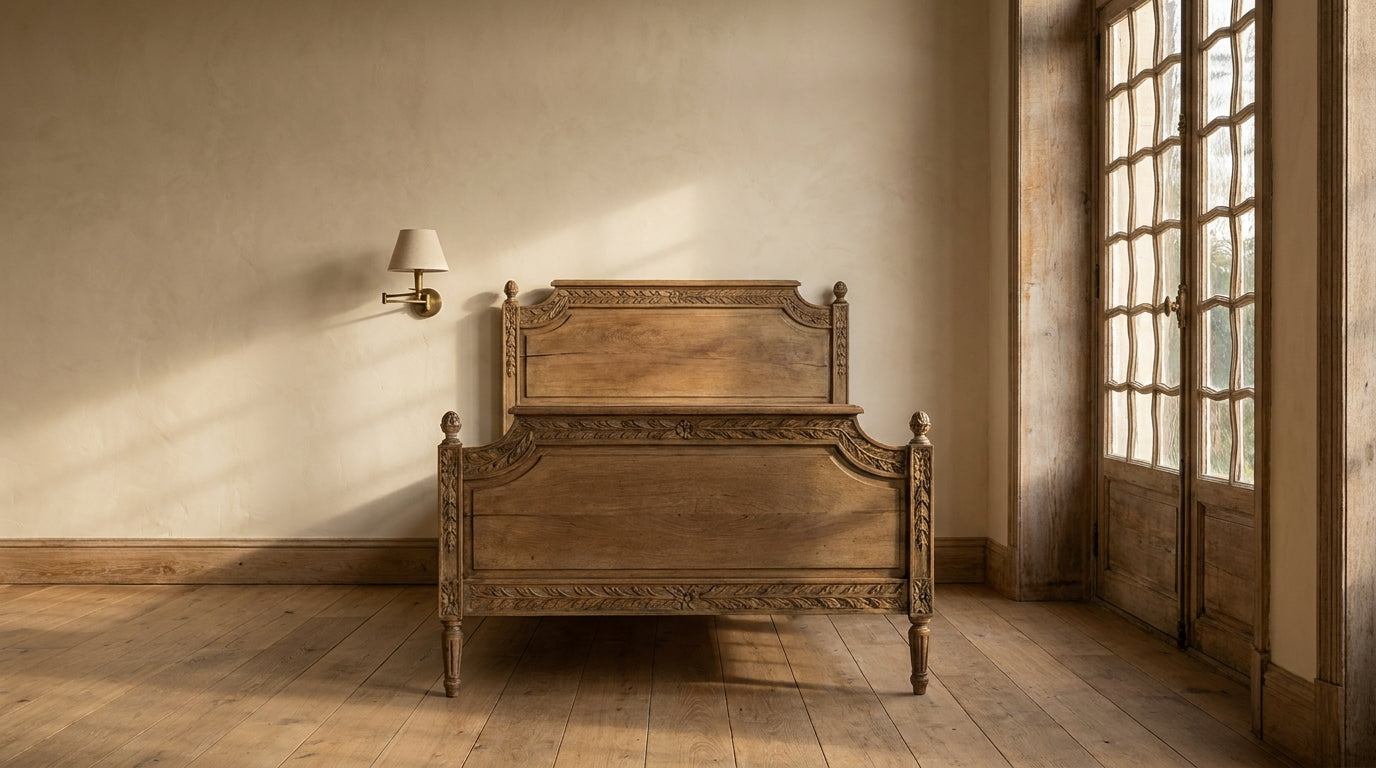
If the bed frame is French country, caned, painted, or carved walnut, flank it with nightstands that don't try to match. A small English country chest in waxed pine on one side, a simple Belgian-style table on the other. Different woods, different eras, similar weight. The eye reads coherence from the proportions, not the finish.
For the seating piece at the foot of the bed or in the corner, the Edna side chair reads French country without echoing the bed. Caned back, painted frame, slightly worn. It belongs to the same family without being from the same set.
The chest of drawers is where Belgian-minimal works best as counterweight. A clean-lined waxed pine chest with simple round pulls sits next to a carved French bed without competing with it. The carved bed gets to be the elaborate piece in the room. Everything else holds the line.
Caring for a Waxed or Oil-Finished French Country Bedroom Piece
Waxed fruitwood and oil-finished pine need less maintenance than people expect, and the wrong product can do more damage than ten years of normal use.
Cadence. Twice a year, applied with a soft cotton cloth in the direction of the grain. Spring and fall is the rhythm we suggest. Dry indoor air from heating and cooling cycles is when wax depletes fastest. Use a neutral paste wax (Briwax Original or Howard Feed-N-Wax work, applied thinly). Buff with a clean cloth after fifteen minutes.
Daily cleaning. A dry cloth or a barely-damp one for dust. Never a wet cloth on waxed wood. Water sits on the surface long enough to whiten the wax, and you'll have to re-wax the panel to clear it.
What will damage the finish. Aerosol furniture polish sprays (Pledge and its category) contain silicones that build up on wax and eventually have to be stripped off with mineral spirits. Steam cleaners drive moisture through wax into the wood. Never use one on a waxed piece. Citrus oil cleaners cut through the wax film and leave the wood bare. Direct sun across the same panel for years will bleach pine and darken walnut unevenly, so if the piece sits in a sunny bedroom, rotate it or shift a rug to break the light.
When to call someone. If a panel gets a ring from a glass, or if a drawer front gets scratched through the wax into the wood, you can almost always fix it yourself with fine steel wool, re-wax, and buff. If a leg joint loosens or a drawer runner cracks, that's a job for a furniture restorer. A real piece is worth the repair. That's the point of buying one.
Common questions
What is the difference between French Country and French Provincial bedroom furniture?
French Provincial is a specific historical category: furniture made in the French provinces between roughly 1680 and 1790 by regional craftsmen working in walnut and fruitwood. French Country is a broader 20th-century retail term that includes French Provincial antiques alongside English farmhouse pieces, Belgian rural furniture, Swedish painted pieces, and modern manufacturing made to evoke any of those. Provincial is a period. Country is a mood. When we describe a piece, we say which it actually is.
How do we tell if a French provincial dresser is a real antique or a reproduction?
Three checks. Pull a drawer and look at the joinery. Pre-1900 pieces use mortise-and-tenon, dowels, or pegged joints, not staples or pocket screws. Look at the cabriole legs from the inside. Hand-cut legs have asymmetric curves and slightly different proportions side to side, while machine-cut legs are perfectly symmetric. Run a fingernail across any carving. Hand carving has short varied tool marks, while routed carving has long parallel fluting at the bottom of every cut.
What wood is used in authentic French country bedroom furniture?
Walnut and the fruitwoods (cherry, pear, apple) for higher-end provincial pieces. Pine and oak for the more rustic farmhouse work, especially from regions where fruitwood was scarce. Painted pieces are usually pine or poplar underneath because the paint hides the lower-grade wood. If a piece is sold as French country in a tropical hardwood like acacia or mango, it's a modern reproduction made for the export market, regardless of how the finish is styled.
Can French country bedroom furniture work in a small bedroom?
Yes, but watch the proportions. A full-size French Provincial armoire is 7 feet tall and 5 feet wide and will swallow a small bedroom. The smaller pieces in the category, a single waxed pine chest, a caned side chair, a simple painted nightstand, work fine in a 10x11 room. Skip the matched set in a small space. One anchor piece plus simpler counterweights reads larger than four matching pieces.
What finish should French provincial bedroom furniture have?
Period-accurate finishes are beeswax over bare wood, milk paint (sometimes limed white), or oil-and-wax on walnut. All three sit in the wood and let the grain show through. Polyurethane, lacquer, and modern chalk paint over MDF are not period finishes. They're modern manufacturing choices that get applied to pieces sold under the French country label. The finish you want depends on the room, but if you want the piece to be refinishable in twenty years, choose wax or oil over poly.


