
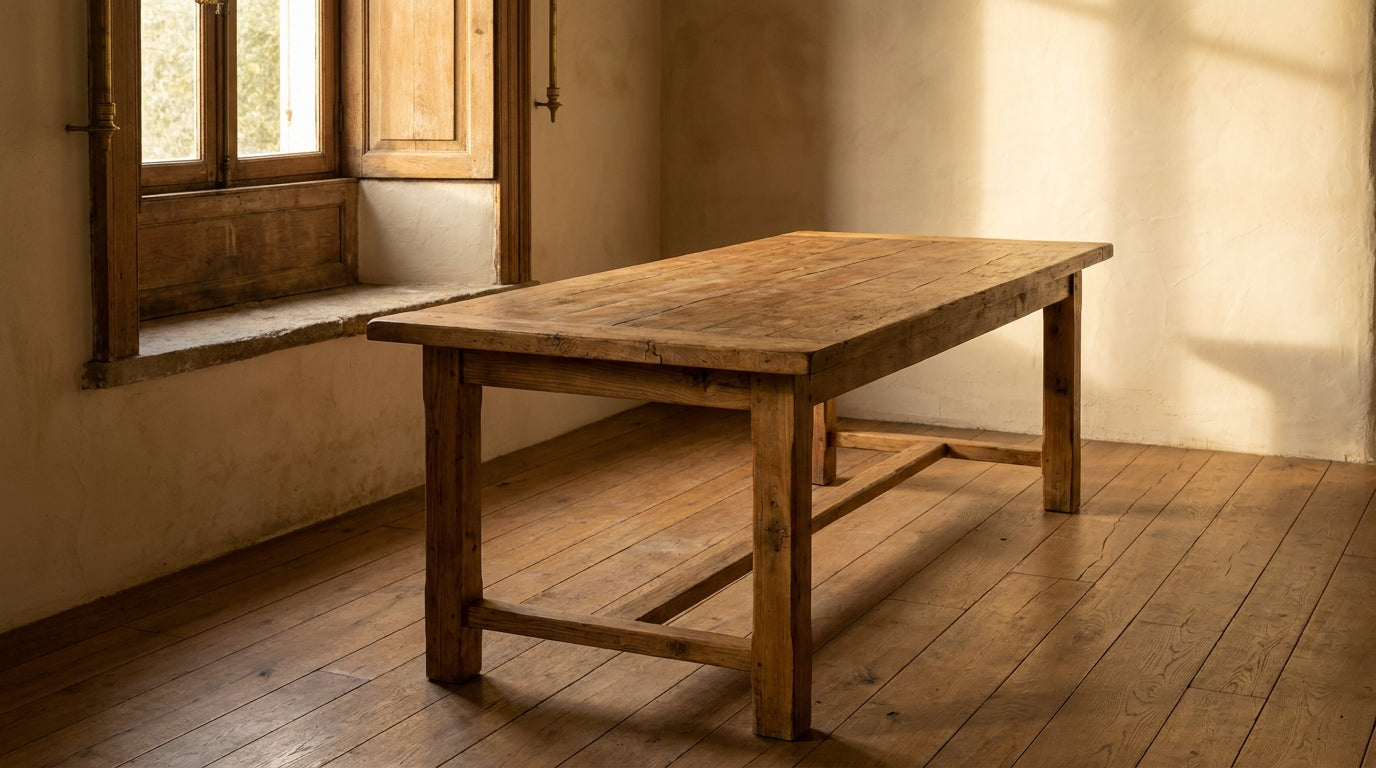
The reclaimed pine parquet baluster table is built from pine pulled out of pre-war buildings, milled into a parquet top, and set on a turned baluster base, and it costs roughly what a mid-range solid oak table costs at the same dimensions. If you're trying to decide whether to spend the money on oak or on reclaimed pine, the honest answer is that both are real solid-wood tables, both will outlast the room they go into, and the right pick depends on which trade-offs you actually want to live with. This guide walks the differences the way we'd walk them at the counter.
How to Tell If a Dining Table Is Solid Wood or MDF and Composite
Before you compare species, confirm you're comparing the same category. A lot of tables sold in the $1,500–$2,500 range are MDF cores with a wood veneer wrap, and the listing copy will not always tell you so directly.
Four checks:
- Read the materials line, then read it again. A solid-wood table will say "solid oak" or "solid reclaimed pine" with no qualifiers. If you see "oak veneer," "engineered wood," "manufactured wood," "MDF with hardwood top," or a materials breakdown that lists three things when one would do, that's a mixed-construction piece. Honest sellers say the word "solid." Less honest ones bury "engineered" three lines down.
- Look at the edge profile in the photos. Solid wood shows continuous grain that wraps around the edge from the top onto the side. Veneer shows a clean break: the top grain stops at the edge and a different banding or solid color picks up on the apron. Zoom in on a corner shot. If you can't tell from the photos, ask for a corner detail before you buy.
- Check the underside. Solid-wood tabletops show the same species on the bottom as the top, with visible end grain on the breadboard ends if there are any. MDF cores look uniform brown, slightly fuzzy, with no grain pattern at all.
- Weigh it against the dimensions. A 72" solid oak dining top runs 95–120 lbs for the top alone. Reclaimed pine of the same size runs 70–90 lbs because pine is less dense. An MDF-core table at those dimensions often comes in heavier than solid oak because the core is dense fiberboard. A surprisingly heavy "oak" table at a surprisingly low price is usually MDF.
If the seller can't or won't answer these four questions, you're not buying solid wood. Move on.
Solid oak against reclaimed pine, by the numbers
| Solid oak | Reclaimed pine | |
|---|---|---|
| Janka hardness | White oak around 1,350, red oak around 1,290 | 380 to 870 |
| Weight of a 72-inch top | 95 to 120 lbs for the top alone | 70 to 90 lbs, because pine is less dense |
| Moisture content it should arrive at | 6 to 9% for indoor use | 6 to 9% for indoor use |
Solid Oak vs Reclaimed Pine: Density, Grain, and Surface Hardness Compared
Oak is harder than pine. That's the headline and it's worth being plain about. White oak runs roughly 1,350 on the Janka hardness scale and red oak around 1,290. Pine, including reclaimed pine pulled from old structural timbers, sits closer to 380–870 depending on the species and how dense the original tree was. Reclaimed pine from old-growth buildings tends to land on the higher end of that range because the trees were slower-grown and tighter-ringed than modern plantation pine, but it's still softer than oak by a real margin.

What this means at the table:
- Oak resists dents better. Drop a heavy cast-iron pan from six inches and oak shows a small white compression mark. Pine shows a visible dent.
- Oak has a closed, ringed grain. It catches stains less. Red wine sits on the surface longer before it gets into the fibers if the finish is intact.
- Pine has open knots and wider growth rings. It accepts wax and oil finishes deeply, which is part of why reclaimed pine takes on the soft, lived-in look it does. The same porosity means a pine table that gets a wet glass left on it overnight will show a ring if the wax has worn thin.
The reclaimed pine parquet baluster table is a good example of how the trade-off plays in practice. The parquet top is made of short, cross-grained sections from old timber, which means dents land in individual blocks instead of running across a full board, so a ding reads as character on one square instead of a scar across the whole surface. That's not a workaround for pine being softer. It's a construction choice that uses pine's softness in its favor.
Does Reclaimed Pine Hold Up as Well as Oak for Daily Dining Use?
Yes, with caveats you should know going in.

Reclaimed pine is softer than oak, so it will pick up surface marks faster. A family with three kids under ten will see dents, scratches, and small chips in a reclaimed pine table inside the first year. The same family with an oak table will see almost nothing for the first three or four years, then the oak will start to show wear in the same places (around the chairs, where elbows rest, where serving dishes get set down), just more slowly.
Here's what reclaimed pine has that new oak doesn't: dimensional stability. Wood moves with humidity. New kiln-dried oak moves measurably in its first five to ten years in a home — you can see it in the gaps that open and close at breadboard joints between summer and winter. Reclaimed pine that's been inside a building for fifty or seventy years has already done most of its moving. The boards have settled into their final dimensions and they don't cup, twist, or check the way new wood does.
So the real comparison isn't "oak is harder, pine is softer." It's "oak resists impact better, reclaimed pine resists movement better." For a dining table that sits in a kitchen with a range running and a dishwasher steaming twice a day, the movement resistance of reclaimed pine matters more than most buyers expect. We carry the full reclaimed pine furniture range for the same reason: old wood behaves predictably in a way new wood can't replicate at any price.
The pine dent question also has a refinishing answer, which is its own section below.
What Reclaimed Pine and Solid Oak Each Do to a Room's Scale and Light
Oak reads heavier than pine even at the same dimensions. The closed grain, the cooler undertone, and the density of the material itself give an oak table visual weight. In a dining room over 14 feet wide with good natural light, that weight grounds the room and looks intentional. In a room under 12 feet wide, a large oak table can crowd the space, because the eye reads it as a single dense block.
Reclaimed pine works the opposite way. The knots, the variation in board color from board to board, and the warmer undertone break the table up visually. The eye reads it as a collection of boards rather than a single mass, which makes the same dimensional footprint feel lighter in the room. In a small or low-ceilinged dining space, that visual lightness is the difference between the table fitting and the table dominating.
Color matters here too. Untreated or waxed reclaimed pine carries an amber-honey tone that warms up cool-painted walls (grey, off-white, pale blue). The French country dining table takes that same logic the other direction: a pine base finished in antique grey, which cools the warmth down and lets the table sit quietly in a room that already has a lot of wood elsewhere. Oak is more neutral in tone and works in either palette without adjusting.
If your dining room is under 12 feet wide, lean pine. If you have the space and you want the table to be the visual anchor of the room, oak earns its keep.
What Owning Either Table Costs You Over Ten Years
Sticker price is one number. Ten-year cost is a different one and it's the number that actually matters.
Oak, ten-year picture. A solid oak table at $2,200–$3,500 will look essentially the same in year ten as it did in year one, assuming a wax or oil finish maintained twice a year. If you damage it (a deep gouge, a burn mark, a water ring that gets past the finish), oak sands and refinishes cleanly. A refinisher will charge $400–$700 for a full top resurface. The table holds resale value: a mid-range solid oak dining table from a reputable maker holds roughly 40–55% of its purchase price on the secondary market at the ten-year mark.
Reclaimed pine, ten-year picture. A reclaimed pine table at the same price point will look visibly different in year ten: more dents, more patina, more darkening at the high-traffic spots. Whether that's a feature or a flaw is the whole question. For buyers who want their table to look used in a way that reads as character, pine ages into itself. For buyers who want pristine, oak is the right pick. Pine also refinishes, but the soft wood means a sand-and-rewax is less of a "restore to new" and more of a "reset the patina clock." Cost is similar at $350–$600, and you can do a partial refinish on a single damaged board section, which oak doesn't really allow.
Pair either table with seating that will outlast it. The Edna side chair is built on a frame that takes ten years of daily pull-out without loosening, which is the chair-side equivalent of the same calculation you're making on the table.
Resale floor on reclaimed pine is harder to predict because the market for it is smaller, but pieces from named makers with documented provenance hold up better than mass-market reclaimed-style pieces.
How to Maintain a Solid-Wood Dining Table: Oak and Pine Side by Side
Both woods need maintenance. The cadence is similar, and the products are slightly different.
Oak: - Dust weekly with a dry cotton cloth. - Wipe spills within ten minutes. Oak's closed grain buys you some time but not unlimited time. - Apply a hardwax oil (Osmo Polyx, Rubio Monocoat) or a paste wax (Howard Feed-N-Wax) twice a year, once in early spring and once in early fall. Apply in the direction of the grain with a cotton cloth, let it sit twenty minutes, buff off. - Avoid silicone-based furniture sprays. They build up on the surface and interfere with future refinishing.
Reclaimed pine: - Same dusting and spill cadence. - Use a paste wax (Howard Feed-N-Wax or a neutral beeswax-based wax) rather than a hardwax oil. Pine accepts wax deeply and the wax actually fills the open grain in a way that protects better than a film finish. - Re-wax three times a year for the first two years, then twice a year after that. Pine drinks the first few applications and needs more frequent topping up early on. - Pine doesn't respond well to water-based cleaners. Skip them entirely. A dry cloth or a barely-damp one is the right move.
What damages either finish: - Bleach and ammonia-based cleaners strip wax and will leave a dull patch you can see in raking light. - Silicone spray polishes (Pledge and similar) build up and interfere with refinishing. - Rubber chair-tip protectors and rubber-backed placemats can mark wax finishes if they sit in one spot under heat. Use felt or cork instead. - Direct sun fades both woods unevenly. If your table sits in a sunbeam half the day, rotate it 180 degrees every six months so the fading evens out.
If you've got pine pieces from the French country furniture collection in the same room, the same wax routine works across all of them, which simplifies the cabinet of products you need to keep around.
What to Check Before You Pay a Premium Price for a Solid-Wood Dining Table
Five questions to ask any seller before you commit:
- What species, and is it solid throughout? "Oak" is not enough. Is it white oak or red oak? Is it solid or is the top a veneer over a different core? On reclaimed pine, where did the wood come from: old structural timbers, old flooring, or new boards run through a distress pass?
- How is it joined? Mortise-and-tenon and dovetail joinery outlast the room. Pocket screws, dowels, and metal brackets don't. Ask. A seller who can answer this question quickly is a seller who knows the piece.
- What's the finish? Hardwax oil, paste wax, polyurethane, lacquer, or shellac. Each has a different maintenance profile and a different repair pathway. Polyurethane is the most damage-resistant and the hardest to spot-repair. Wax is the easiest to maintain and the easiest to refresh.
- Is the wood kiln-dried, and to what moisture content? New solid-wood tables should arrive at 6–9% moisture content for indoor use. Reclaimed wood is usually well below that already, but the seller should still know the number.
- What's the return policy if the wood moves? Solid wood moves with the seasons. A reputable seller will tell you what's normal (small breadboard gaps in winter) and what's covered (a board that cups by more than 1/8 inch in the first year). If the policy doesn't address movement, the seller hasn't sold enough solid wood to know they need to.
Browse the full dining table lineup and run any table you're considering, ours or anyone else's, through those five questions. If the answers come quickly and concretely, you're buying from someone who knows the piece. If they don't, you're buying from a catalog.
Common questions
Is reclaimed pine as strong as oak for a dining table?
No, but the gap matters less than the Janka numbers suggest. Oak is roughly twice as hard as pine on the standard hardness scale, so it resists dents and impact better. Reclaimed pine compensates with dimensional stability. The wood has already done most of its moving over fifty-plus years inside a building, so it stays flatter and gaps less between seasons than new oak. For a dining table that gets daily use, both are real options. Oak shows wear more slowly; pine shows it faster but tends to wear into character rather than damage.
How can I tell if a dining table is solid wood or MDF from the product listing?
Look for the word "solid" without qualifiers. "Solid oak" or "solid reclaimed pine" is solid wood. "Engineered wood," "manufactured wood," "MDF with hardwood veneer," or a materials line that lists three components is mixed construction. Check the edge in product photos. Solid wood shows grain that wraps continuously from the top onto the edge; veneer shows a clean break. Ask for a corner detail shot and an underside shot if the listing doesn't include them. A seller who won't provide either isn't selling solid wood.
Does reclaimed pine dent more easily than oak?
Yes. Pine is softer, so a dropped pan or a heavy serving dish will leave a visible dent in pine where oak would show a faint white compression mark. The trade-off is that dents in reclaimed pine tend to read as part of the wood's existing character. The surface already shows age, so new marks blend in rather than standing out. On a brand-new oak table, any damage reads as damage. On reclaimed pine, most damage reads as use.
Which wood is easier to refinish if the surface gets damaged, oak or pine?
Oak refinishes more cleanly because the harder, denser surface sands evenly and takes new finish predictably. A refinisher can take an oak top back to near-new condition for $400–$700. Pine sands well too, but its softness means deep gouges sometimes need to be filled rather than sanded out, and a refinished pine top resets the patina you may have been growing into. Pine also allows partial refinishing on a single damaged section, which oak doesn't easily allow, so the right answer depends on whether you want a full reset or a spot repair.
Why do some solid-wood tables list multiple wood species in the materials breakdown?
Common reasons: the top is one species (oak), the base is another (poplar or pine, often stained to match), and the breadboard ends are a third for grain-direction reasons. This is normal and not a red flag. Most solid-wood tables use a secondary wood somewhere in the structure. The red flag is when the breakdown lists "engineered wood" or "MDF" alongside the solid species, which means part of the table is composite. Read the breakdown carefully and ask the seller to clarify which component is which.
How often does a solid-wood dining table need to be oiled or waxed?
Oak: twice a year, once in early spring and once in early fall. Pine: three times a year for the first two years, then twice a year after that, because pine accepts wax more deeply and needs more frequent topping up early on. Use a paste wax (Howard Feed-N-Wax) or a hardwax oil (Osmo Polyx, Rubio Monocoat), applied with a cotton cloth in the direction of the grain, allowed to sit twenty minutes, then buffed off. Skip silicone-based sprays and water-based cleaners. Both damage the finish and complicate future refinishing.


