
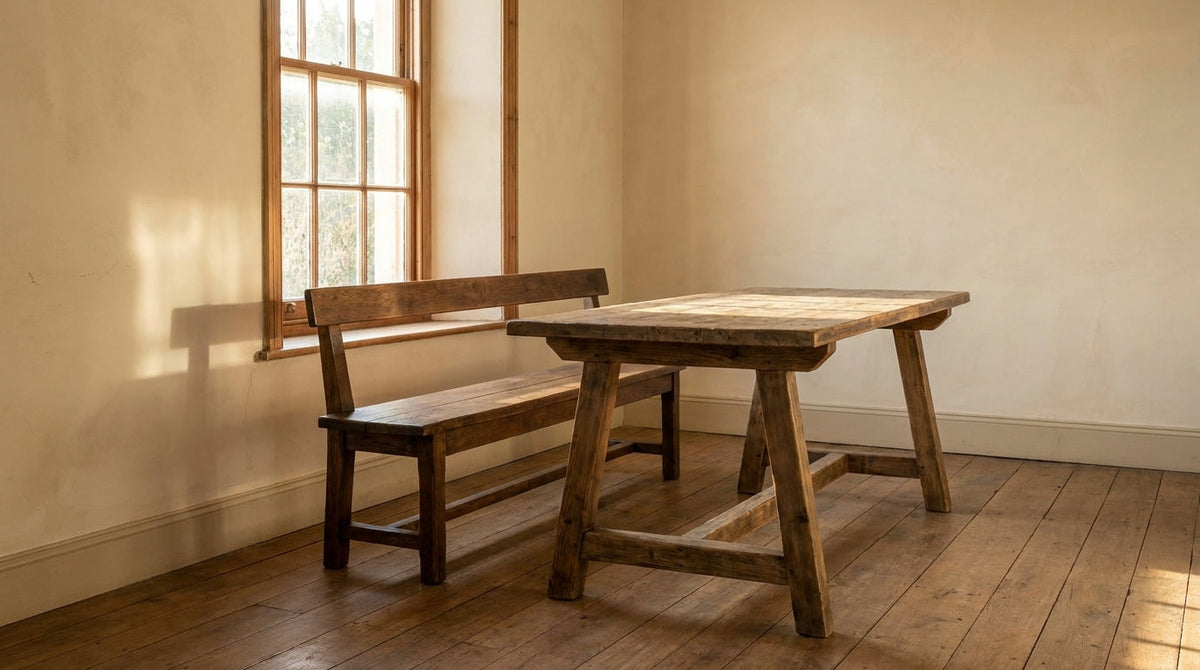
Choose a bench when you seat children, want the seating to tuck fully under the table, and the table has no apron in the way. Choose chairs when adults sit through long meals, when you need back support, and when you want to add one seat later without rebuying the whole set.
The Edna Country French Side Chair is what starts most of these conversations at the counter. A customer has picked a heritage dining table, is standing there with a phone open to the chair page, and asks whether they should run a bench down one side instead. The honest answer depends on four things: how many people you actually seat, how the room takes daily wear, whether the table's apron leaves room for a bench at all, and what happens in year seven when something gets damaged. This guide walks through all four before you spend $2,000 on the set.
How Many People a Bench Actually Seats Versus Chairs at the Same Table
A dining bench runs about 18 inches of width per person (source). A side chair like the Edna needs 22 to 24 inches of table edge to sit comfortably without shoulders touching. The chair itself is 18 to 20 inches wide at the seat (source), but you need clearance on both sides for elbows and for pulling the chair out.
Here is what that arithmetic does to a table:
- A 72-inch table takes three chairs down each long side comfortably (24 inches each), or four people on a bench (roughly 18 inches each). Bench gains you two seats.
- An 84-inch table takes three to four chairs per side, or four to five on a bench. Bench gains you one to two seats depending on how much you value elbow room over a headcount.
The bench math assumes adults, seated at the same time, eating a meal. If you're feeding kids or seating people for coffee and a puzzle, the bench holds even more. If you're seating six adults who each want a wine glass and a plate, run chairs.
Bench against chairs
| Bench | Chairs | |
|---|---|---|
| Seat count | Flexible, people squeeze in | Fixed |
| Tucks under the table | Fully, if there is no apron | Partly |
| Back support | None | Yes |
| Best for | Children and casual meals | Long meals with adults |
| Adding a seat later | Costs nothing | Buy another chair |
Solid Wood Bench vs Upholstered Side Chair: What Takes Daily Use Better
A waxed pine or oiled oak bench takes daily use the way a butcher block takes it. Scratches darken and blend into the finish, spills wipe off if you catch them, and a full refinish is a weekend of sanding to 100 grit and re-oiling (source). That's the whole maintenance story.

An upholstered dining chair is a different economy. Professional upholstery cleaning runs $90 to $190 per chair (source), and a full reupholster is $100 to $250 per seat depending on fabric (source). On a set of six chairs, that is a $600 to $1,500 line item every seven to ten years if the room actually gets used.
That doesn't mean skip the upholstered chair. A linen-seat side chair reads dressier at the head of the table than a bench ever will, and the Edna's cushion softens a hard evening in a way a plank of pine doesn't. It means know which one is in front of the kids. A common configuration: bench on the wall side where the kids climb in, chairs on the room side where the adults sit. Browse our solid wood benches if you want to see what pairs with what.
Running One Bench on One Side and Chairs on the Other: When It Works and When It Doesn't
The mixed configuration works when three conditions are met:

- Seat heights are within four inches of each other. Standard dining chair seat height is 18 to 20 inches; standard bench height is 18 to 19 inches (source). Most heritage pieces land in that band. If you have a low farmhouse bench at 16 inches and 20-inch chairs, everyone at the bench is eating with their chin at plate level.
- The apron clears the bench. A dining table apron runs 2 to 6 inches deep (source). You want 10 to 12 inches of clearance from bench seat to apron underside. Measure before you buy. A 30-inch table with a 6-inch apron gives you 24 inches to the apron bottom. Minus a 19-inch bench, you have five inches for thighs. That's tight.
- The bench is 6 to 12 inches shorter than the table length. A 72-inch table wants a 60 to 66-inch bench (source). Longer than that and the bench sticks out past the ends. Shorter than that and it reads undersized.
The upholstered chair adds one more variable: the cushion compresses one to two inches under weight (source), so a chair listed at 19 inches sits closer to 17.5 under a person. Factor that in when you're checking the four-inch seat-height rule against the bench. If the pairing gets tight, the full chair collection has options at a range of seat heights.
Why a Heritage Dining Table With a Bench Holds Its Value Better Than a Matched Chair Set
The resale problem with a matched set of six upholstered chairs is that when one gets a wine stain that won't lift, the set is now a set of five plus one, and the market prices it as five, not six. A refinishable solid-wood bench doesn't have that failure mode. A scratch sands out. A dent from a dropped serving dish darkens with the next coat of wax and disappears into the piece.
We see this most clearly with the French Country table. A heritage table paired with a bench refinishes as one continuous piece across ten years, and the bench itself can be re-oiled twice in that window without the set falling out of alignment. The buyer's real gain here is optionality: bench today, chairs later, or vice versa, without having to source a matching sixth chair from a run that's no longer being made.
Cleaning and Maintaining a Wood Bench Alongside Upholstered Chairs
For a waxed pine or oiled oak bench: neutral paste wax (Howard Feed-N-Wax or similar) twice a year, applied with a cotton cloth in the direction of the grain. For an oiled finish, a light coat of pure tung oil or a furniture-grade Danish oil once a year is enough. Spills come off with a damp cloth. Do not use a spray polish with silicone in it, which builds up and turns the wax finish cloudy.
For an upholstered chair like the Edna: dry-brush the seat weekly with a soft upholstery brush to lift crumbs before they grind into the weave. Blot spills immediately with a clean white cloth, and do not rub. Once a year, either vacuum with an upholstery attachment or have the chairs professionally cleaned at the price point above. Rotate the chairs around the table twice a year so head-of-table chairs and end-of-table chairs wear evenly.
How to Choose the Right Bench or Chair Pairing for the Table You Already Have
Three checks, in order:
- Seat height against apron clearance. Measure the apron bottom from the floor. Subtract 10 to 12 inches. That's your target seat height. Anything outside that band is going to feel wrong at dinner.
- Wood species or finish alignment. A reclaimed pine bench under an oak table reads as a set if the finishes are in the same tonal family. Antique grey with warm oak works, bright white with dark walnut doesn't. When in doubt, pull the bench two shades away from the table rather than trying to match exactly. Exact matches from different makers almost never land.
- Leg style compatibility. Trestle table takes a trestle bench. Four-leg table takes a four-leg bench or a bench with turned legs that echo the table's leg profile. A modern splayed-leg bench under a farmhouse trestle looks like an accident.
If you're starting the room from scratch instead of retrofitting a bench to a table you already own, work backwards from our heritage dining tables. The bench and chair options that line up on all three checks are shorter than the list you'd get browsing seating in isolation.
Common questions
How much space does a dining bench need per person?
Plan on 18 inches of bench width per adult for comfortable seating, or 24 inches if you want elbow room for a longer meal. On a 60-inch bench you can seat three adults comfortably or four if they're friendly. Kids need less. A 60-inch bench holds four kids without complaint. Measure the bench length before you count seats, not the table length.
Can you mix a bench and chairs at the same dining table?
Yes, and it's one of the most useful configurations in a heritage dining room: bench on the wall side, chairs on the room side. Three rules: seat heights within four inches of each other, bench 6 to 12 inches shorter than the table length, and the bench needs to clear the table apron with 10 to 12 inches from seat to apron bottom. Meet those and the pairing reads intentional.
Does a dining bench work with a table that has an apron?
It depends on the apron depth. A 2 to 3-inch apron leaves plenty of clearance for a standard 18 to 19-inch bench under a 30-inch table. A 6-inch apron gets tight. You're down to about five inches of thigh room, which is fine for kids and cramped for adults. Measure the apron before you order the bench.
What is the standard seat height for a dining bench versus a dining chair?
Both land in roughly the same band: benches at 18 to 19 inches, chairs at 18 to 20 inches. That's designed to work with dining tables at 28 to 30 inches, giving you 10 to 12 inches of clearance from seat to table underside. If you're mixing pieces from different makers, measure each seat height rather than trusting the category default.
Is a solid wood bench or an upholstered chair easier to keep clean?
A solid wood bench is easier day to day. Spills wipe off, scratches blend into the finish, and a full refinish is a weekend of sanding and re-oiling. An upholstered chair needs weekly brushing, immediate spill blotting, and either yearly professional cleaning at $90 to $190 per chair or eventual reupholstery at $100 to $250 per chair. If the room takes daily use with kids, run the bench where the kids sit.
How do you match a bench to a dining table if they are from different makers?
Check three things: seat height sits within the 18 to 20-inch band that matches your table's apron clearance, the finish sits in the same tonal family (two shades off is usually better than trying to match exactly), and the leg style echoes the table's, trestle to trestle, four-leg to four-leg. Exact species matches across makers rarely land, so aim for tonal harmony instead of identical wood.


