
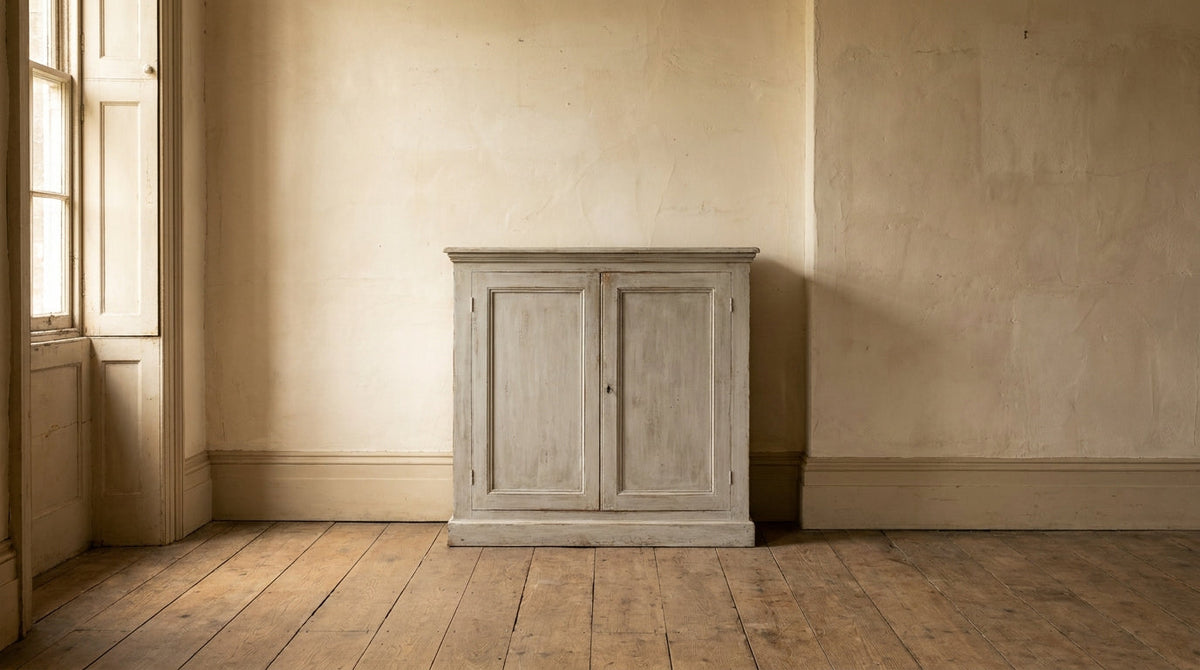
Gustavian grey is a layered hand-pigmented finish, not a paint colour. Coats of grey are worked over a chalk-white ground and sealed with clear paste wax, so the white reads through wherever an edge has been rubbed back. It is not chalk paint, not sprayed lacquer, and not a printed laminate.
The three-drawer chest in Gustavian grey is reclaimed pine, hand-pigmented in layered coats of grey over a chalk-white ground, then sealed with clear paste wax. It is not chalk paint, not a spray lacquer, and not a printed grey laminate. We wrote this guide because the difference matters at $1,500–$4,000, and because most painted-pine furniture sold online right now is none of those three things.
What Gustavian Grey, Distressed Walnut, and Antique White Actually Are
Gustavian grey is a finish family that traces back to late-18th-century Swedish interiors: pale, chalky, slightly green-tinged greys built up in thin pigment washes over a primed wood ground. On our pieces, the finish is hand-applied in three to five layers. A chalk-white base goes on first. Then a thinned grey pigment, brushed in the direction of the grain, wiped back at the edges while still wet. Then a second pigment pass to deepen the field colour. Then clear paste wax, buffed by hand, which warms the surface and locks the pigment without sealing it under a hard film.
Distressed walnut is a different system entirely. The wood underneath is still pine. "Walnut" describes the finish colour, not the species. A walnut-toned stain is wiped on, allowed to settle into the grain, and then sanded back at the corners, drawer fronts, and top edge so the lighter wood shows through. The contrast between the dark field and the lighter wear points is the whole point. A spray lacquer cannot do this because it sits on the surface uniformly.
Antique white is closest to the Gustavian process but skips the grey pigment pass. A warm off-white is layered over the primed ground, edges and high points are rubbed back with a fine abrasive to expose hints of the wood, and the wax goes on last. The white shifts toward cream over the first year as the wax cures.
What all three share: pigment that lives in the wood, not on top of it. Wax sheen, not lacquer gloss. Hand-brushed direction marks that catch light unevenly. You can see this on the three-drawer chest in Gustavian grey along the drawer edges. The grey is thinner there because that is where a hand wipes it back, not because a machine programmed a fade.
Gustavian grey against the things it gets confused with
| Gustavian grey (ours) | Chalk paint | Sprayed lacquer | |
|---|---|---|---|
| How it is built | Grey worked over a chalk-white ground, sealed with wax | One opaque coat | A pigmented film |
| At the edges | The white ground reads through | Uniform | Uniform |
| Depth | Layered, varies across the piece | Flat | Flat |
| Repair | Re-wax and rub back | Repaint | Refinish |
Why Pine Takes These Finishes Better Than Hardwood
Pine has open grain and uneven density between the soft spring growth and the harder summer growth rings. Pigment soaks into the soft bands and skates across the hard ones. That is the visual texture of a Gustavian finish: the slight banding you see across a drawer front when light hits it from the side. Without that uneven absorption, the finish goes flat.
Oak and maple are too dense and too uniform to take pigment this way. A grey wash on oak reads as a single tone across the whole panel because the wood will not let the pigment in unevenly. Maple is worse. It accepts so little stain that the result is essentially paint sitting on a sealed surface, which is the lacquered-paint look these finishes are supposed to escape.
This is why our reclaimed pine pieces are the right substrate for these finishes and why we don't sell a Gustavian-grey oak chest. Reclaimed pine has another advantage on top of grain structure: fifty or more years of life in a building has already pulled most of the movement out of the wood. New kiln-dried pine still wants to cup and twist as humidity shifts. Reclaimed pine sits still, which means the pigment layers and wax do not crack along seasonal stress lines.
What the Distressing Marks on Our Pieces Are — and Whether Grey Staining Is Normal
A few things on a hand-finished piece look like damage and aren't. A few things look like character and actually are damage. Worth separating them.

Intentional, and on every piece we sell:
- Edge wear at corners, drawer pulls, and the top front lip, where the pigment is rubbed back to show the chalk ground or the wood.
- Small variations in field colour across a single panel, slightly darker in the centre, lighter near edges, because the pigment was wiped back by hand.
- Visible brush direction in raking light, running with the grain.
- Faint nail holes, old screw locations, and small surface scars from the wood's previous life in a building.
Also normal, but counterintuitive: on a waxed grey finish, you may see grey tonal shifts appear over the first months. Wax pulls pigment slightly as it cures, and the colour settles. This is not staining or failure. It is the finish doing what it was designed to do. You can watch it happen on the antique grey dining table. The field tone deepens noticeably between month one and month six.
Not normal, and worth a phone call to us if you see it:
- White cloudy patches that don't wipe off (moisture trapped under a wax layer, fixable).
- Pigment lifting in flakes rather than wearing thin (a finish-failure issue, almost never seen on a hand-waxed piece but possible if the piece was sprayed with a household polish containing silicone).
- A sticky surface (silicone contamination, again from a polish, not from our finish).
If you ever can't tell which category something falls into, send us a photo. We sold the piece. We know what it should look like.
How to Tell a Hand-Applied Gustavian Finish From a Paint Imitation
Four markers separate the real thing from a grey-painted reproduction:

- Layered edge wear. On a hand-finished piece, sand a corner gently with your fingernail and you should feel, and see, the chalk ground under the grey, and the wood under the chalk. On a sprayed paint job, you hit colour, then primer, then bare wood with no intermediate layer.
- Pigment depth at the grain lines. Look at the open pores of the pine across a drawer front. On a hand-pigmented finish, the grey sits deeper inside the pores than on the surrounding wood, because pigment soaked in. On a sprayed finish, the colour is uniform across pores and wood alike because the spray coated the surface flat.
- Wax sheen, not lacquer sheen. Hand-waxed pine has a soft sheen that varies slightly across the surface as you change viewing angle. Lacquer is uniform and slightly plastic in feel. Run a hand across it: wax feels like wood, lacquer feels like a sealed shell.
- Visible brush direction. Tilt the piece into a window and look across the field at a shallow angle. Hand brushing leaves faint directional marks running with the grain. Spray application is directionless.
The painted base of the reclaimed pine console shows all four when you look at it in person, which is why we mention it specifically. It is one of the easier pieces in the catalog to read.
What You Gain From a Hand-Applied Finish Over a Lacquered One
Three concrete buyer outcomes, all of which matter at this price point.
First, the piece is spot-repairable. If you ding the corner of a Gustavian-grey chest five years in, we (or any furniture restorer who handles wax finishes) can re-pigment that corner, blend it, and re-wax. The repair disappears because the surrounding finish is the same material system. A lacquered piece with the same ding has to be sanded down to bare wood across the whole panel and refinished from scratch, because lacquer cannot be locally repaired without showing a seam.
Second, wax builds protective depth over decades. Each annual wax pass adds a thin layer that absorbs into the previous one. After ten years, the surface has a depth and a slight luminosity you cannot fake with new finish. A lacquer coat does the opposite. It sits as a single film that scratches, yellows, and eventually peels at the edges, at which point the whole finish has to come off.
Third, the resale floor holds. A Gustavian-grey or antique-white pine piece from the French country range has a finish that the next owner, and the owner after that, can maintain or restore. A lacquered grey reproduction, once it starts peeling, is at salvage value. This matters when you are spending $2,000+ and thinking about the piece as something that outlasts you.
How to Care for a Gustavian Grey or Antique White Finish Without Stripping the Patina
The maintenance cadence is short and almost embarrassingly low-effort:
- Weekly: dry-dust with a soft cotton or microfibre cloth. That's it.
- Twice a year: apply a thin coat of clear neutral paste wax (Howard Feed-N-Wax or a comparable beeswax-based product works well) with a cotton cloth, in the direction of the grain. Let it haze for 15 minutes. Buff lightly with a clean cloth. Once on top, once on the drawer fronts. Skip the legs unless you can see them drying out.
- As needed: wipe up spills with a dry cloth immediately. Water beads on a fresh wax coat, so a fast wipe leaves no mark. A slow wipe can leave a faint ring, which the next wax pass will pull out.
What to avoid, because each of these will damage the finish in a different specific way:
- Silicone sprays (most aerosol furniture polishes, Pledge and its cousins). Silicone contaminates the wax and makes the surface impossible to re-wax cleanly. Once silicone is on, it stays on.
- Water-based polishes and "wood cleaners." These lift pigment from the upper layers because the pigment is held by wax, not by a sealing film. You will see grey come off on the cloth.
- Steam cleaners and damp microfibre. Water drives into the open grain through the wax and creates the cloudy white patches mentioned earlier. Always dust dry.
- Direct sunlight all day. The pigment is stable, but UV will lighten one face of a piece relative to the others over years. Rotate or shade if a piece sits in a south-facing window.
You can see this care cadence in action on a piece that has been with a customer for years: the distressed sideboard is finished the same way as our greys and whites, and the example we keep photos of has been waxed twice a year for six years. It looks deeper and softer now than the day it shipped. That is the finish working as designed, which is also the answer to whether one of these pieces, including the three-drawer chest in Gustavian grey, is worth the money: yes, if you plan to keep it long enough for the wax to do its job.
Common questions
Are grey marks on a lacquered furniture finish normal or a sign of damage?
On a lacquered finish, grey marks are usually damage: moisture trapped under the lacquer film, showing as cloudy patches. On a hand-waxed Gustavian grey finish, faint grey tonal shifts across the surface during the first months are normal and expected, because wax pulls pigment slightly as it cures. The two situations look different in person: lacquer damage is cloudy and localised, finish settling is even and across the whole field. If you are unsure which you are looking at, send us a photo.
What is the difference between a Gustavian grey finish and chalk paint?
Chalk paint is a single-pass DIY paint that sits on the surface and is usually sealed with wax over the top. A Gustavian finish is a layered system: chalk ground, two or more thinned pigment passes, hand-wiped edges, paste wax, built up over days, not minutes. The visual difference is depth. Chalk paint looks flat from any angle. A Gustavian finish catches light differently across the same panel because the pigment lives at different depths in the wood.
Can a hand-applied painted finish be repaired if it chips?
Yes, and this is one of the main reasons we use this finish system instead of lacquer. A chip can be re-pigmented locally, blended into the surrounding field, and re-waxed. The repair disappears because the materials are the same as the rest of the piece. We can talk you through it on the phone, or refer you to a restorer in your area who handles wax finishes.
Does distressed walnut finish mean the wood itself is walnut?
No. On our pieces, "distressed walnut" describes the finish colour: a walnut-toned stain wiped onto reclaimed pine and sanded back at the edges. The wood underneath is pine. We use this name because it accurately describes the visual outcome, but the species is always disclosed in the product specs. If you want a piece in actual walnut wood, call us and we'll tell you what's available.
How often should a waxed painted finish be re-waxed?
Twice a year is the right cadence for a piece in normal household use. Once a year is enough if the piece sits somewhere it doesn't get touched often, a guest bedroom dresser, for example. Use a clear neutral paste wax, apply thinly with a cotton cloth in the direction of the grain, let it haze 15 minutes, then buff with a clean cloth. The wax adds depth with each pass, so missing a year is not a problem; over-waxing is also not a problem.
Will a Gustavian grey finish darken or change colour over time?
It will deepen slightly in the first six months as the wax cures and pulls the pigment, then stabilise. After that, the colour stays largely consistent for years if the piece is dusted and re-waxed on schedule. Direct sunlight on one face of a piece all day will lighten that face relative to the others over a long period. Rotating the piece or moving it out of a south-facing window solves this.


