
Eight-way hand-tied means every spring is tied by hand in eight directions so the seat flexes as one deck instead of as separate coils. Sinuous springs cost less and firm up sooner at the front edge. The upgrade earns its money if you sit in the same seat most days for a decade.
The Keswick two-seater is built on eight-way hand-tied springs over a kiln-dried hardwood frame, which is the construction method most furniture catalogs name in their copy and most factories don't actually use. This guide is how we tell the difference, and how to decide whether the upgrade over sinuous-spring construction is worth what it costs.
What Eight-Way Hand-Tied Construction Is and How It Differs From Sinuous Spring
Eight-way hand-tied means coil springs, usually 8 or 9 gauge steel, set in rows across the seat deck, are knotted to each other and to the frame with twine, at eight separate points per coil. Front-to-back, side-to-side, and both diagonals. That's the eight. The twine is hand-knotted by a person sitting at the frame with a coil compressor and a spool, and on a full sofa it's a half-day of labor per seat deck.
Sinuous spring is different hardware doing a different job. It's an S-shaped wire, sometimes called a no-sag spring, bent in a continuous zigzag and stapled or clipped to the front and back rails of the frame. There are no coils, no twine, no knots. A sinuous-spring deck takes about twenty minutes to install.
You can feel the difference when you sit down. A hand-tied deck gives at the point of contact and stays firm at the edges, because each coil compresses independently while its neighbors hold their position. A sinuous-spring deck flexes across the whole wire, so when one person sits, the seat next to them dips slightly too. Neither is wrong for a low-traffic sofa in year one. The split shows up in year eight.
Eight-way hand-tied against sinuous spring
| Eight-way hand-tied | Sinuous spring | |
|---|---|---|
| Build time per seat deck | About half a day by hand | About twenty minutes |
| How the seat flexes | At the point of contact | Across the whole wire |
| By year eight | Still firm at the edges | The wire takes a set |
| Repair | Re-knot from underneath | Strip the upholstery deck |
| Working life | 30 to 50 years with one reupholster | 10 to 15 years |
Why Eight-Way Hand-Tied Seats Hold Their Shape Longer Than Sinuous Spring
The longevity argument is about how steel fails. Sinuous-spring wire is bent into shape and then loaded in the same direction, in the same spots, for the life of the sofa. After ten to fifteen years of daily use, the wire takes a set, meaning the zigzag flattens slightly where the weight sits, and the seat deck loses its lift. You feel this as a soft spot in the middle cushion that doesn't bounce back when you stand up. The fix is replacing the springs, which on most sinuous-spring sofas means tearing off the upholstery deck because the wire is stapled to structural rails.
Coil springs in a hand-tied deck distribute load across the whole network. When you sit, the coil under you compresses, the twine pulls on its neighbors, and the load spreads outward to eight other points. No single coil takes a concentrated daily stress. The twine itself can loosen over decades (Italian or Italian-style hemp twine is what's used on the better frames), and a loose tie can be re-knotted from underneath without touching the upholstery. A coil that's lost tension can be replaced individually.
A hand-tied sofa built on a kiln-dried hardwood frame is a 30- to 50-year piece if it's reupholstered once around year 20. A sinuous-spring sofa on a softwood or plywood frame is usually a 10- to 15-year piece, after which the economics of repair don't make sense against buying new.
How to Verify a Sofa Is Actually Eight-Way Hand-Tied Before You Buy
"Hand-tied" gets used loosely. Some factories tie two or four points per coil and call it hand-tied. Some staple coils to a webbing deck and call the webbing the tie. The phrase has marketing weight, so it gets attached to frames that don't earn it. Three checks separate the real thing from the copy.

Ask for an underside photo of the seat deck. A true eight-way hand-tied frame looks like a grid of coil springs with twine running in eight directions across the tops, knotted at every intersection. You'll see the knots. A sinuous-spring deck looks like parallel S-curves of bare wire stapled to the front and back rails. A webbing deck looks like flat jute or polypropylene straps woven across the frame. If the seller can't or won't send the photo, that's the answer.
Ask who built the frame and where. A retailer selling real hand-tied construction can name the workshop or mill. The answer should be a place, not a region. "Built in North Carolina by [workshop name]" is a real answer. "Imported from Asia" or "our manufacturing partners" is not.
Read the spec sheet for the gauge and count. Honest specs say something like "8-gauge sinuous springs" or "9-gauge coil springs, eight-way hand-tied with Italian twine." Vague specs say "premium spring system" or "engineered seat support." If you can't find the gauge or the spring type written down, the seller is hiding it on purpose. Browse the full seating range on any retailer's site and check whether the spec sheets actually name the hardware. Most don't.
What the Frame and Cushion Fill Should Look Like in a Sofa at This Price Point
Eight-way hand-tied springs are pointless on a softwood frame. The springs will outlast the structure they're tied to, and the frame will rack out at the corners before the deck loses tension. At $2,000 and above, the spring system has to come with a frame that earns it.

The frame should be kiln-dried hardwood (maple, oak, or ash are common) with the moisture content brought down to 6–8% before joinery. Wet-wood frames split as they dry in a heated room. Joints should be mortise-and-tenon or doweled at the corners with hardwood corner blocks glued and screwed into the rail intersections. Pocket-screw joinery alone is not enough on a sofa that will carry 600 pounds of seated weight across three positions for two decades.
Cushion fill is the third leg. The best seat cushion on a hand-tied deck is a down-wrap over a high-density foam core: a slab of 1.8 to 2.5 lb-density foam wrapped in a feather-and-down ticking, so the cushion holds its shape against the spring lift but reads soft on contact. All-down cushions need plumping daily and flatten by year two. All-foam cushions over hand-tied springs feel oddly firm because the foam doesn't give where the springs are giving.
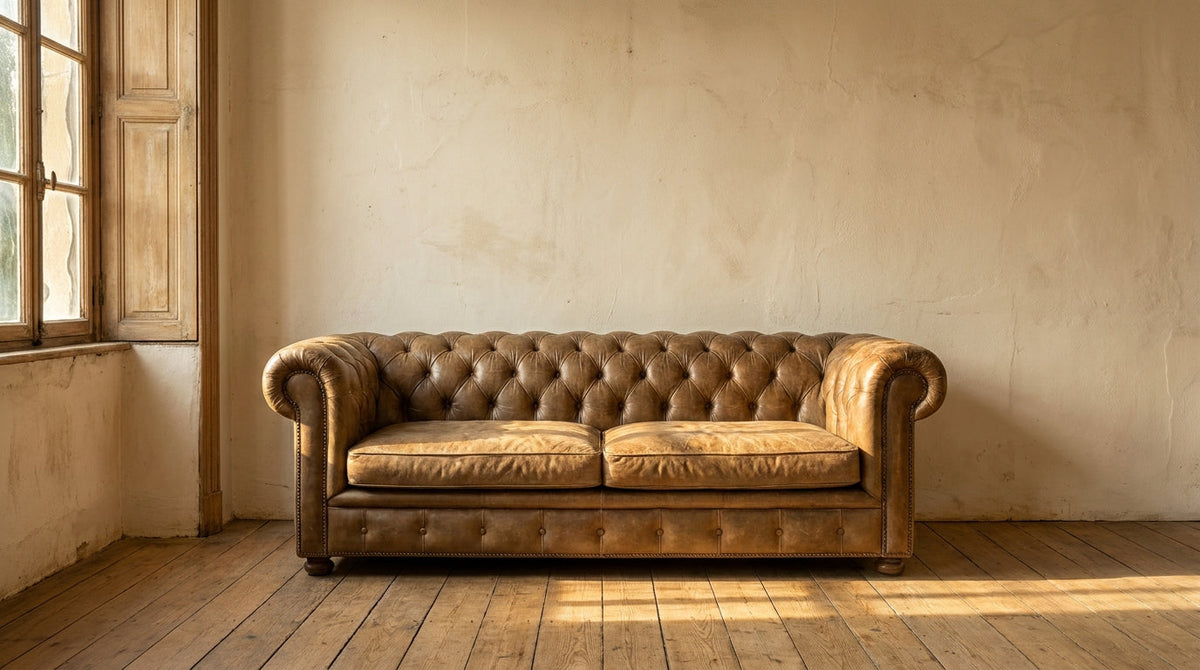
The Keswick two-seater is built to this spec: kiln-dried hardwood frame with corner-blocked mortise-and-tenon joinery, eight-way hand-tied springs in 9-gauge steel, down-wrapped high-density foam cushions, and vegetable-tanned buffalo leather hand-nailed along the arms and base. The price reflects all four of those things working together, not the springs alone.
How to Keep an Eight-Way Hand-Tied Sofa in Good Condition for 20 Years
A sofa built this way doesn't need much, but the small things matter because the frame is going to outlive most of the things you do to it.
Rotate the seat cushions every six weeks. Front to back, then side to side on the next rotation. Down-wrap cushions compress unevenly if one seat takes more use than the others, and a six-week cycle keeps the wear distributed. While you're rotating, run a hand under the seat deck and feel for any coil that's lost tension or any twine knot that's gone slack. A loose tie pulls one coil down and creates a soft spot above it. Catch it early and a re-knot from underneath is a 10-minute fix. Wait three years and the coil deforms.
For leather upholstery, dust with a dry cotton cloth weekly and condition once a year with a neutral leather balm, nothing with silicone, nothing colored. Vegetable-tanned hides like the one on the Dalston highback develop a patina over years, and uniform fading is slowed by keeping the sofa out of direct sun. For fabric upholstery, vacuum the deck and arms monthly with a brush attachment and treat spills with a clean dry cloth before reaching for water. Most fabric warranties are voided by over-wetting.
Don't shampoo the deck. Don't pull off the cushions and machine-wash the covers unless the spec sheet says the covers are washable, and most are not. When a tie or a spring eventually needs work at year 15 or year 20, find an upholstery shop that does frame repair, not just recovering. Two different trades.
When Sinuous Spring Is the Right Call and When It Is Not
Eight-way hand-tied is not the right answer for every sofa. It's the right answer for the sofa you sit on every day for the next 20 years.
Sinuous-spring construction performs adequately in a guest room, a finished basement, a second living room that gets used twice a month, or a starter apartment where the sofa is going to move three times before it settles. It's also reasonable on a small accent piece, a slipper chair or a low-use loveseat, where the load and the hours don't justify the labor cost of hand-tying. A well-built sinuous-spring sofa from a reputable maker will give a household 10 to 12 good years.
The math tips toward hand-tied when the sofa is the primary seat in a household of two or more, used four or more hours a day, and expected to be there long enough that replacing it means redecorating the room around the new piece. A $1,200 sinuous-spring sofa replaced three times over 30 years costs more than one $4,000 hand-tied sofa reupholstered once at year 20, and the hand-tied one will sit better the whole time. The trade-off is upfront cost and lead time: a built-to-order hand-tied sofa runs 10 to 20 weeks from order to delivery, against in-stock turnaround on sinuous-spring inventory.
The pieces in the sofa collection are all built on hand-tied decks because that's the math we're solving for. If you're looking for a sofa to last three years before a move, that's a different decision and a different store.
Common questions
What does eight-way hand-tied mean on a sofa?
It means coil springs in the seat deck are knotted to each other and to the frame with twine at eight separate points per coil: front-to-back, side-to-side, and both diagonals. The knotting is done by hand at the frame, takes several hours per seat deck, and produces a suspension that compresses independently under each sitter while staying firm at the edges. It is the construction method used on the longest-lasting upholstered sofas, and it is the method most frequently named in marketing copy for sofas that don't actually use it.
How can you tell if a sofa is really eight-way hand-tied and not just labeled that way?
Ask for an underside photo of the seat deck. A real hand-tied frame shows a grid of coil springs with visible twine knotted across the tops in multiple directions. A sinuous-spring deck shows parallel S-shaped wires stapled to the front and back rails. Then ask the seller to name the workshop that built the frame, not the country, the workshop. And read the spec sheet for spring gauge and type written in plain language. If those three answers don't come back specific, the construction probably isn't what the listing says.
Is eight-way hand-tied construction worth the extra cost over sinuous spring?
For a primary sofa used daily over 15 or more years, yes, the math works out. A hand-tied sofa on a kiln-dried hardwood frame is a 30-to-50-year piece if reupholstered once around year 20. A sinuous-spring sofa is typically a 10-to-15-year piece. The replacement cost of buying two or three sinuous-spring sofas across the same span usually exceeds the upfront premium on one hand-tied piece, and the hand-tied sofa sits better the entire time. For a guest room or low-use second sofa, the upgrade is harder to justify.
How long should an eight-way hand-tied sofa last with regular household use?
A hand-tied sofa on a kiln-dried hardwood frame with corner-blocked mortise-and-tenon joinery should be a 30-year piece in a typical two-person household, with one reupholstery around year 20 to refresh the fabric or leather and re-knot any twine that's loosened. Individual coils can be replaced without dismantling the frame. The structural lifespan is longer than the upholstery lifespan, which is the inverse of how a sinuous-spring frame ages.
What other construction details should we check when buying an eight-way hand-tied sofa?
Frame material and joinery first: kiln-dried hardwood at 6–8% moisture content, mortise-and-tenon or doweled corners, glued and screwed hardwood corner blocks. Cushion fill second: down-wrap over high-density foam (1.8 to 2.5 lb density) is the standard match for a hand-tied deck. Then upholstery weight, especially in leather, where a full-grain hide of 3mm or thicker holds nailhead trim flush and resists puncture. A sofa with the right springs and the wrong frame is a sofa that will fail at the corners before the deck loses tension.
Can a sinuous spring sofa be as comfortable as eight-way hand-tied in the short term?
Yes, for the first two or three years a well-built sinuous-spring sofa with good cushion fill can feel close to a hand-tied sofa, especially to someone not sitting on both in the same week. The difference is edge support and how the seat dips when more than one person sits down: a sinuous deck flexes across the whole wire, a hand-tied deck compresses only at the contact point. The bigger gap is in year eight and beyond, when the sinuous wire takes a set and the hand-tied deck still reads firm.


