
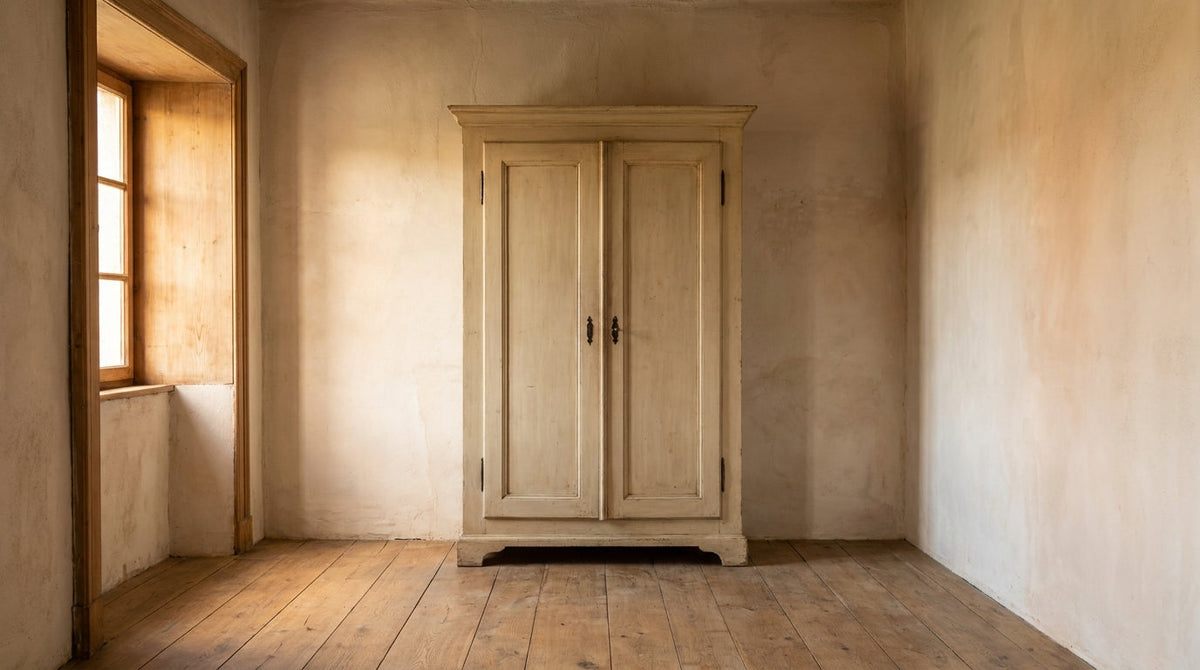
Build the room around a single tall case piece with real proportion, then keep everything else smaller and deliberately unmatched. A provincial armoire or a glazed cabinet can anchor a wall on its own. A six-piece set in one finish reads as a showroom floor, not as a room assembled over years.
The large cabinet with glass and panel doors is the kind of piece a French country bedroom is built around. A tall two-door case with glazed uppers over solid panel doors, sized to anchor a wall the way a Provincial armoire was meant to. Most "French country bedroom" advice online tells you to assemble a look from six matching pieces in one collection. We'd argue the opposite: pick one real anchor, get the proportions right, and let the rest of the room come together over a year.
What Makes French Country Bedroom Furniture Different From Other Heritage Styles
French country, Belgian-minimal, and English-country all live in the same neighborhood (solid wood, aged finishes, no chrome) but they're built differently and the differences show up on the piece.

French country pieces carry the curve. The defining marker is the cabriole leg, an S-shaped leg that swells out at the knee and tucks back in toward the foot, usually ending in a scroll or pad. It's a Louis XV–period hallmark (source). You'll also see scalloped aprons (the carved undulating rail running along the bottom edge of a chest or table) and serpentine drawer fronts that curve outward at the center. Belgian-minimal pieces drop all of that. Flat planes, straight legs, no carved relief. English-country pieces keep the heft but square it off: heavier rectangular case work, turned (not cabriole) legs, less curve in the apron.
Finish tells the same story. French country uses painted finishes in earthy or soft pastel palettes (chalky greys, soft blues, warm whites) usually over solid oak, cherry, or walnut, with pegged mortise-and-tenon joinery and hand-cut dovetails underneath (source). Belgian-minimal stays in raw waxed wood or limewashed grey, almost never painted. English-country leans toward dark stained oak with wax, not paint.
If you're shopping the bedroom collection and trying to tell which is which, look at the legs and the apron first. Curves and carved edges, French. Flat and quiet, Belgian. Squared and stained, English.
One anchor against a matched set
| Approach | Reads as | Where the money goes | The risk |
|---|---|---|---|
| One tall anchor, everything else unmatched | A room assembled over years | Concentrated in the anchor | Needs a judgement call on proportion |
| Six-piece set in one finish | A showroom floor | Spread thin across six pieces | Veneer over MDF at that price |
Which Piece to Buy First and Why the Bed Frame or Armoire Anchors the Room
Two pieces set every other proportion in a bedroom: the bed frame and the armoire. Buy one of those first, and the nightstands, chest, and bench all have something to scale against. Buy the nightstands first and you'll spend a year rebuying them when the bed arrives a different height than you expected.
Choose between bed and armoire by measuring two things: ceiling height and the longest uninterrupted wall.
If your ceiling is under 9 feet, anchor with the bed. A tall armoire in a low-ceiling room reads top-heavy and shrinks the rest of the wall. Keep the vertical mass in the bed frame, like a four-poster or a tall paneled headboard, and use shorter case pieces around it.
If your ceiling is 9 feet or more and you've got at least 60 inches of clear wall that isn't a doorway or window, the armoire becomes the better anchor. The large cabinet with glass and panel doors sits in this category. It needs the ceiling height to breathe and the wall width to read as architecture rather than as a box pushed against drywall. The freestanding armoire form goes back to 17th-century France, developed by André-Charles Boulle for Louis XIV's court, and the proportions haven't changed much since (source). They were built to anchor a room. They still do.
One more rule: never buy bed and armoire in the same week. Live with one for thirty days before choosing the other. The room tells you what it needs next.
Why Solid Wood and Waxed or Milk-Paint Finishes Outlast Veneer in This Style
This is where the price-band difference shows up. A $700 painted armoire from a mass-market reproduction seller and a $2,400 painted armoire from us look similar in a thumbnail. They behave nothing alike at year five.

Veneer is a thin slice of real wood, under 3 mm, glued over a core of MDF, plywood, or particleboard (source). Once that top layer chips, bubbles, or peels, you can't sand it back. There's nothing underneath but compressed fiber. Solid wood, by contrast, can be sanded and refinished multiple times across its life (source). A waxed pine chest that picks up a deep scratch in year three gets walked back with steel wool and a fresh coat of wax in twenty minutes. A veneered chest with the same scratch is done.
Milk paint behaves the same way. It's a casein-based finish (milk protein dissolved in an alkali and mixed with pigment) that produces a mottled, depth-of-color surface modern latex can't fake (source). When milk paint wears at a drawer edge, it wears down to the wood underneath and reads as honest age. When latex wears on MDF, it reads as damage.
A reclaimed pine console with a painted base is the example of this construction at work. Old-growth pine from a structure built before 1940, milk-painted base, waxed top. Twenty years from now it gets re-waxed, not replaced.
How to Choose Fabrics and Curtains That Work With French Country Wood Tones
French country pieces fall into two finish families: warm-white or chalk-painted, and honey or waxed natural pine. The textile rules are different for each.
Warm-white and chalk-painted finishes (the grey-blues, soft whites, dusty sage) want linen in oatmeal, soft flax, or warm white. Toile in faded blue or muted red works when the pattern is true-period: small repeating pastoral scenes, not oversized florals. Avoid pure cool greys and cool whites in the curtains. They pull green against the warm pigments and the room reads mismatched.
Honey-pine and waxed natural finishes want more saturation in the textile to balance the wood's warmth. Heavier linen in clay, ochre, or muted indigo. Cotton ticking in narrow stripes. Avoid bright white. It makes the pine look orange.
What to skip in both cases: synthetic blends with a sheen, large-scale geometric prints, and anything in a true black. French country traditionally used woven rush, floral cotton, and toile against painted wood (source). The textile palette evolved to sit next to those finishes specifically.
If you're working from a piece in the French country furniture range, pull a drawer out and bring it to the fabric store. Match the wood, not the photograph.
How to Mix a New French Country Piece With Furniture You Already Own
Most readers aren't replacing a whole bedroom. They're introducing one heritage piece into a room with a flat-pack bed frame, a nightstand from a previous apartment, and curtains that were already there. Three rules for making that work:
One. Scale the new piece up, not sideways. The new heritage piece should be the tallest or widest thing in the room: the anchor, not a peer. Putting a beautiful French country chest next to a same-height flat-pack dresser makes both look worse. Putting a tall armoire opposite a low platform bed makes the bed look intentional.
Two. Repeat the finish color once, somewhere small. If the new piece is chalk-blue, find one other blue thing in the room (a lamp base, a stack of books, a throw) within six feet of it. One repeat reads as styled. Zero repeats reads as accidental.
Three. Don't mix wood tones within three feet. A waxed pine chest next to a dark-walnut nightstand reads as a clash. Move them apart and put a soft surface (a chair, the bed) between them. The distressed sideboard is the kind of piece that works under this rule: distinct enough to anchor a wall on its own, painted enough that it doesn't fight other wood tones across the room.
Waxed and Milk-Paint Finishes: Maintenance Cadence and What to Use
Waxed pine: paste wax twice a year, more in dry winters with forced-air heat. Howard Feed-N-Wax or a neutral beeswax paste, applied with a cotton cloth in the direction of the grain, buffed off with a clean cloth after fifteen minutes. That's it. No sprays, no polishes labeled "wood cleaner." Most of them contain silicone or solvents that lift the wax and leave the surface streaky.
Milk paint: leave it alone. Dust with a dry cloth. If you need to spot-clean, use a barely damp cloth and dry it immediately. Milk paint is alkali-based and sits on the wood as a thin pigmented layer (source). Standard household cleaners with ammonia, bleach, or citrus solvent will strip it down to bare wood in one pass. If a drawer edge wears through to the wood after a few years, that's the finish doing what it's supposed to do. Touch up with matched milk paint powder, mixed fresh, and feather the edge with a dry brush.
Two things to keep away from both finishes: direct sun (fades pigment, dries out wax) and radiator heat (opens grain, cracks paint). Position pieces from the reclaimed pine furniture range on interior walls when you can, and pull them eight inches off any heat source.
The cadence sounds like work. It isn't. Waxing a chest takes ten minutes twice a year. The piece you bought from us at thirty-five years old will look like the piece you bought from us at year one.
Common questions
What is the difference between French country and farmhouse bedroom style?
French country is curved and painted. Farmhouse is square and stained. A French country bed frame has cabriole legs, a scalloped apron, and a chalk-painted or warm-white finish over solid oak or pine. A farmhouse bed frame has straight posts, flat aprons, and a stained or natural wood finish, usually pine, sometimes reclaimed oak. The two styles share solid-wood construction and a preference for visible joinery, but the silhouette is the giveaway. Curves and paint, French. Straight and stained, farmhouse.
Does French country bedroom furniture work in a small room?
Yes, if you scale down the anchor piece. In a bedroom under 130 square feet, skip the full-height armoire and anchor with the bed frame instead. A four-poster with curved posts gives you the style marker without taking floor space. Use one painted case piece (a chest or a small commode) and stop there. The mistake in small rooms isn't choosing French country; it's choosing too many pieces.
Can French country pieces mix with a white or grey contemporary bedroom?
They can, and a single French country piece often saves a contemporary bedroom from feeling like a hotel. The rule is to pick a painted piece, not a stained one (chalk-blue, soft grey, warm white) so the finish bridges to the existing palette rather than fighting it. One armoire or one painted chest is the right dose. Two pieces and the room starts to look indecisive.
How often does waxed pine bedroom furniture need to be re-waxed?
Twice a year for most homes. Three times a year if you run forced-air heat through dry winters or live somewhere arid year-round. Use a neutral paste wax, apply a thin coat with a cotton cloth in the direction of the grain, let it sit fifteen minutes, buff it off. The wax isn't a sealant. It's a sacrificial layer that protects the wood underneath. If the surface ever feels dry to the touch or looks chalky in raking light, it's time.
What curtain fabric works best with French country bedroom furniture?
Linen first, in oatmeal, flax, or warm white for painted pieces. In clay, ochre, or muted indigo for honey-pine pieces. Cotton ticking in narrow stripes works as an alternative. True-period toile works when the print is small and the colorway is faded. Large-scale modern toile reproductions usually don't. Skip synthetics with a sheen, oversized geometric prints, and pure cool greys against warm wood.
Is French country bedroom furniture available without a full matching set?
It should be. Buying a six-piece matched bedroom set is the fastest way to make a room read as a showroom rather than a home. We sell pieces individually because that's how heritage furniture was acquired historically: one chest from a grandmother, one armoire bought new, a bed inherited from a parent. The room comes together over years. Start with one anchor piece, live with it for a season, and add the next one when you know what's missing.


