
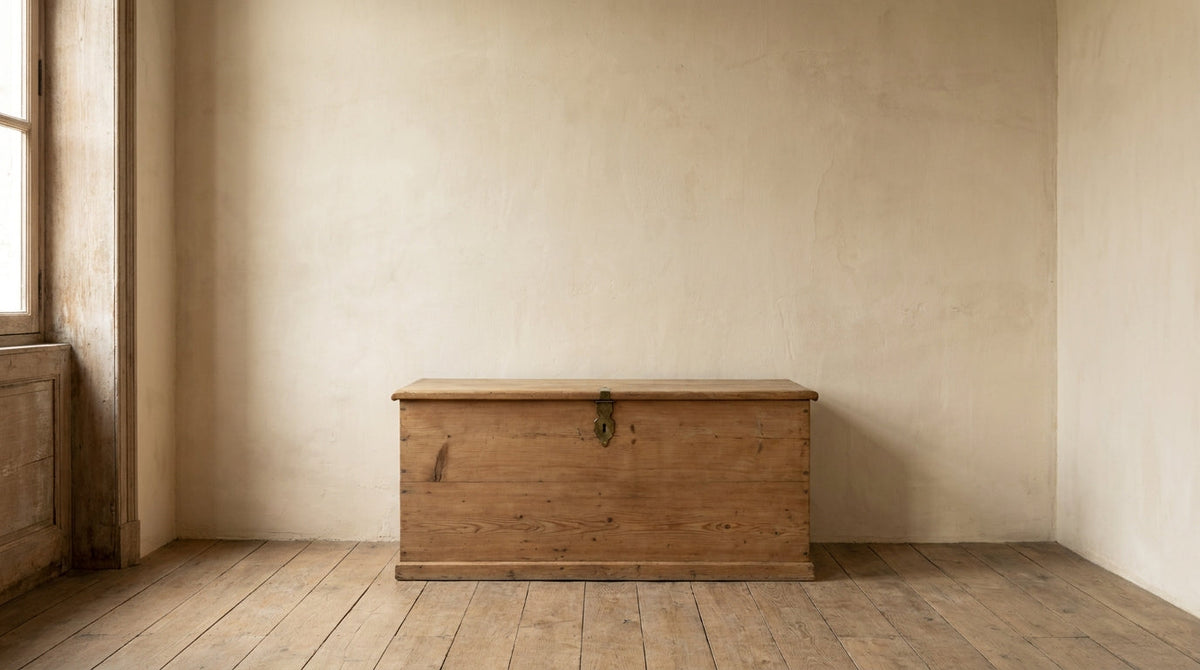
Reclaimed pine moves less than new pine, because the boards spent decades indoors before we milled them, but it still moves. It holds up well in a kitchen and in a powder room. Avoid a full bathroom that has a shower and no extraction, and never stand it against an exterior wall that sweats.
The Reclaimed Pine Console with Painted Base is built from boards that spent most of a century inside a building before we milled them, which means the wood has already done most of the moving it's going to do. That's the short answer to whether reclaimed pine holds up in a kitchen or bathroom. It moves less than new pine, but it still moves, and where you put it matters more than most retailers admit. This guide is how we think about placement, finish, and maintenance for reclaimed pine in the two rooms buyers ask about most.
Why Reclaimed Pine Moves With Humidity (and What 'Movement' Actually Means)
Wood is hygroscopic. It absorbs and releases moisture from the surrounding air until it reaches balance with the room (source). That balance point is called equilibrium moisture content. At 70°F and 35% relative humidity, typical of a dry heated house in January, EMC sits around 7%. At 70°F and 65% RH in a humid August, it climbs to about 12% (source). Every board in your house is moving between those numbers whether you notice or not.

A 4% swing in moisture content produces roughly 1% dimensional change across the grain (source). On a 24-inch-wide console top, that's about a quarter inch of width change between winter and summer. Movement happens across the grain, not along the length, which is why drawers rattle in January and stick in July while the case itself stays square.
Pine moves more than oak because it's a softwood with an open cellular structure that lets moisture in and out faster than denser hardwoods (source). "Movement" is normal. A hairline gap opening between a drawer front and the case in winter is the wood doing what wood does. "Warping" is different: a cupped top, a twisted stile, a split running across the grain. That's what happens when one face of a board takes on moisture and the other doesn't, and it's almost always caused by a rapid humidity swing or a piece placed against a moisture source (source).
Room by room
| Room | Verdict | Why |
|---|---|---|
| Kitchen | Yes | Humidity spikes are short and pass |
| Powder room | Yes | No shower, so no sustained damp |
| Full bathroom with extraction | With care | Keep it off the wettest wall |
| Full bathroom, no extraction | No | Sustained high humidity |
| Against an exterior wall that sweats | No | Condensation sits on the back panel |
What Reclaimed Pine Has That New Pine Doesn't When It Comes to Stability
Reclaimed pine has already cycled through humidity swings for decades. The wood has reached equilibrium with indoor air, released the moisture it was going to release, and settled into whatever shape it's going to hold (source). New kiln-dried pine, by contrast, was force-dried to around 8% moisture content in a chamber over a few days (source). The drying is done, but the wood has never had to hold shape through a real seasonal cycle. It has residual movement to work out. Your kitchen is where it works it out.
There's a second advantage. Old-growth reclaimed lumber typically shows 20 or more growth rings per inch, versus 8 to 12 in modern plantation pine (source). Denser grain means fewer open cells for moisture to enter, which means slower absorption and slower response to a humidity spike. This is the argument for our reclaimed pine collection over cheaper new-pine reproductions dressed up with a distress pass. The wood itself is doing structural work that new pine can't.
Reclaimed pine still isn't oak. It still moves. But the residual movement you get from a board that spent 130 years in a barn is a fraction of what you get from lumber that came out of a kiln last month.
Kitchen Placement: Which Spots Are Safe and Which Will Cause Problems
Kitchens aren't uniformly humid. They have zones. The places that cause problems are the ones with rapid humidity swings, not the ones that are damp all the time.
- Directly adjacent to a dishwasher (within about 12 inches of the vent). This is the worst spot in the house. Dishwashers dump hot steam every cycle, and the humidity spike is fast enough to hit one side of the wood before the other side catches up. That's the mechanism behind cupping. Don't place reclaimed pine here.
- Over an open range without a hood, or under a low soffit that traps cooking steam. Same problem, slower. If your range hood vents outside and actually pulls, a console eight feet away is fine. If it recirculates or you don't run it, treat the whole cooking wall as a humidity zone.
- Near a west or south-facing window in direct sun. Not a humidity problem, a drying problem. Direct sun on one face while the back stays cool creates a moisture differential that causes twist. Use a sheer or move the piece three feet off the window wall.
- Across the room from the sink, along the eating or seating wall. This is where reclaimed pine belongs in a kitchen. Ambient humidity swings, but slowly, which is what the wood is built for. A piece like the Barn Door Entertainment Cabinet lives comfortably in an open-plan kitchen used as a bar or a coffee station, provided it's not sitting six inches from the dishwasher door.
The rule underneath all of these is the same one: rapid humidity change is what damages wood, not high humidity itself (source). Steady is fine. Spikes are the problem.
Bathroom Placement: What the Humidity Threshold Is and How to Check Yours
Solid wood furniture is happiest between 35% and 50% relative humidity. Below 30% RH the wood loses moisture and shrinks; above 65% RH it swells (source). A bathroom during a shower routinely hits 80% and can sit there for an hour. That's the threshold question.
Reclaimed pine in a bathroom is viable if two conditions are true. First, the room has real ventilation, meaning a working exhaust fan that runs during and for twenty minutes after every shower, or a window that opens. Second, the ambient humidity between showers returns to under 60% within an hour or two. If the room stays at 70% RH for six hours after a morning shower, that's not a room for solid wood.
Check yours with a hygrometer. A basic digital one runs about $15 at any hardware store. Put it on the counter, run your normal morning routine, and read it at intervals: right after the shower, thirty minutes later, two hours later. If the peak stays under 70% and the room drops back into the fifties within two hours, reclaimed pine will hold up. Half-baths without showers are almost always fine.
Don't place a wood piece where it will be splashed directly, and don't place it against a wall shared with the shower. The wall itself holds moisture the wood will read.
Finish Type and Its Effect on How Much Moisture Reclaimed Pine Absorbs
Finish doesn't stop moisture. Given enough time, wood reaches equilibrium with the room regardless of what's on it (source). What finish changes is the speed of exchange, and speed is what determines whether a piece cups.

Three categories worth knowing:
- Hardwax oil and penetrating oils. Soak into the wood fibers and leave a thin protective layer. Microporous, so moisture moves through in both directions at a controlled rate (source). This is what we use on most of our reclaimed pine.
- Paste wax. Sits on top of an oiled or bare surface. Adds a light water-resistant layer and a hand-feel most buyers want on reclaimed pine. Needs reapplication once or twice a year.
- Polyurethane. A synthetic film that forms a plastic barrier on the surface. Slows moisture exchange dramatically, but if only one face of a board is coated, the uncoated face responds to humidity faster than the coated face, and the board cups. This is the failure mode on cheap reproduction pine pieces where the top is heavily sealed and the underside is bare.
The Vintage Sideboard and the console at the top of this page both carry a hardwax oil finish sealed with paste wax, the combination that gives reclaimed pine the widest usable placement range without trapping moisture on one face.
The Maintenance Routine That Keeps Reclaimed Pine Stable Year-Round
The routine is short. Do it and the wood does the rest.
- Twice a year, apply a neutral paste wax. Howard Feed-N-Wax or a comparable beeswax-and-carnauba blend. Apply thinly with a cotton cloth in the direction of the grain, wait fifteen minutes, buff off with a clean cloth. Spring and fall are the right cadence, before the winter dry-out and before the summer humidity.
- Wipe spills immediately. Pine's open cell structure means standing water absorbs within minutes. A dry cloth first, then a barely damp one if needed, then dry again.
- Run a humidifier in winter if your house drops below 30% RH. This matters more than any finish decision. A whole-house or single-room humidifier that keeps the space at 35–45% RH prevents the winter cracking that a hygrometer will predict before your eyes will.
- Avoid ammonia-based cleaners, all-purpose sprays, and anything with citrus solvents. They strip wax and drive moisture into the wood at the same time. Damp cotton cloth is enough for weekly cleaning.
- Don't put the piece against an exterior wall in a cold climate. The wall itself is cold, condensation collects behind the piece, and you won't see it until the back board warps.
The Reclaimed Pine Console at the top of this post has been in kitchens, entryways, and dining rooms in every climate zone we ship to. It holds up because the wood has already done its moving and the finish lets it breathe. Put it somewhere the humidity swings slowly and wax it twice a year. That's the whole job.
Common questions
Will reclaimed pine warp if it's near a dishwasher?
Within about twelve inches of a dishwasher vent, yes, over time. The problem isn't the ambient kitchen humidity, it's the fast steam pulse every cycle. Hot moist air hits one face of the wood before the other face equalizes, and that differential is what causes cupping. Three feet away with the dishwasher venting normally, we haven't seen a problem. If you're planning a piece against a dishwasher run, move it to the opposite wall or across the room.
What humidity level is too high for reclaimed pine furniture?
Sustained relative humidity above 65% will cause the wood to swell noticeably. Drawers stick, doors stop closing cleanly. Above 70% for extended periods invites cupping and mildew on the underside. The target range for solid wood furniture is 35 to 50% RH (source). Short spikes into the 70s and back down, a shower, a pot of pasta, aren't the problem. Sustained levels are.
Does waxed pine resist moisture better than oiled pine?
Slightly, in the short term. A paste wax layer adds surface water resistance that beads up a splash long enough to wipe it off. Long-term moisture transmission is roughly the same, because both are microporous. The advantage of the wax-over-oil combination isn't waterproofing. It's that the finish lets the wood breathe evenly on all faces, which prevents the cupping you get with polyurethane.
Can reclaimed pine be used in a bathroom if there's good ventilation?
Yes, if the room returns to under 60% RH within two hours of a shower and never sits above 70% for extended periods. Powder rooms and half-baths without showers are almost always fine. Full baths with working exhaust fans and a door left open between uses usually work. Windowless baths without ventilation don't. Buy a $15 hygrometer and measure before you commit.
How do you tell the difference between normal wood movement and actual warping?
Normal movement is symmetric and seasonal. Drawer gaps that open a hairline in January and close in July are the wood breathing, and nothing is wrong. Warping is asymmetric and permanent. A top that reads flat with a straightedge in one direction and shows daylight underneath in the other direction is cupped. A leg that no longer sits square on the floor is twisted. Normal movement returns to shape with the season. Warping doesn't.
How often does reclaimed pine furniture need to be re-waxed or re-oiled?
Twice a year for waxed pieces, spring and fall. If the piece lives in a high-use spot like a kitchen console or an entry table, add a third pass in high summer. You'll know it needs wax when the surface stops feeling silky under a dry hand and starts feeling dry or slightly rough. Re-oiling under the wax is a longer cadence, every three to five years unless the piece has been through a refinish or a significant repair.


