
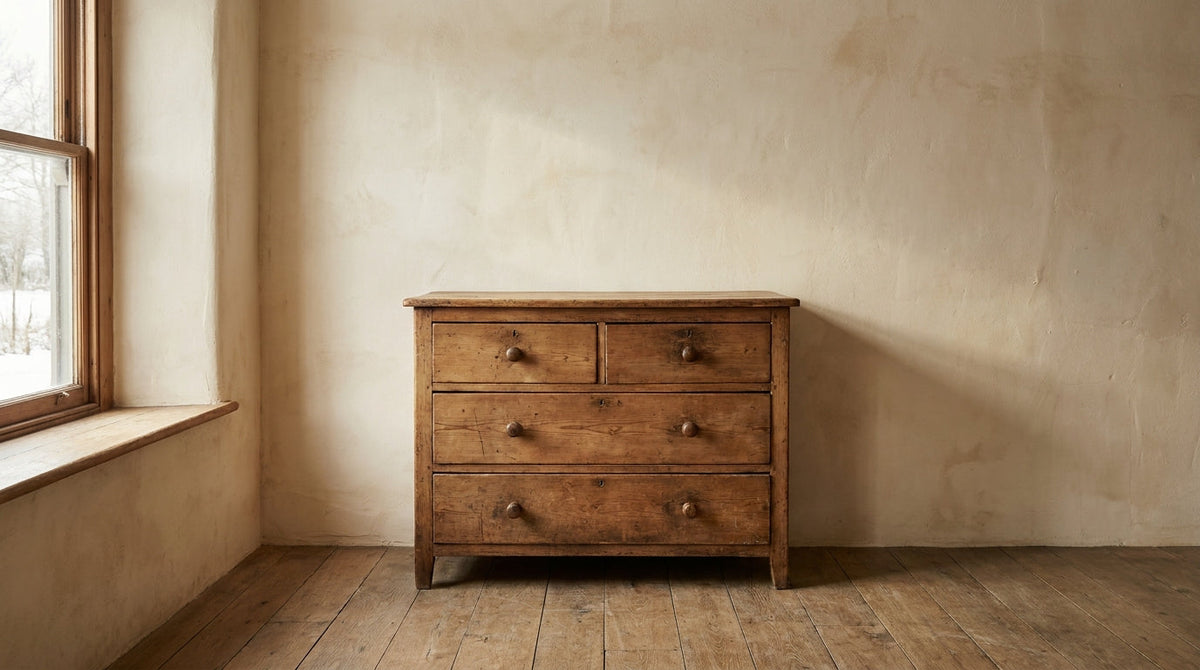
Hairline gaps that open along a drawer face in February and close again by May are normal in reclaimed pine, not a defect. The wood takes on moisture in humid months and gives it back in dry heated air. Keep indoor humidity between 40% and 55% and the movement stays inside the joinery's tolerance.
The Lori Four-Drawer Chest is reclaimed pine, which means the boards you're looking at have already spent decades adjusting to indoor air before we ever saw them. That history is the reason you'll see hairline gaps open along a drawer face in February and close again by May, and it's the reason we build the chest the way we do. This is a guide to what's normal, what isn't, and what to do when the wood tells you the season has changed.
Why Reclaimed Pine Moves More Than New Pine or Veneered Wood
Wood is hygroscopic. It absorbs and releases moisture from the air until it reaches equilibrium with whatever room it's sitting in (source). That exchange never stops. When the air dries out in winter, the boards give up moisture and shrink across the grain. When summer humidity comes back, they take it up and swell.
Two things make reclaimed pine move noticeably more than the alternatives on the market. First, pine is a softwood, and softwoods generally move more than hardwoods like oak in response to humidity swings (source). Second, our reclaimed pine is old growth that was air-dried slowly over years in a working building, not kiln-dried in a chamber to a commercial 6–8% moisture target (source). It moved a lot during that life and then settled. It still moves now, just within a narrower range than a fresh-cut board would.
An MDF-core veneered chest doesn't move because there's no solid wood in the case to move. The substrate is glued fiber. That's the trade-off. You either get a piece that behaves like a laminate countertop, or you get real wood that responds to the room. We sell the second kind.
What the wood does across a year
| Season | Indoor humidity | What you see | What to do |
|---|---|---|---|
| Winter, heated | Low | Hairline gaps at the drawer faces | If readings sit below 35%, add a humidifier |
| Spring | Rising | Gaps close on their own | Wipe down in early spring, one of the two annual passes |
| Summer | High | Drawers can get sticky | Watch that the room does not sit above 60% for weeks at a time |
| Autumn | Falling | Gaps start to reappear | Wipe down in late fall, before the heating season |
What Normal Seasonal Movement Looks Like on a Pine Chest or Table
On a wide pine board, say a 14-inch drawer face or a 36-inch tabletop plank, expect a hairline gap of 1/8" to 3/16" to open across the grain during the driest weeks of winter. On a reclaimed pine dining table with a top made of three or four boards, you may see a similar gap open at one seam and not the others, because no two boards move exactly the same amount.
You may also see raised grain, a slight ridging along the earlywood/latewood lines where the softer bands have compressed and the harder bands haven't. Run your hand across the top. If it feels like fine corduroy in January and glass again in June, that's the wood breathing.
What's not normal: a gap wider than 1/4", a joint that has visibly separated at a corner, a drawer bottom that has fallen out of its dado, or a crack that runs across the grain instead of along it. Those are structural, not seasonal. Call us.
How Our Joinery Is Built to Accommodate Movement, Not Fight It
Three construction features let a solid pine piece move without tearing itself apart, and we look for all three when we sign off on a piece for our reclaimed pine collection.

Breadboard ends. On a tabletop, the end cap runs perpendicular to the main planks. It's attached with a mortise-and-tenon joint where only the center 3–6 inches are glued. The outer peg holes are elongated horizontally so the tenon slides as the panel expands and contracts (source). If a maker glues the whole joint, the top splits within two seasons.
Floating panels. In a case piece like the Lori chest, the side panels sit in grooves cut into the frame stiles. They're not glued in. The panel can grow and shrink inside the frame without prying the joints apart.
Elongated peg holes. Wherever a cross-grain piece meets a long-grain piece, the pegs pass through a slot instead of a round hole. Same principle as the breadboard: the peg holds the parts in the same plane but lets them slide past each other.
Fixed joints on solid wood, with glue everywhere, round holes, and no allowance for movement, crack. Ours are built to move.
The Seasonal Care Routine That Keeps Gaps from Widening
The single most useful thing you can do is keep indoor humidity between 40% and 55% year-round (source). That's the range where wood movement stays inside the joinery's tolerance. Below 30%, which is where forced-air heating drops a lot of houses in January, the pine will give up moisture fast, and gaps that would have been 1/8" open to 1/4" or more.
Buy a $15 hygrometer and put it in the room where the piece lives. If winter readings sit below 35%, add a humidifier. A single-room evaporative unit is enough for most bedrooms. If you have a piece like the three-drawer chest sitting near a heating vent, redirect the vent or move the piece two feet. Direct hot air on one face of a chest will pull moisture from that side faster than the other and cup the panel.
In summer, if you're running the AC hard in a humid climate, you're usually fine. AC dehumidifies as it cools. In a shoulder season with the windows open in a wet region, watch that the room doesn't sit above 60% for weeks at a time. That's when drawers get sticky.
Twice a year, in early spring and late fall, wipe the piece down with a barely damp cloth, let it dry, and apply a thin coat of neutral paste wax with a cotton rag in the direction of the grain. Buff after ten minutes. That's the whole routine.
Wax vs. Oil Finish on Reclaimed Pine: Which One Works With Movement
We finish our reclaimed pine with either a natural paste wax or a penetrating oil, and there's a reason. Both finishes sit in the wood rather than on top of it. When a board moves, the finish moves with it.

A polyurethane or lacquer top-coat builds a film across the surface that bridges the grain lines. When the boards shrink in winter, that film doesn't shrink at the same rate. It cracks along the seams, and once it cracks it lifts. You then have to strip it before you can refinish, which on reclaimed pine usually means losing the patina you paid for.
Hardwax oil and penetrating oil finishes let the wood exchange moisture with the room air through the finish itself (source). Paste wax does the same. When a piece like the bowfront chest needs a touch-up in year three, you rub on a fresh coat of wax over the existing one. No stripping, no sanding, no refinisher.
That's why we don't sell reclaimed pine under a poly topcoat. The finish has to match the material.
What to Do When a Gap or Raised Grain Appears Mid-Season
Four steps, in this order:
- Check the hygrometer. If humidity is below 35%, the gap is telling you the room is dry, not that the piece is failing. Add a humidifier and give it two weeks.
- Wait for the season to stabilize. Do not do anything to a gap that appeared in January. It will close in April. Filling it now guarantees a bulge in July when the wood comes back.
- Apply paste wax to the affected edge. If raised grain is catching your hand, a light coat of wax and a buff will settle it. Do not sand, or you'll cut through the patina.
- Call us only if the gap exceeds 1/4" or a joint has visibly separated. Those are the two things that mean something is wrong with the piece, not the room. (336) 431-9929 or hello@emmagracehome.com — you'll reach us, not a queue.
Do not use wood filler. Do not use caulk. Do not glue anything. All three lock the wood in a position it won't stay in, and the next season will either pop the filler out or crack the board next to it.
The Lori chest and every other reclaimed pine piece we sell is built to live in a real house with real seasons. The movement is the material working the way it's supposed to.
Common questions
Is it normal for reclaimed pine furniture to develop gaps in winter?
Yes. A hairline gap of 1/8" to 3/16" across a wide board face during the driest weeks of winter is normal seasonal movement, and it will close again as humidity rises in spring and summer. Reclaimed pine is a solid softwood, so it responds to indoor humidity swings more visibly than hardwoods or veneered pieces. The joinery on our chests and tables is built with elongated peg holes and floating panels specifically to let those gaps open and close without stressing the joints.
How much movement should we expect across a wide pine tabletop between seasons?
On a 36-inch-wide tabletop made of three or four planks, expect one or more seams to open 1/8" to 3/16" during the driest stretch of winter, then close by early summer. Movement across the grain is always greater than movement along the grain, and flat-sawn boards move more than quarter-sawn ones (source). If the gap exceeds 1/4" or a breadboard end starts to protrude noticeably past the panel edges, the room is likely well below 30% humidity and needs a humidifier.
Will a humidifier actually stop my pine chest from cracking?
A humidifier keeps the wood from reaching the extreme dryness where cracking becomes likely. Sustained indoor humidity below 30%, common in forced-air-heated homes in January and February, pulls moisture out of the boards fast enough to open joints and raise grain (source). A single-room evaporative humidifier that keeps the space at 40–55% is enough for most bedrooms and living rooms. It won't stop movement entirely (nothing does), but it keeps movement inside the range the joinery was designed for.
Can I fill the gap in my reclaimed pine with wood filler?
No. A gap that opened in winter will close in summer, and any filler in it will either pop out or push the boards apart when the wood swells back. The same is true of caulk, glue, or epoxy. The right response to a seasonal gap is to check the room's humidity, wait for the season to stabilize, and leave the piece alone. If a gap is still wider than 1/4" after humidity has been at 45% for several weeks, call us before doing anything to it.
Does wax finish prevent wood movement or just hide it?
Neither, exactly. Wax doesn't prevent movement. Nothing applied to the surface stops the wood from exchanging moisture with the air. What wax does is move with the board instead of cracking across it. A polyurethane film bridges the grain and splits when the wood shrinks; paste wax and penetrating oil sit in the fibers and flex. Wax also makes touch-ups possible without stripping, which matters over the twenty- or thirty-year life of the piece.
At what point is seasonal movement in pine a warranty or quality issue?
A gap wider than 1/4" that doesn't close as humidity returns, a joint that has visibly separated at a corner, a crack that runs across the grain (not along it), or a drawer bottom that has dropped out of its dado. Those are structural and we want to hear about them. Hairline gaps that open and close with the seasons, raised grain you can feel in January and not in June, and slight cupping on a wide board that reverses each year are the wood doing what solid pine does. Call (336) 431-9929 if you're unsure. We'd rather look at a photo than have you guess.


