
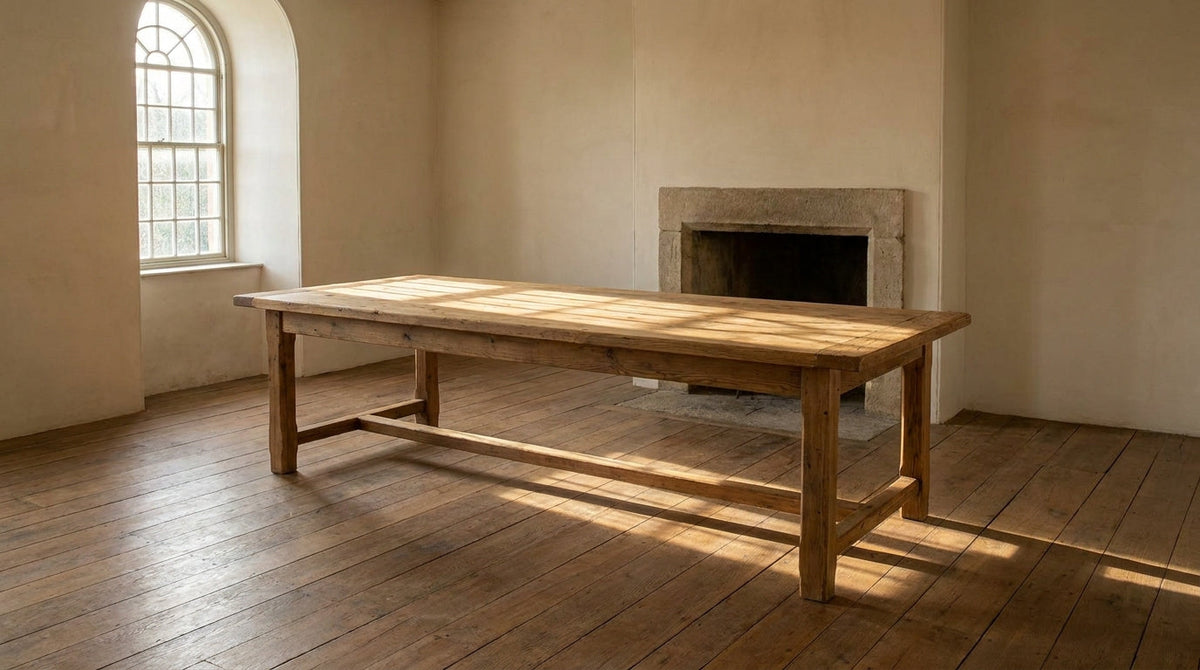
Genuine reclaimed pine comes out of pre-1940 structures and carries nail holes, saw marks and settled grain that a wire brush cannot fake. New plantation pine distressed at the factory photographs the same and separates in its second summer. Check the end grain and the underside before you buy.
The Reclaimed Pine Parquet Top Baluster Table is built from pine pulled out of pre-1940 structures, milled into a parquet-pattern top over a turned baluster base. We're writing this guide because most of what gets sold as "reclaimed pine" at the $1,200–$2,500 dining range is new plantation pine put through a wire-brush distress pass, and the difference shows up in the second summer of use, not on the showroom floor.
Reclaimed Pine vs. New Pine vs. MDF-Veneer: What the Price Gap Actually Buys You
There are three real tiers in pine dining tables, and the price gap between them reflects a structural difference, not a finish difference.
Reclaimed pine, the kind we build with, comes from old-growth trees that grew 60 to 150+ years before they were cut, then spent another fifty to a hundred years in a building. The growth rings are tight, the wood has already done its moving and shrinking, and the surface scores roughly twice as hard on the Janka scale as new plantation pine (source). New solid pine is softer. Eastern white pine measures around 380 lbf, longleaf around 870 lbf (source), and it's still going to move with the seasons for the first few years out of the mill.
MDF with a printed pine veneer is the third tier, and it's the one that fills the $400–$900 slot at mass retailers. It's wood fiber bonded with urea-formaldehyde resin at 600–800 kg/m³, pressed into a sheet, then wrapped in a paper or thin-veneer top (source). It looks fine for a year. It cannot be sanded and refinished. Once the veneer is through, the fiber underneath is exposed (source), and it swells when a wet glass sits on it long enough (source).
The price gap between the parquet baluster table and a veneer table at a big-box retailer is roughly the difference between a piece you refinish in year fifteen and a piece you replace in year five.
Telling genuine reclaimed pine from factory-distressed new pine
| Tell | Genuine reclaimed | Factory-distressed new pine |
|---|---|---|
| Nail holes | Irregular, and they go through the board | Shallow and decorative |
| Saw marks | The original mill pattern | Uniform wire-brush passes |
| End grain | Tight rings, 20 or more per inch | Wide rings, 4 to 8 per inch |
| Underside | Left unfinished, shows its history | Finished to match the top |
| Second summer | Stable | Gaps open and edges lift |
How to Read a Reclaimed Pine Table Before You Buy
Four signals tell you the wood is what the tag says it is.

Nail holes that go nowhere. Genuine reclaimed pine has square or rectangular nail holes left over from cut nails (pre-1900) or early wire nails. They don't line up in a pattern. They sit in the surface at angles, sometimes filled with old paint, sometimes plugged with a darker wood. CNC distress patterns repeat. If you see the same "nail hole" twice on the same board at the same angle, the wood is new.
Saw marks across the grain. Pre-WWII milling left visible saw marks because the band saws of that era ran wider, slower blades. On a real reclaimed top you can run your hand across the grain and feel faint ridges every quarter inch or so. New "distressed" pine has scratch patterns that run with the grain. A wire wheel makes lines, not cross-cuts.
Tight rings. Hold the edge up to light. Old-growth pine shows growth rings packed close together, often 15–25 per inch. New plantation pine shows wide rings, often 4–8 per inch, with a soft early-wood band you can dent with a fingernail.
Tone variation between boards. Reclaimed stock is pulled from different beams in the same building, sometimes different buildings. Tone shifts board-to-board. If every plank on the top is the same color, the table was either stained uniformly after assembly (a finish choice, not a tell) or the wood is new.
The French Country table in antique grey is a good comparison piece: the grey is a milk-paint wash applied over reclaimed stock, so you still see the nail holes through the finish.
Round vs. Rectangular: Which Table Format Works for a Summer Dining Setup
A 60-inch round seats six comfortably and pushes the foot traffic around the perimeter, which is what you want when people are moving between a kitchen, a porch door, and a side table with drinks. The rule we use: leave 36 inches of clear floor between the table edge and the nearest wall or piece of furniture so a chair can pull all the way out without a person standing.
A 72-inch rectangle seats six with elbow room and eight at dinner. It also handles a runner, a center arrangement, and serving platters down the middle, which a round won't. The trade-off is traffic flow: a rectangle creates two long sides that funnel people single-file.
The oval drop-leaf format splits the difference. Leaves down it's a 36-inch oval against a wall for everyday breakfast; leaves up it seats eight. For a summer house or a room that swings between two and ten, the drop-leaf is the format we'd recommend before any other.
What Chairs and Benches Pair With a Reclaimed Pine Table Without Competing With It
Reclaimed pine has its own color story, from warm honey to weathered grey depending on how it was finished, and the seating that works around it is seating that doesn't try to add a second wood tone.
Rush-seat country chairs in a darker wood (walnut, dark oak, ebonized) anchor the table without matching it. The Edna side chair is the one we reach for most often: turned legs, woven seat, a finish dark enough to read as contrast rather than near-miss.
Leather-seat farmhouse chairs in antique buffalo or saddle leather work for the same reason. The leather patinas separately from the wood and the two finishes get more interesting next to each other over time.
A plain wood bench along one long side is the format that lets a rectangular reclaimed pine table breathe. Pair it with chairs on the other side and the heads, and the bench reads as a quiet plank, not a competing object.
What to avoid: white-painted chairs (too clean, makes the table look dirty), light oak chairs (two near-matching wood tones reading as a mistake), and chrome-frame chairs (the cold metal fights the warm pine). For more options, browse French country seating.
What Reclaimed Pine Actually Does Over Five to Ten Years of Daily Use
Reclaimed pine dents. That's the honest answer. It dents less than new pine because the wood is denser, but a dropped knife or a heavy serving dish on the edge will leave a mark.
Here's the part that matters: the table already has marks. The nail holes are there, the saw marks are there, the old paint trace is there. A new dent in year three reads as continuation, not damage. A new dent on a polyurethane-finished new pine table reads as a scratch through the finish, which it is, and which you'll see every time the light hits it.
The other behavior worth knowing: minor dents in pine can often be raised back out with a damp cloth and a warm iron (source). Steam rehydrates the crushed fibers. You won't get the surface perfect, but you'll take a dent from obvious to invisible at conversational distance.
Over ten years the top develops a softer sheen where hands and plates have polished the wax. The legs and base stay closer to original. That tonal split is the patina people pay for, and it's the reason we lean into reclaimed for dining over any other category. Browse the rest of our reclaimed pine pieces for the same wood used in chests, sideboards, and consoles.
How to Maintain a Reclaimed Pine Dining Table Through Summer and the Season Change
The maintenance cadence on a waxed or hardwax-oiled reclaimed pine table is two passes a year and a wipe-down in between.
In late spring, before humidity climbs, wipe the top with a damp (not wet) cloth, let it dry an hour, then apply a thin coat of a neutral hardwax oil or paste wax with a cotton cloth in the direction of the grain. Let it sit fifteen minutes. Buff off the excess. The finish needs roughly two to three weeks to fully cure (source), so do this when you have a stretch without a dinner party.
In early fall, repeat. The two pressure points on the wood are the late-summer humidity spike (which can cause surface checking if the wood dried too far in air conditioning) and the first weeks of winter heat (which dries the wood back out). Keeping indoor humidity between 35% and 55% helps more than any finish does (source).
Between waxings: a damp cloth for spills, dry cloth to follow. Don't use Pledge, Murphy Oil Soap, Windex, or anything with silicone, ammonia, or detergents. They either strip the wax or build a film that the next wax coat won't bond to. Plain water and a microfiber cloth is the right tool.
The parquet baluster table comes from us with a hand-rubbed finish ready for normal use. Your first maintenance pass isn't due until the following spring.
Common questions
Can a reclaimed pine dining table be used outdoors or in a covered patio?
Not outdoors, even in a covered space. The wood was already weathered for decades in its first life, and putting it back outside accelerates checking, cupping, and finish breakdown. A screened porch in a dry climate can work if humidity stays under 60% year-round, but a covered patio in a humid region (anywhere the table experiences seasonal swings from 40% to 90%) will move the wood enough that joints loosen within two or three seasons. For outdoor dining, a teak or ipe table is the right material; for indoor dining that opens to a porch in summer, reclaimed pine is exactly the right call.
How many coats of wax does a reclaimed pine table need each year?
Two thin coats, one in late spring and one in early fall, applied with a cotton cloth in the direction of the grain and buffed off after fifteen minutes. A third coat in deep winter is worth it if you run forced-air heat that drops indoor humidity below 30%. More than three coats per year is excessive and starts to build a hazy film. If the surface feels dry to the touch or water no longer beads on it, that's the signal to wax, not the calendar.
Does reclaimed pine dent more easily than new pine?
No. Reclaimed pine scores roughly twice as hard on the Janka scale as new plantation pine because the wood came from slow-growth old-growth trees with tighter rings (source). Both will dent under enough force (pine is still a softwood), but the reclaimed top resists daily wear noticeably better. The bigger advantage is visual: new dents on a reclaimed surface blend with the existing nail holes and saw marks, where a fresh dent on a smooth new-pine top stands out as an obvious flaw.
Can you refinish a reclaimed pine table yourself, or does it need to go back to a workshop?
A waxed or hardwax-oil finish can be refreshed at home. Strip the old wax with mineral spirits and a cotton cloth, sand lightly with 220-grit only where the surface needs it, vacuum the dust, then apply a fresh coat of hardwax oil or paste wax. The hardwax oil needs two to three weeks to cure (source). If the table has a polyurethane finish or deep water damage that's grayed the wood, send it back to a workshop. Sanding through to bare wood on a reclaimed top is something you want a refinisher to handle without removing the saw marks.
What is the difference between antique pine and reclaimed pine in a dining table?
Antique pine refers to a complete piece of furniture made 75+ years ago: the table itself is old, and so is the wood. Reclaimed pine refers to old wood used to build a new piece. Our parquet baluster table is a new table built from pre-1940 pine; an antique pine table would be a 19th-century farm table sold as-is. Both have the wood character. The new-built reclaimed piece gives you modern dimensions, level joinery, and a finish that's ready for daily use, where an antique table often needs structural work before it can host dinner.


