
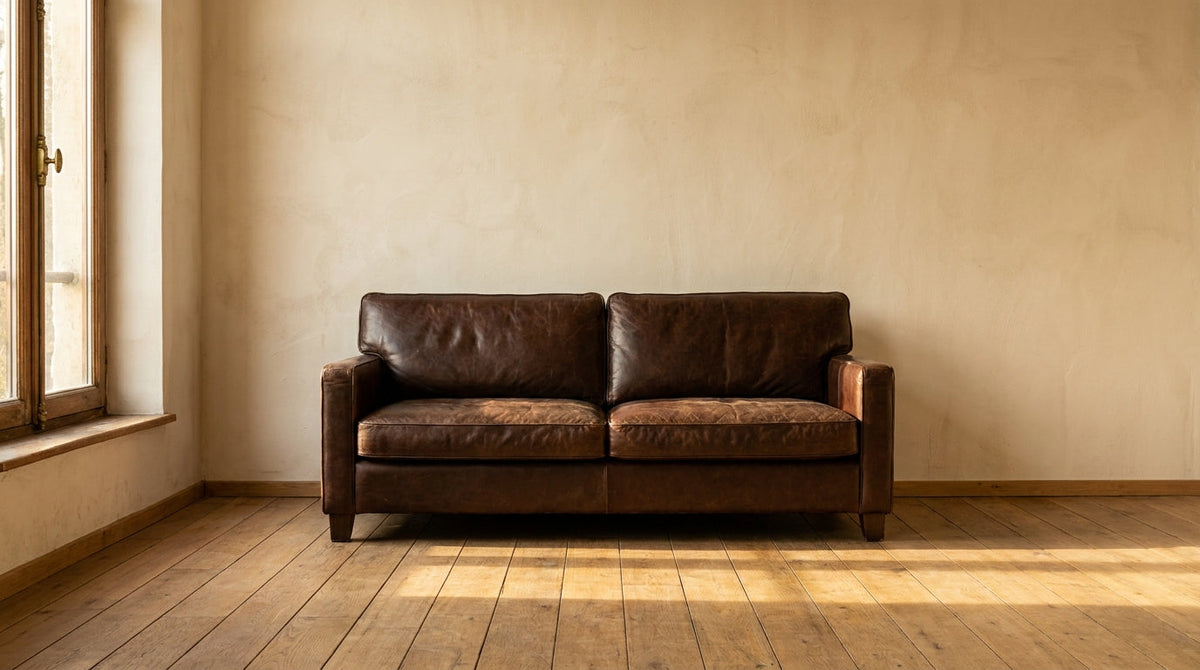
The Broadford is a 78-inch three-seater on a kiln-dried hardwood frame with eight-way hand-tied springs, wrapped in vegetable-tanned water buffalo hide roughly three times the thickness of a typical aniline leather. At $3,900 the frame and the hide are where the money goes, and both can be verified before you order.
The Broadford three-seater is a 78-inch leather sofa built on a kiln-dried hardwood frame, wrapped in vegetable-tanned water buffalo hide, and hand-nailed along the arms and base. Most leather sofas at this price point are softwood-and-plywood frames with corrected-grain hide stretched over high-density foam. We built the Broadford the other way around, and this post is how to verify that before you spend $3,900 on something you haven't sat on yet.
What the Broadford Three-Seater Is and Where It Sits in Our Catalog
The Broadford is a heritage leather sofa. Not a Chesterfield (no deep button tufting, no rolled arms), not a modern sectional (one piece, fixed configuration), not a mid-century low-slung lounge. It's the sofa your grandfather's law office might have had, built squarer and slightly lower in the back so it sits comfortably in a room with antique chests or a room with newer pieces.
It anchors the leather end of our catalog at $3,900. Below it sit fabric three-seaters in the $2,200–$2,800 range. Above it sit one-off pieces and longer four-seaters. If you're cross-shopping a $1,400 mass-market leather sofa, the Broadford will look expensive on the spec sheet until you read the construction line. If you're cross-shopping the $6,000–$8,000 heritage tier, the Broadford does most of what those sofas do without the made-to-order wait that runs past a year.
The buyer it's built for: someone furnishing a room they intend to keep furnished for fifteen years, who would rather buy once than buy three times. If that's not the math you're running, the sofa is probably more sofa than you need.
The Broadford against a typical sofa at this price
| Component | Broadford | Typical at this price |
|---|---|---|
| Frame | Kiln-dried hardwood, corner-blocked | Softwood and plywood |
| Suspension | Eight-way hand-tied springs | Sinuous spring |
| Hide | Full-grain vegetable-tanned buffalo, roughly three times the thickness | Corrected grain, about a third as thick |
| Seat cushion | Down-wrap over a high-density foam core | High-density foam alone |
How the Broadford's Frame Is Built and Why the Joint Type Matters
The frame is kiln-dried North American hardwood. Kiln-dried means the lumber was heat-cured down to roughly 6–8% moisture content before it was cut and joined, which is what keeps the frame from twisting or cracking later when it sits in a heated room through a Northeast winter. Softwood frames (pine, spruce, sometimes poplar marketed as hardwood) will move under that same load. You'll feel it as a creak in the second year and a sag in the fourth.

The joints are mortise-and-tenon at the load-bearing corners with hardwood corner blocks glued and screwed at the legs. This matters because a frame fails at its joints, not in the middle of a rail. A staple-and-glue assembly, what most sub-$2,000 sofas use, holds for the first three or four years and then loosens at the corner where the arm meets the back, which is also exactly where people lean. Once that joint opens up, the leather above it starts to crease in a way that won't smooth back out.
Suspension is eight-way hand-tied springs. Each spring is tied to its neighbors with twine in eight directions so the seat flexes as a unit instead of as a row of independent coils. Sinuous-spring construction (the S-shaped wire suspension in most factory sofas) is faster to build and cheaper by a wide margin, but it loses tension at the front edge first, the spot where you sit down hardest. Hand-tied springs lose tension across the whole seat at roughly the same rate, which keeps the cushion level for decades instead of years.
Full-Grain vs Top-Grain Leather: Which Hide the Broadford Uses and What That Means for Aging
The Broadford uses full-grain vegetable-tanned water buffalo hide, roughly 3.5mm thick — about three times the thickness of the aniline leather on a typical mid-market sofa.

Full-grain means the outermost layer of the hide is intact, with the natural grain pattern, the occasional scar, and the tonal variation that comes from a real animal. Top-grain has been sanded down to remove the surface imperfections and then re-embossed with a uniform grain. It looks consistent on day one and stays exactly that way, which is the problem. Corrected-grain (sometimes called "genuine leather" on a tag) is sanded deeper and coated with a pigmented finish that cracks and peels at the seven-to-ten-year mark.
Vegetable-tanning uses tree bark tannins instead of chromium salts. It takes about a month per hide instead of a day, which is why most sofa leather isn't tanned this way. The trade-off the buyer sees: vegetable-tanned hide darkens and softens with use. Chrome-tanned hide stays the color it was when it left the tannery, and feels the same in year ten as in year one, which sounds like a benefit until you realize "the same" includes "the same stiffness."
Expect the Broadford's hide to shift in color across the panels. Arms darker than the back, seat darker than the arms, sun-side darker than the wall-side. The hide isn't matched panel-to-panel. That's the point.
Seat Depth, Weight Capacity, and the Dimensions That Determine Whether This Sofa Works in Your Room
The Broadford measures 78.5"W × 35.5"D × 32.25"H. Seat height is 18.5", arm height is 26", seat depth is 22".
Twenty-two inches of seat depth is a working number. Twenty inches is a perch: you sit forward and your back never touches the cushion. Twenty-four-plus inches is a lounge, comfortable if you're six feet tall, a slouch if you're not. Twenty-two seats most adults with their back against the cushion and their feet on the floor.
The frame is rated for roughly 600 lbs of distributed load (two adults plus a third at dinner, or a kid jumping). The sofa itself weighs about 165 lbs. White-glove delivery puts it in the room and removes the packaging. There's no assembly.
Measure the access route before you order. The Broadford clears a 30" doorway with the legs on, a 28" doorway with the legs off (they unscrew from the underside). It will not turn a tight 90-degree stair landing under 36" wide. If your route includes that turn, tell us before the order ships. For sofas that don't fit through standard doorways we sometimes recommend stepping over to the broader seating collection for a chair pair instead, which gives you flexible delivery and the same leather build.
Why a Heritage Leather Sofa Holds Its Value Longer Than a Performance-Fabric Alternative
A performance-fabric sofa in the $1,400–$1,800 range, the dominant category right now, is built to a four-to-six-year lifespan. The frame is softwood or engineered plywood, the suspension is sinuous spring, the cushion is high-density foam wrapped in a stain-resistant polyester weave. The fabric is the selling point and also the failure point: it pills along the arms by year three, the foam compresses by year five, and at year six the sofa is on the curb.
The Broadford's math runs differently. The hide can be cleaned, conditioned, and re-dyed by a leather specialist for a few hundred dollars at year ten or twelve. The cushion cores are removable and replaceable. The frame outlasts the buyer if the buyer doesn't move it too many times. Cost-per-year on a $3,900 sofa kept for fifteen years is $260. Cost-per-year on a $1,500 fabric sofa replaced three times in that same window is $300, before delivery fees and the hassle of buying a sofa three separate times.
The resale floor matters too. A heritage leather three-seater in good condition holds roughly 30–40% of retail on the secondary market a decade in. A performance-fabric sofa holds roughly nothing. We don't track resale because we don't broker it, but you can verify the floor yourself by searching local estate sales for full-grain leather sofas of similar build. They sell, and they sell quickly. The same search for ten-year-old fabric sofas turns up free-to-haul listings. The Broadford is the cornerstone of the sofa range for that reason: it's the piece that pays you back if you ever decide to part with it.
How to Condition and Clean the Broadford's Leather: Annual Cadence and Products to Use
Condition the hide once a year. Use a neutral leather balm (Leather Honey, Bick 4, or a comparable pH-neutral conditioner) applied with a clean cotton cloth in small circles, then buffed off after twenty minutes. Avoid anything containing silicone, which builds a film that traps dust and dulls the surface, and avoid saddle soap on a vegetable-tanned hide, which strips the natural oils that the tanning process locked in.
Dust weekly with a dry microfiber cloth. For spills, blot immediately with a dry cloth. Do not rub, do not wet the spot. Water spots on full-grain leather usually rehydrate evenly across the panel within a few days as the hide re-equalizes. Wine, oil, and ink need a leather specialist within 48 hours. Don't try to lift them with household cleaner.
Keep the sofa out of direct sun for more than three or four hours a day. Sun fades the dyes unevenly. The sun-facing panel will lighten faster than the rest, and the difference is permanent. If your room has a south-facing window, rotate the cushions every three months so they fade together.
The first week of ownership, the hide will smell faintly of the tannery. That fades within ten days as the leather acclimates. It is not a defect.
What to Confirm Before the Broadford Is Delivered to Your Home
Before the truck arrives, walk the access route with a tape measure. Measure the front door, any interior doorway the sofa will pass through, and any hallway turn or stairwell landing along the route. The Broadford needs 30" of clearance with legs on, 28" with legs off. A tight 90-degree turn under 36" is the most common point of failure. Flag it before delivery, not on the day.
If you live in a building with an elevator, measure the elevator depth (not just the door width). A 78-inch sofa standing on end needs roughly 80" of elevator height clearance. If your elevator is shorter, the sofa goes up the stairs, which the crew will know in advance if you tell us in advance.
When the sofa arrives, the crew will unwrap it and place it. Before they leave, inspect three things: the leather across the seat and back (look for shipping creases that don't relax within an hour, which need to be documented), the frame at the four corners (push down on each arm to check for any rocking), and the cushions (make sure both seat cushions are present and the covers zip cleanly).
For broader room planning around the Broadford (side tables, lighting, the chest that goes opposite the sofa), the living room collection is organized to scale alongside it. Call (336) 431-9929 or email hello@emmagracehome.com with measurements before you order if anything about the route looks tight. We'd rather route you to a different piece than send a sofa that won't fit.
Common questions
What is the weight capacity of the Broadford three-seater sofa?
The frame is rated for roughly 600 lbs of distributed load, which covers two adults seated comfortably with room for a third at dinner or a child climbing. The kiln-dried hardwood frame with mortise-and-tenon joinery at the load-bearing corners is what holds that rating over time. Softwood frames at the same dimensions will rate similarly on day one and lose capacity by year five as the joints loosen.
What leather grade does the Broadford use?
Full-grain vegetable-tanned water buffalo hide, roughly 3.5mm thick. Full-grain means the outermost layer of the hide is intact rather than sanded and re-embossed, so the surface shows the natural grain, occasional scarring, and tonal shifts of the animal. Vegetable-tanned (rather than chrome-tanned) means the hide will darken and soften with use over the years instead of staying static.
How deep is the seat on the Broadford three-seater?
Seat depth is 22 inches, which seats most adults with their back against the cushion and their feet on the floor. Seat height is 18.5 inches and arm height is 26 inches. If you're over six feet tall and prefer a deeper lounge, the Broadford will feel slightly upright. If you're under five-six, it will feel right.
Can the Broadford three-seater be re-dyed or repaired if the leather scuffs?
Yes. Full-grain vegetable-tanned hide takes re-dye and conditioning well. A leather specialist can clean, condition, and re-dye the sofa for a few hundred dollars at the ten-to-fifteen-year mark, which is part of why the cost-per-year math works out. Light scuffs usually buff out with a conditioning treatment at home. Corrected-grain and bonded leather sofas can't be repaired this way because the surface coating fails rather than the hide itself.
What is the minimum doorway width needed to deliver the Broadford?
The Broadford clears a 30-inch doorway with the legs attached and a 28-inch doorway with the legs removed (they unscrew from the underside). A tight 90-degree stair turn under 36 inches wide is the most common access problem. Measure that turn before ordering. If your route looks marginal, call us with measurements before placing the order and we'll route the delivery crew accordingly.
How often does the Broadford's leather need to be conditioned?
Once a year is the baseline cadence, with a neutral pH leather balm applied in a thin coat and buffed off after twenty minutes. Twice a year if the sofa sits near a heat source or in a dry climate. Avoid silicone-based products and saddle soap. Both damage vegetable-tanned hide over time. Weekly dry dusting with a microfiber cloth covers the rest of the maintenance.


