
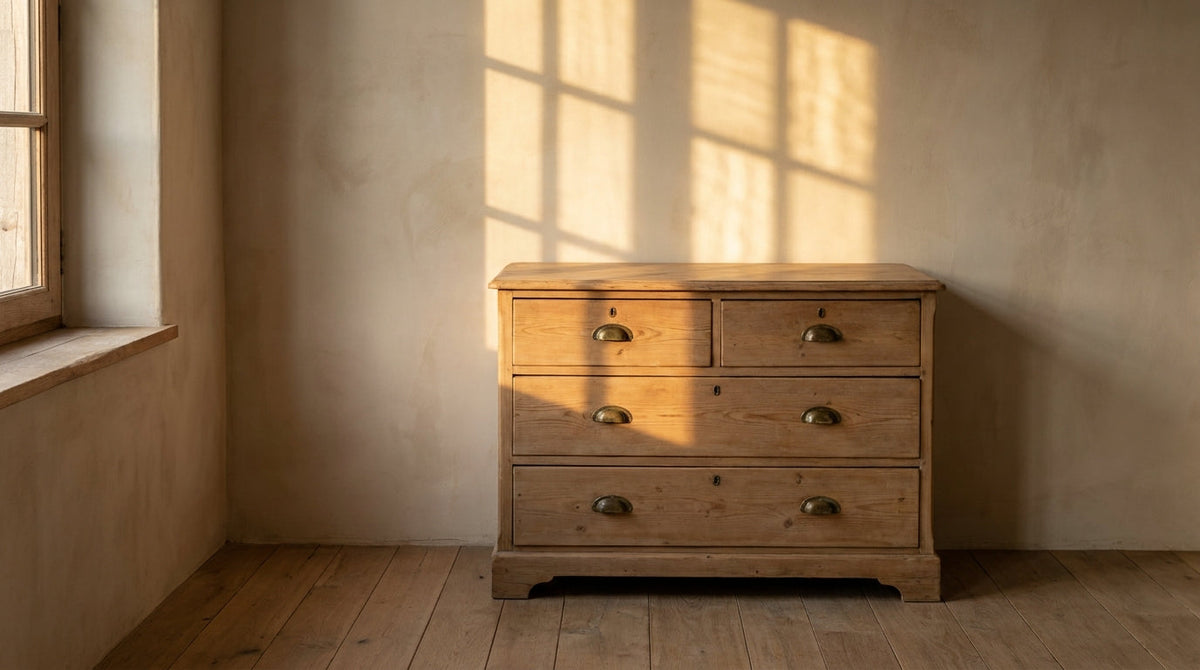
Oak is harder and shrugs off dents. Reclaimed pine is lighter, warmer in colour, and takes a hand-applied finish you can repair at home with a cloth and a tin of wax. For a bedroom chest you intend to keep twenty years, pine costs less up front and stays serviceable; oak costs more and stays flatter.
The Lori Four Drawer Chest is reclaimed pine finished in French blue, and at $2,400 it sits square in the middle of the price band where most buyers get stuck between pine and oak. This guide is how we answer the question when a customer calls and asks which one to buy for a bedroom they plan to keep the piece in for the next twenty years.
What Oak and Pine Actually Are in the Context of a Heritage Chest
Pine and oak are not two versions of the same thing. Pine is a softwood with an open, resinous grain and a wide density range, anywhere from 22 to 53 lb/ft³ depending on species and growth rate (source). Oak is a hardwood, 44 lb/ft³ for red oak and 47 lb/ft³ for white, with a tight ring-porous grain that reads darker and busier than pine at the same finish.
Inside pine there are two categories that behave very differently. New-growth pine is fast-farmed softwood harvested from plantations at 25 to 40 years old. Reclaimed pine is salvaged from buildings roughly 50 to 150 years old, most often barns, factories, and industrial buildings from the 19th and early 20th centuries (source). The reclaimed material grew slowly in old-growth forests before it was ever milled, which gives it tighter growth rings and better dimensional stability than the new-growth stock on most retailers' floors (source).
The Lori, the three-drawer chest in natural pine, and most of the pine in our catalog is reclaimed, not new-growth. That matters for the rest of this guide, because reclaimed pine and new-growth pine perform differently under weight, humidity, and time.
Oak against reclaimed pine, for a chest you keep
| Trait | Reclaimed pine | Oak |
|---|---|---|
| Dent resistance | Softer, takes dings | Harder, shrugs them off |
| Weight to move | Lighter | Noticeably heavier |
| Finish repair | Wax it back yourself | Usually a refinisher's job |
| Colour over time | Darkens and warms | Holds, ambers slightly |
| Where it wins | Price and repairability | Flatness and hardness |
How Oak and Pine Differ in Weight, Drawer Construction, and Daily Use
Oak is heavier. A six-drawer oak chest in the 50-inch range will run 180 to 220 lbs. The same footprint in pine, even reclaimed, runs 110 to 150. That weight difference shows up when you move a piece up a staircase, when you decide whether a floor with no subfloor reinforcement can hold it, and when you think about whether a delivery team can position it alone or needs two.

Where the weight difference shows up daily is the drawer. Oak's density lets it hold screws and pins tightly for decades. Pine, being softer, does not grip fastening hardware the way hardwood does, and cheap pine drawers loosen at the joints over time (source). This is why the joinery matters more in a pine chest than an oak one. Dovetailed drawers in reclaimed pine will outlast stapled drawers in new oak. Every chest we sell in either wood is dovetailed at the drawer corners and mortise-and-tenon at the case, which is the construction that keeps a pine piece square through thirty years of daily opening.
Oak vs Pine: Which Surface Holds Up to Dents, Humidity, and Wear
The hardness gap between pine and oak is real and it is measurable. Pine rates 380 to 870 on the Janka hardness scale, which is the standard test for a wood's resistance to denting. Oak rates around 1,290 for red oak and 1,360 for white (source). A dropped hairbrush leaves a mark on pine that it would not leave on oak.
Whether that matters depends on what you want the piece to look like in year ten. A dent on an oak chest reads as damage because the surrounding surface is pristine. A dent on a pine chest, especially reclaimed pine that already carries nail holes and saw marks from its first life, reads as part of the wood. The material was already showing a century of use when we milled it. That is either a feature or a defect depending on the room. A pine chest with a stone top sidesteps this entirely on the surface most likely to see wear, because the bluestone takes the abuse pine would not.
Humidity behaves the opposite of what you'd guess. White oak resists water absorption and warping well (source), and pine's open grain does absorb more moisture than oak (source). But reclaimed pine has already lived through fifty to a hundred winters of expansion and contraction inside a building. Most of the movement is out of it. New-growth pine and new oak both move more, in the first three years, than a reclaimed pine chest will.
Why Reclaimed Pine Chests Can Outlast New-Growth Alternatives
The reason a reclaimed pine chest at $2,400 can outlast a new oak chest at $2,400 comes down to two facts about the wood.

First: the tree grew slowly. Old-growth pine from the 1800s put on tighter growth rings than the plantation pine cut today, and tight-ring pine is denser and more stable than fast-farmed stock. Second: the wood is already seasoned. A hundred years of sitting in a barn wall means the moisture cycling is largely complete. Kiln-dried new lumber, oak or pine, is dried to about 8 percent moisture and then starts moving again the moment it enters a house at a different humidity. Reclaimed stock has finished most of that adjustment.
The material assumption most category shoppers bring is that "hardwood = better." At the level of Janka hardness that is true for surface dents. At the level of long-term dimensional stability, a well-milled reclaimed pine chest sits closer to old-growth oak than to new pine. This is the argument for the reclaimed category, and it's why our reclaimed pine pieces are priced closer to oak than to new-growth pine at other retailers. What makes reclaimed stock worth its price is the provenance and the seasoning, not the appearance of age. Wire-brushed new pine can be made to look reclaimed. It cannot be made to behave like reclaimed.
What Owning Either Wood Means for Refinishing, Touch-Ups, and Long-Term Value
Pine and oak refinish very differently. Oak has an open, ring-porous grain that absorbs stain readily and evenly, which is why furniture refinishers work with oak comfortably at any color (source). Pine's grain absorbs unevenly and stain can bleed or blotch without a pre-stain conditioner (source). This is why most heritage pine chests are painted, waxed, or oil-finished rather than stained.
The cost of refinishing runs about the same for either wood at a professional shop, roughly $300 to $600 for a chest of this size. The difference is at home. A wax refresh on a pine chest is thirty minutes with a cotton cloth and a can of paste wax. Repairing a scratch on a poly-finished oak chest usually means stripping the top panel. Pine is more forgiving to the owner. Oak is more forgiving to the child in the room.
Over a twenty-year hold, a properly-cared-for chest in either wood holds a resale floor most new furniture cannot touch, because both are solid wood on solid frames and can be sanded and refinished repeatedly. Neither will end up on a landfill in year seven the way a veneered-MDF case piece will. Both are one-of-one in the sense that the grain does not repeat. The Lori's four drawers are cut from boards that were part of a specific building. There is not a second Lori identical to the first.
Caring for an Oak or Pine Chest: Maintenance Cadence and Products to Use
For a waxed pine chest, apply a neutral paste wax like Howard Feed-N-Wax twice a year, once in spring and once in fall, using a cotton cloth in the direction of the grain. Buff after twenty minutes. This is the whole maintenance routine. Do not use silicone-based sprays, do not use Murphy's Oil Soap on the finish, and do not put a live plant directly on the top without a saucer.
For an oil-finished oak chest, use a wood-specific conditioning oil once a year. Dust weekly with a dry cloth. Oak tolerates humidity swings better than pine but still benefits from a room held between 40 and 60 percent relative humidity. In dry winter climates a room humidifier helps both woods equally.
For a painted piece like a painted chest with stone top, touch up chips with a small brush and matching paint, then re-wax the affected panel. Milk-painted and chalk-painted surfaces are meant to age, so a chip that shows the wood underneath is expected in year three or four, not a defect. On any of the stone-top pieces, seal the stone once a year with a natural-stone sealer and wipe spills quickly. Bluestone stains from red wine and olive oil if left overnight.
Both woods dislike direct sunlight for long stretches, which fades pine to a warmer tone and darkens oak. Position the piece off the direct summer sun line and both will hold their color for decades. The Lori has been in customers' bedrooms for six and seven years now with nothing more than the wax cadence above, which is the argument, at the end of it, for buying reclaimed pine at oak-adjacent prices in the first place.
Common questions
Is oak or pine better for a bedroom chest of drawers?
Neither is universally better. Oak resists dents and holds hardware more tightly, which matters if the piece will see rough handling or heavy drawer loads. Reclaimed pine is lighter, easier to touch up at home, and often more dimensionally stable than new oak because the wood has already finished most of its moisture cycling. For a bedroom holding folded clothing, either works for thirty-plus years if the joinery is dovetailed and the frame is mortise-and-tenon. For a bedroom shared with young children who will bang toys against the base, oak's harder surface is the safer choice.
Does pine furniture dent easily compared to oak?
Yes, measurably. Pine rates 380 to 870 on the Janka hardness scale and oak rates around 1,290. A dropped object that leaves no mark on oak will leave a small dent on pine. Whether that matters depends on the finish and the wood's history. Reclaimed pine already shows nail holes, saw marks, and prior wear from its first life, so new dents blend in. A pristine new pine chest reads dented. A reclaimed pine chest does not.
Can you refinish a pine chest of drawers at home?
Yes, more easily than oak. A waxed pine chest can be refreshed with paste wax and a cotton cloth. A scratched pine top can be lightly sanded and re-waxed at home. Restaining pine at home is harder because the grain absorbs unevenly and typically requires a pre-stain conditioner. If the piece is painted, chips can be touched up with matching paint and rewaxed over the affected panel. For a full-color change, use a professional refinisher.
How heavy is an oak chest of drawers compared to a pine one?
An oak chest at the six-drawer, 50-inch size runs 180 to 220 lbs. The same size in reclaimed pine runs 110 to 150 lbs, roughly 60 to 70 percent of the oak weight. This affects delivery access, floor loading in older homes, and whether one person can reposition the piece. It also affects felt-pad wear on hardwood floors, since heavier pieces compress pads faster.
Does reclaimed pine furniture warp in humid rooms?
Less than you'd expect. New kiln-dried pine, oak or otherwise, is dried to about 8 percent moisture and begins moving as soon as it enters a room at different humidity. Reclaimed pine has spent 50 to 150 years cycling through seasonal humidity inside a building, so most of its dimensional movement is complete. In a bedroom held between 40 and 60 percent relative humidity, a reclaimed pine chest will move less over the first three years than a new oak chest.
Is oak furniture worth the higher price over pine?
Not always. New oak at $2,400 versus reclaimed pine at $2,400 is a genuine trade: harder surface and heavier build versus tighter growth rings and completed seasoning. New oak versus new-growth pine at the same price is not a fair fight; the oak will hold up better. Reclaimed pine versus new oak is closer than most category shoppers expect, and the pine is often the better long-term buy at that specific price point.
What finish should a pine chest of drawers have to last longer?
Wax or oil, applied over an unstained or lightly stained surface, is the traditional finish for heritage pine and the easiest to maintain. Paste wax refreshed twice a year keeps the surface protected without building up a film that yellows or cracks. Painted finishes over pine, particularly milk paint or a hard-wearing chalk paint sealed with wax, hold up well and touch up easily at home. Polyurethane over pine works but is harder to repair invisibly when it scratches. Avoid heavy lacquer finishes on pine, which crack as the wood moves under them.


