
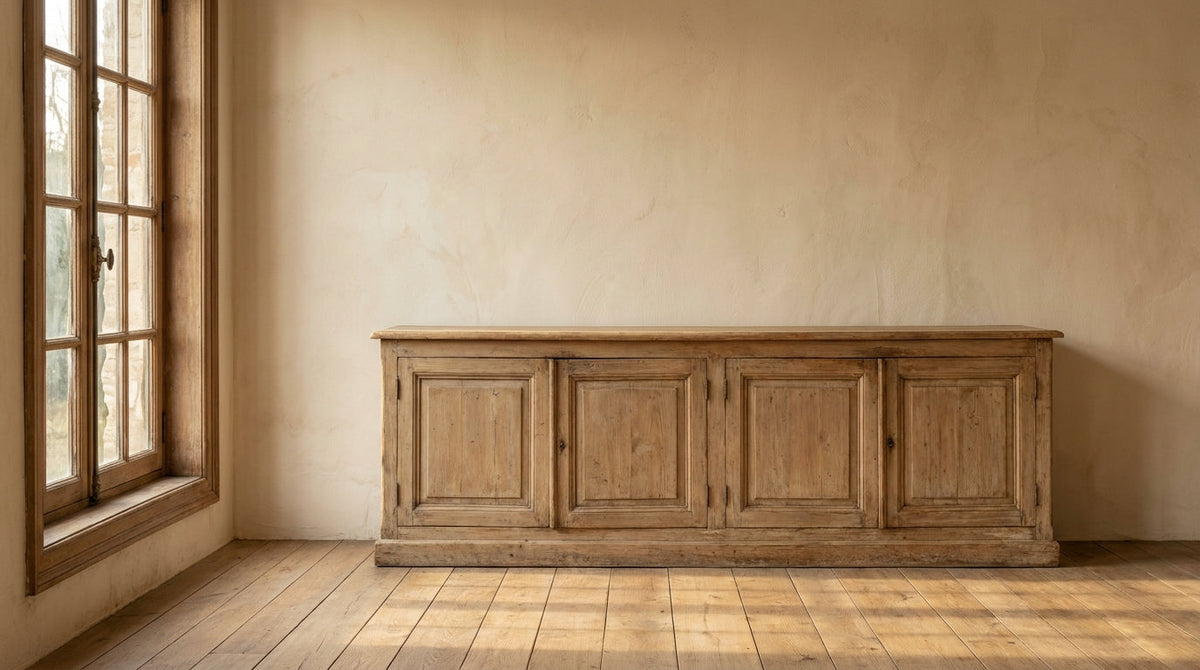
A sideboard works for drink service when the top can take condensation and the depth clears a bottle and a glass together. A zinc centre panel handles wet rings that an oiled hardwood top will not. Read the finish before you load it, and keep ice off waxed wood entirely.
The elm breakfront sideboard has a zinc center panel that shrugs off condensation the way an oiled hardwood surface can't, which is why we point people to it first when they ask about summer drink service. The rest of this guide is what we tell customers on the phone: what a sideboard actually needs to do beverage work, how to read the finish before you load it up, and what breaks first when you skip either question.
What Makes a Sideboard Actually Work as a Beverage Station
Three things separate a sideboard that runs a real beverage station from one that just parks a few bottles.
First, surface depth. A typical dining sideboard runs 18–22 inches deep (source), and you want to be at 20 or better. At 18 inches, a rocks glass, an ice bucket, and a bottle of gin fight for the same six inches of front-to-back space, and something ends up hanging over the edge. At 20–22 inches, you can run a tray across the back and still have room to pour without elbowing anything off.
Second, drawer access. Bar tools (jigger, strainer, muddler, bottle opener, a stack of cocktail napkins) belong in the top drawer, not on the surface. If the top drawer is shallow (under 4 inches interior) or the glides bind when the drawer is full, the station stops working by the third guest.
Third, interior shelf clearance. Highball glasses run 6 inches tall. Wine glasses run 8–9. If the interior shelf spacing is fixed at 10 inches or less, you're stacking, which means you're washing every glass before you use it. The elm breakfront sideboard has adjustable interior shelves and a zinc-topped center bay specifically because that's the geometry a working station needs.
Which tops take drink service
| Top | Condensation | Spills | Note |
|---|---|---|---|
| Zinc panel | Handles it | Handles it | Wipes clean and patinas |
| Oiled hardwood | Rings | Blot immediately | Re-oil the patch afterwards |
| Waxed pine | Rings | Blot immediately | Keep ice off it entirely |
| Stone | Handles it | Handles it | Heavy, and cold to the touch |
How to Read a Sideboard's Surface Before You Load It
The finish is what decides whether you need coasters or whether you can wipe and move on.

Waxed pine or waxed reclaimed wood. Wax gives you almost no moisture barrier. A buffed wax coat won't stop condensation transfer, and a sweating pitcher left for 20 minutes will leave a white ring you'll have to buff out (source). Waxed surfaces are also more prone to trapping the moisture under the wax, which is why those rings are harder to remove than rings on a lacquered surface (source). Pine is a softwood, so it absorbs faster than oak or elm to begin with (source). If your sideboard is waxed pine, use a tray. Not decorative. Structural.
Lacquered or polyurethane surfaces. Film finishes slow moisture transfer significantly. A lacquered top like the one on the Brighton server will take a sweating glass without a coaster for the length of a dinner party. It won't take a puddle overnight, but nothing will.
Oiled hardwood. Middle ground. Better than wax, worse than lacquer. Wipe standing moisture promptly and you'll be fine.
Zinc, marble, or stone panels. These are what we spec into pieces meant for drink service. Zinc patinas and won't ring. Marble will etch from citrus, so keep the limes on a small board.
One rule that applies to every finish: keep the citrus off the wood. Lemon juice is acidic enough to soften lacquer and dissolve wax over time (source). A slice that sits in a puddle of its own juice for an hour will leave a cloudy patch that won't buff out.
How to Arrange a Beverage Station on a Sideboard Without It Looking Cluttered
Zone it. Bottles left, glassware center, ice and prep right. Left to right because most people are right-handed and pour with their dominant hand from a bottle they picked up with their off hand. The arrangement follows the motion.
On a 48-inch sideboard, that's roughly 16 inches per zone, which is tight. You'll fit four bottles left, six to eight glasses center on a tray, and an ice bucket plus a small board on the right. That's the working ceiling for 48 inches. Anything more and you're stacking.
On a 60-inch sideboard, you get 20-inch zones, which is where a station stops feeling like a compromise. Six to eight bottles left, a full glassware tray plus a decanter center, ice bucket and prep board with room for garnishes on the right. This is the width a piece like a distressed blue sideboard gives you, and the painted finish hides the inevitable drip you won't catch until morning.
Skip the vertical clutter. One tall element per zone: the tallest bottle on the left, a decanter or hurricane in the center, an ice bucket on the right. Everything else stays low. The eye reads three tall points and calls it composed. Five tall points and it reads as a bar cart shoved against a wall.
What Pairs with a Sideboard Beverage Station in a Dining Room or Living Room
A tray under the glassware zone is not optional. A 14x20 rattan or brass tray does two jobs: it defines the center zone visually, and it catches every drip before it reaches the wood. An insulated ice bucket beats a decorative one on any surface that isn't zinc or stone. If you're running a party longer than three hours, a small bar cart pulled up alongside gives you the overflow lane for backup bottles and dirty glassware, which keeps the sideboard from turning into a landfill by hour two.
Scale matters. On a reclaimed pine or painted sideboard, brass and rattan sit better than chrome and glass. The warm-toned metals read as part of the piece, not against it. On a darker hardwood, pewter and matte black hold up. If you're shopping to pair, the full sideboard collection is organized by finish, which makes it easier to see which pieces already carry the metal tone you want to build around.
Why a Solid-Wood Sideboard Holds Up to Daily Beverage Use Better Than Veneer
The specific failure point on a veneered sideboard is the edge. Once the edge banding lifts (usually from a spill running down the front), moisture reaches the MDF or particleboard core underneath, and MDF swells irreversibly when it gets wet (source). You'll see it as a soft, puffy spot along the front edge that won't sand out because there's nothing solid to sand into. The veneer layer itself is usually under 2mm thick (source), which means one aggressive sanding takes you through it and you're staring at glue.

Solid wood fails differently. It marks (rings, dents, scratches), but the marks live in wood you can sand and refinish. Solid-wood pieces like this six-door sideboard can be sanded and refinished multiple times across decades (source), which is the actual argument for the price difference. A veneered piece at $700 is a five-year piece if you use it hard. A solid reclaimed-wood sideboard at $2,800 is a thirty-year piece that gets refinished twice.
How to Maintain a Sideboard You're Using as a Beverage Station
Weekly, during heavy-use months: wipe the surface down with a barely damp cotton cloth in the direction of the grain, then dry immediately with a second cloth. No sprays, no polish, no citrus-based cleaner. Citrus solvents can soften wax finishes and won't touch a moisture ring anyway (source).
End of summer, on a waxed piece: reapply a neutral paste wax (Briwax clear or an equivalent) with a cotton cloth, let it haze for 15 minutes, buff off with a clean cloth. Once a year is enough for light use. Twice a year if the sideboard ran drink service all summer.
The two things that shorten a waxed-pine finish the fastest: standing moisture (a pitcher that sweated for an hour, a spilled drink that sat overnight) and citrus oils (a lemon wedge on the wood, an orange peel next to a bottle). Neither is a problem if you use a tray under the wet zone and a small board under the citrus. Both are a problem if you don't.
If you get a ring anyway, and eventually you will, a light 0000 steel wool with a dab of wax, worked in the direction of the grain, will pull most of it. If the ring is dark instead of white, the moisture reached the wood itself, and that's a refinisher's call, not a home fix.
The elm breakfront sideboard sidesteps most of this because the zinc panel handles the wet work and the elm surrounds handle the composed work. That's why we spec it the way we do.
Common questions
Can a waxed pine sideboard handle condensation from pitchers and ice buckets?
Not without help. Wax gives you almost no moisture barrier. A buffed coat won't stop a sweating pitcher from transferring water into the finish, and pine absorbs moisture faster than hardwoods to start with. Run a tray or a stone slab under anything that sweats, and wipe standing moisture immediately. You'll still get the occasional ring across a season of use, and that's what the end-of-summer rewax is for. If you want a piece that handles wet service without a tray, look at a zinc-topped or lacquered sideboard instead.
How much surface depth does a sideboard need to work as a beverage station?
Twenty inches is the working minimum, 22 is more comfortable. Standard sideboards run 18–22 inches deep. At 18, you're crowded: a bottle, an ice bucket, and a rocks glass all want the same six inches of front-to-back. At 20+, you can run a tray across the back with the bottles behind it and still pour comfortably in front. Anything under 18 is a console, not a sideboard, and it won't do beverage work without spillover.
Do sideboard drawers hold bar tools without warping from humidity?
Solid-wood drawers built with dovetail joinery move seasonally but don't warp. They get slightly tighter in summer humidity and loose again by fall. Bar tools (jigger, strainer, muddler, opener) are fine inside them. What you don't want is a drawer full of cocktail napkins or paper coasters that sit in humid drawer air all summer, because they wick moisture and go soft. Store paper goods in a closed tin inside the drawer, or in a lower cabinet with a door.
What's the difference between a sideboard and a buffet for drink station use?
Mostly leg height. Sideboards sit taller, usually 34–36 inches, with longer legs and more air underneath. Buffets are lower and more grounded (source). For beverage service, the taller sideboard is easier on your back because you're pouring closer to counter height. A buffet works, but you'll feel it after a long evening. Either one needs the surface depth and finish behavior described above. The leg height is comfort, not function.
Can you use a sideboard as a beverage station outdoors or on a covered porch?
No. Even under a covered porch, ambient humidity swings, direct temperature changes, and the occasional wind-blown rain will do damage a wax or oil finish can't take. Reclaimed pine especially will move: the wood absorbs moisture, the joinery moves with it, and by the third summer you'll see gaps in the case and a finish that's failed at the edges. Buy an outdoor-rated bar cabinet or a stone-topped console for exterior use. Keep the sideboard inside, roll it into the dining room, and let it do the work it was built to do.


