
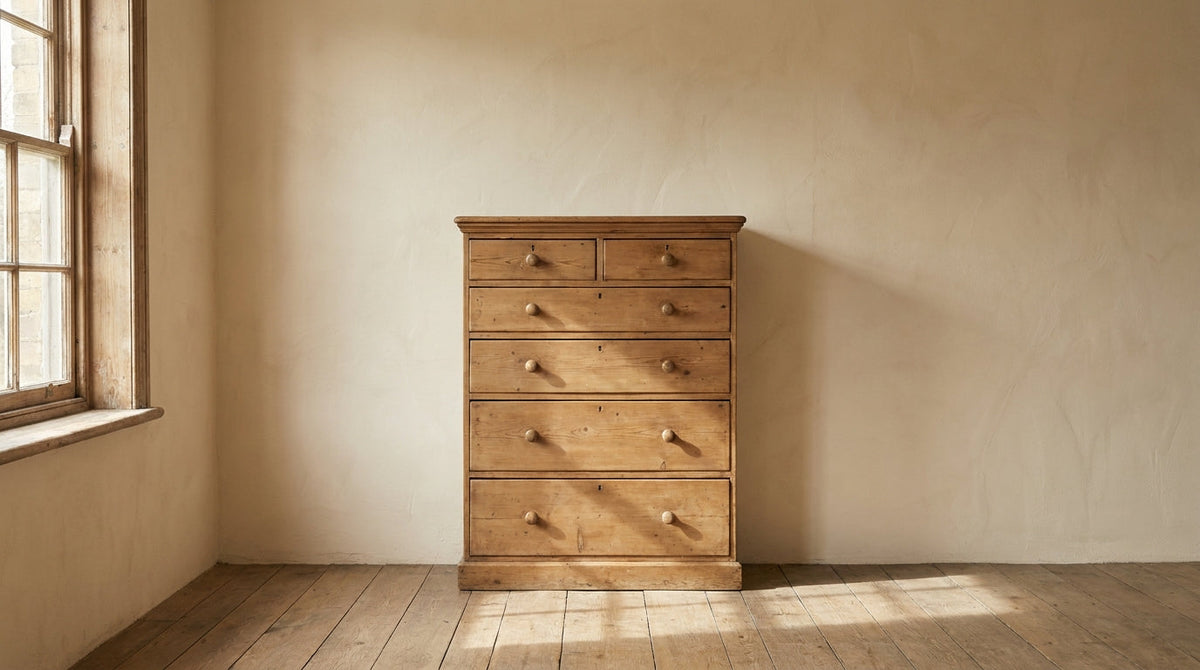
A chest of drawers is taller and narrower than a dresser, so it styles vertically: one mirror or lamp above it, two or three objects on top, nothing crowding the pulls. Leave 24 to 30 inches of clear floor in front so the bottom drawer opens fully. Our Lori chest is 48 inches wide.
The Lori Four-Drawer Chest is 48 inches wide in reclaimed pine, and it's the piece we keep pointing customers toward when they ask how to fit real storage into a bedroom that isn't oversized. A chest of drawers is not a dresser, and once you understand the difference in footprint, most of the styling and placement questions answer themselves.
Chest of Drawers vs Dresser: What the Difference Means for Bedroom Layout
A chest of drawers runs 44 to 60 inches tall and 24 to 38 inches wide (source). A dresser runs shorter and wider, usually 30 to 36 inches tall and 40 to 70 inches wide. That's the whole distinction, and it decides where each piece can live.
A chest goes against a shorter wall run, in the corner opposite the bed, or in a narrow alcove where a dresser wouldn't fit. Because the storage stacks vertically, you get four or five drawers of capacity in the footprint of a nightstand and a half. A dresser needs a long wall, usually the one across from the bed, and it reads as horizontal furniture that carries a mirror or artwork above it.
If your bedroom is under 120 square feet, or if the long walls are taken up by windows and doors, the answer is almost always a chest. The Lori is a good example of the format at its wider end: four drawers, 35 inches high and 48 inches wide. For a genuinely tight wall, the Chest in Distressed Light Blue is 34 inches wide and does the same job in less space, fitting between two windows or beside a closet door where a dresser cannot.
Chest of drawers against a dresser
| Chest of drawers | Dresser | |
|---|---|---|
| Footprint | Tall and narrow | Low and wide |
| Typical width | 32 to 38 inches | Wider, which is why it wants a long free wall |
| What goes above | One mirror or a single lamp | A wide mirror, lamps either side |
| Floor clearance needed | 24 to 30 inches in front | 24 to 30 inches in front |
| Right for | Smaller bedrooms | A long free wall |
How to Read Your Wall Before You Commit to a Chest
Measure the wall from baseboard to baseboard, then subtract anything that swings or slides into that space. A bedroom door needs 32 to 36 inches of clear swing arc. A closet door, hinged rather than sliding, needs its own arc, usually 24 to 30 inches. The chest itself needs 24 to 30 inches of pull-out clearance in front of the drawers so you can open the bottom one all the way.
Chalk this out on the floor before you order. Painter's tape on hardwood works even better. If you're left with less than three feet of clear standing room after the chest goes in, the room will feel tight, and no amount of styling on top will fix it.
The other check: sightlines from the bed. A tall chest across from the bed becomes the first thing you see in the morning. That's fine, usually good, but it means the top of the chest matters more than the top of a dresser tucked to the side of the room.
The One Vertical, One Horizontal, One Sculptural Rule for Styling a Chest Top
Three objects on top of a chest is the ceiling for most rooms. More than that and the surface reads as cluttered from across the room.
The rule we use: one tall vertical (a lamp, a stemmed vase, a stack of two framed prints against the wall), one flat horizontal (a wooden tray, a stack of three books laid sideways, a folded linen runner), and one sculptural object with irregular mass (a small ceramic vessel, a stone, a piece of carved wood, an antique brass candlestick). The three shapes read as three different weights, so the eye moves across the surface instead of stopping on a single crowded pile.
On a piece like this distressed blue chest, the sculptural object is where the wax finish gets to breathe. Leave enough surface around it that you can still see the grain. If the chest is under a mirror, the vertical object can drop lower (a squat lamp) so it doesn't compete with the mirror's frame.
Why the Chest's Finish Changes What You Can Put Next to It
Waxed reclaimed pine reads warm and yellow-toned. It pulls beautifully against unlacquered brass, unglazed terracotta, natural linen, and cream ceramic. It fights with chrome, nickel, and cool-grey ceramics; the temperature mismatch makes both pieces look off.
A painted milk-finish chest, like a painted three-drawer chest in antique white, runs cooler and more neutral. It sits well with either warm or cool metals, but the surface is porous, so anything wet (a sweating water glass, a fresh-cut flower stem) will leave a mark if it isn't sealed with wax on top of the paint (source). Use a tray under anything that holds water.
A dark-stained hardwood chest pulls the room toward the deep end. It handles heavier objects (a thick ceramic lamp base, a bronze bowl, a leather-bound stack) better than a pine chest, which can look overloaded under the same weight. If the rest of the room is light, a dark chest wants a lighter styling hand on top: one lamp, one small ceramic, done.
What a Heritage Chest Does for a Bedroom Over Time
At the $1,500–$4,000 price point, the question worth answering is what the piece looks like in year fifteen, not year one.

A solid-wood chest with dovetailed drawers is refinishable. The dovetail joint (interlocking trapezoidal pins and tails) locks mechanically rather than with glue and staples, which means the drawer boxes stay square as the wood moves seasonally (source). If the top gets scratched, it can be sanded and rewaxed. If the finish dates itself in ten years, it can be repainted or stripped back to raw wood without the carcass falling apart. The Lori is built this way: solid reclaimed pine, dovetailed drawer boxes, hand-applied wash finish. You can strip it and refinish it in a different color in 2038 and the frame will still be square.
A chest of drawers with an MDF carcass and stapled drawer boxes can't do any of that. The MDF swells if it's ever refinished, the drawer boxes wear through at the corners in five to eight years, and the piece becomes a candidate for the curb, not the restorer. That's the price argument for solid wood: the piece can be brought back.
Keeping a Reclaimed Pine or Painted Wood Chest in Good Condition
Reclaimed pine has already done most of its moving. The wood spent decades in a building before it became furniture, so it's more dimensionally stable than kiln-dried new pine, but it still moves with humidity. Keep the room between 35% and 55% relative humidity year-round (source). A humidifier in winter is usually enough.

Wax the top and sides twice a year with a neutral paste wax, once in early fall and once in late spring. Apply with a cotton cloth in the direction of the grain, let it haze, buff off with a clean cloth. Skip silicone-based sprays; they build up and turn the surface sticky.
Drawer runners stiffen in humid months because the wood swells and the tolerances tighten. Pull the drawer out, wipe the runner clean, and rub a beeswax block along the wood-on-wood contact points (source). That's usually enough to get them moving again.
Milk-painted finishes need gentler treatment. Dust with a dry cloth, wipe spills immediately, and reapply a light coat of wax every few months to keep the surface sealed (source). Skip vinegar, ammonia, and anything abrasive; they'll cut through the wax and mark the paint.
If you're weighing options across the category, our reclaimed pine pieces are all built to this care profile, and the Lori is the chest we'd start with for most bedrooms under 150 square feet.
Common questions
What is the difference between a chest of drawers and a dresser?
A chest of drawers is taller and narrower, usually 44 to 60 inches tall and 24 to 38 inches wide, with drawers stacked vertically. A dresser is shorter and wider, usually 30 to 36 inches tall and 40 to 70 inches wide, with drawers arranged in two or three columns side by side. A chest fits shorter wall runs and gives you the same drawer capacity in a smaller footprint. A dresser needs a long wall and reads as horizontal furniture, often paired with a mirror above.
How much wall space does a bedroom chest of drawers need?
A chest with a 32-to-38-inch width needs at least 44 inches of clear wall (so it isn't crowded against a door casing or window trim), plus 24 to 30 inches of clear floor in front for pulling out the bottom drawer. Before ordering, tape the footprint on the floor and check the swing arc of any nearby door.
What do you put on top of a bedroom chest of drawers?
Three objects, at different heights and shapes: one vertical (a lamp or tall vase), one horizontal (a tray, a stack of books, a folded runner), and one sculptural piece with irregular mass (a ceramic vessel, a stone, a candlestick). Leave enough surface between the objects that the wood still reads. More than three objects makes the surface look busy from across the room.
Does a chest of drawers need to match the bed frame?
No, and it usually shouldn't. A room where every wood tone matches reads as a bedroom set from a catalog. A reclaimed pine chest against a dark walnut bed, or a painted milk-finish chest against a natural oak bed, gives the room depth. The rule is that the wood tones should sit in the same temperature family (both warm, or both cool), but they don't need to match.
Can you use a chest of drawers in a small bedroom?
Yes. A chest is the format made for small bedrooms. Because the storage stacks vertically, you get four or five drawers of capacity in the footprint of a nightstand and a half. In a room under 120 square feet, a chest almost always works better than a dresser.
How do you style a chest of drawers without it looking cluttered?
Cap the surface at three objects. Vary the heights so the tallest object is roughly twice the height of the shortest. Leave visible wood between each piece. If you can't see the top of the chest from across the room, there's too much on it.


