
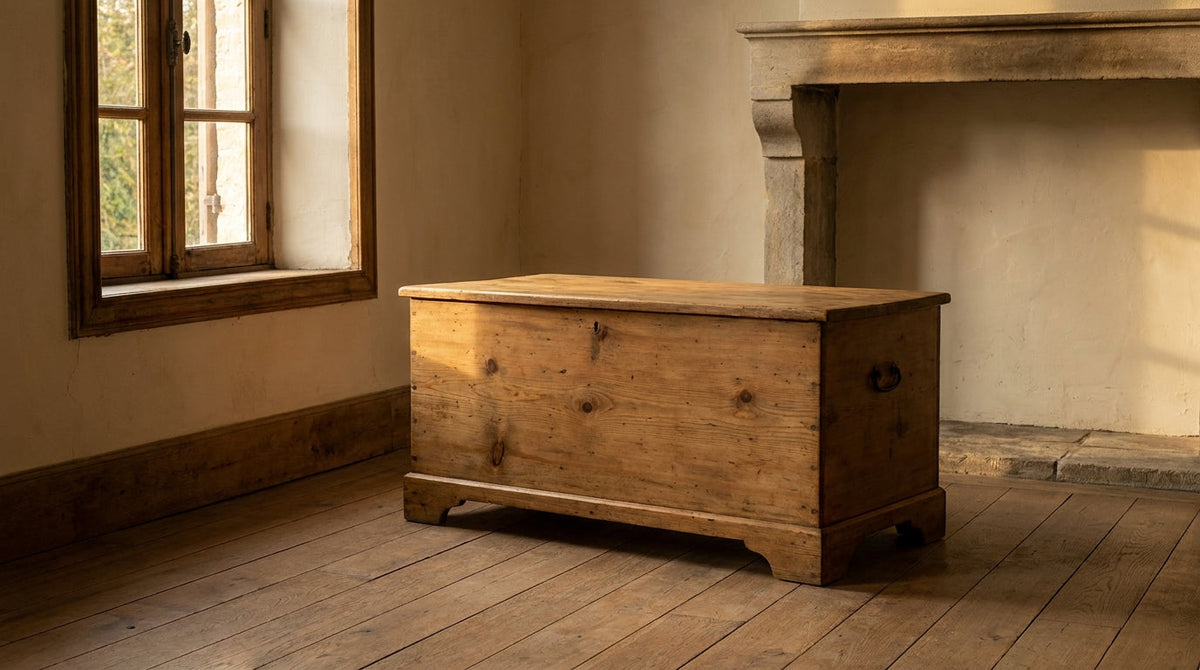
A hand-applied finish is built up in separate passes rather than sprayed on in one. On our reclaimed pine pieces that means a penetrating oil driven into the end grain, a hard-wax oil rubbed across the top, and paste wax buffed out once the oil has cured. It wants re-waxing about twice a year, never refinishing.
The Reclaimed Pine Parquet Top Baluster Tbl is finished by hand in three passes. A penetrating oil goes into the end grain of the parquet, a hard-wax oil coat is rubbed across the top, and a paste wax is buffed out once the oil has cured. That sequence is what a hand-applied finish actually is, and it's why the care instructions for a piece like this are different from what you'd do to a sprayed catalog table.
What Separates a Hand-Applied Finish From a Factory Spray Coat
A factory spray line puts down lacquer through an HVLP gun because lacquer dries too fast to brush without lap marks. It's a production-speed decision, not a quality one. The result is a hard, uniform film sitting on top of the wood, usually two or three passes stacked wet-on-wet, cured in a heated tunnel in under an hour.

Hand-applied is the opposite rhythm. On our reclaimed pine, one person wipes oil into the wood with a cotton cloth working with the grain, waits for it to penetrate (usually overnight), wipes back the excess, and comes back the next day for the second coat. A wax or hard-wax oil layer goes on after that, buffed by hand. The full build is three to five days, not forty minutes.
Two things fall out of that. First, the finish sits in the wood as much as on it, so what you see is grain, not plastic over grain. Second, every board takes the finish a little differently. Old-growth reclaimed pine has 20–25 growth rings per inch versus 6–8 in modern plantation pine, and the tighter rings drink less oil, so the color settles unevenly across a top. That variation is the finish working correctly, not a defect.
Hand-applied against sprayed finishes
| Finish | How it goes on | Repairable at home | Upkeep | Surface reads as |
|---|---|---|---|---|
| Hard-wax oil over penetrating oil, waxed (ours) | Rubbed in by hand in three passes | Yes | Re-wax twice a year | Soft sheen, open grain |
| Sprayed lacquer | HVLP gun, cured in a heated tunnel | No | Strip and refinish | Hard film, slight glare |
| Polyurethane | Brushed or sprayed, sits on top | No, chips flake | Strip the panel and start over; spot repair is not really possible | Plastic over the wood |
The Three Finish Types We Use and What Each One Does to the Wood
Paste wax over raw wood. The lightest build. Beeswax and carnauba buffed into sanded pine. Low sheen, very tactile — you can feel the grain through it. Zero moisture resistance to speak of, so it's best on pieces that don't take heavy handling like a bedroom chest, a hall console, a display cabinet. Needs re-waxing annually.
Hard-wax oil. The workhorse. Plant-based oils combined with wax; the oil penetrates and darkens the wood the way linseed does, and the wax component leaves a thin water-resistant layer on top. This is what's on the parquet-top table and most of our dining and console pieces. Matte to low satin sheen. Repairable in place.
Hand-rubbed varnish. The most protective of the three we use, and the slowest to build. Brushed on in thin coats, sanded lightly between with 400-grit, three to four coats total. Gives a warmer, slightly deeper sheen than the wax-oil. We use it on pieces that will see wet glasses or serving dishes regularly.
A note on what we don't do: sprayed polyurethane. It's more scratch-resistant on paper, but it turns the reclaimed pine into a photograph of itself under a plastic sleeve. The whole reason to buy a piece with 100-year-old saw marks is to feel them.
Why a Hand-Applied Finish Holds Up Differently Than Polyurethane
Polyurethane is a film-forming finish. It bonds to itself, not the wood, and the film either holds or it fails. There's no in-between state. When it scratches, the scratch cuts through the film and shows a bright pale line where the wood underneath is now exposed. When water sits on it long enough to get past the film, you get a white cloudy ring under the coating that has to be sanded through to remove. Spot repair isn't really possible; you strip the panel and start over.
A penetrating oil-wax finish behaves the other way. Because the oil is in the fiber rather than on top of it, a scratch shows as a slightly duller, drier patch. No bright line, because there's no film to cut through. Water rings are usually a wax problem, not a wood problem, and they lift with a fresh application of wax and a buff. On something like the barn door cabinet, where the doors slide open several times a day and hands touch the same spots for years, a hand-applied finish will show wear where the hands go, and you re-wax that area, not the whole cabinet.
The honest trade: penetrating finishes are less moisture-resistant than film finishes in an absolute sense. You cannot leave a sweating glass on a waxed pine tabletop overnight and expect nothing to happen. What you get in exchange is a finish you can maintain yourself for the life of the piece, instead of one that eventually needs a professional refinisher when the film gives out at year fifteen.
The Maintenance Routine for a Waxed or Oiled Pine Piece
The cadence is simpler than it sounds.
Weekly: dust with a dry microfiber cloth or a soft cotton rag. That's it. No sprays, no polishes.
Monthly: wipe down with a barely damp cloth if the piece is in a kitchen or dining space where it picks up cooking film. Dry it immediately with a second cloth. Water is fine in passing; standing water is not.
Twice a year (spring and fall): a maintenance coat of paste wax on waxed pieces, or a light coat of the same hard-wax oil the piece was finished with on oil-wax pieces. Apply with a cotton cloth in the direction of the grain, let it sit fifteen to twenty minutes, buff off the excess with a clean cloth. On our reclaimed pine collection, a neutral paste wax (Briwax clear or Howard Feed-N-Wax) is the safe default when you can't confirm which finish is on the piece.
Never: silicone-based furniture polishes (Pledge and its cousins), ammonia cleaners, orange-oil sprays, or Murphy's Oil Soap. Silicone especially. It soaks into a waxed finish, contaminates the wood, and makes future refinishing miserable. If somebody in your house has sprayed Pledge on the table, call us before you do anything else.
How to Touch Up a Scratch or Worn Patch Without Refinishing the Whole Piece
This is the whole reason to own a piece with a hand-applied finish. On this console or any other waxed or oil-waxed piece, here's the sequence for a localized repair.

- Clean the area. Wipe with a dry cloth first, then a barely damp one, then dry it. Any grit left in the scratch will get sealed under the repair.
- Assess the depth. If your fingernail catches on it, it's into the wood. If it doesn't catch, it's a finish-layer scuff and you can skip to step 4.
- Feather the edge. For a scratch that caught your nail, take 0000 steel wool or a worn piece of 600-grit sandpaper and rub only the scratch and about a quarter-inch around it, going with the grain. Ten to fifteen light passes. Wipe the dust.
- Apply the matching finish. For an oil-waxed piece, a small amount of hard-wax oil on a cotton pad, rubbed into the scratch and the feathered area. Let it sit ten minutes. For a purely waxed piece, paste wax the same way. Wipe back the excess.
- Buff into the surrounding surface. Take a clean cloth and buff outward from the repair in widening circles, so the sheen of the fresh area blends into the existing surface. Come back the next day and buff the whole panel lightly to even it out.
If you're unsure which finish is on your piece, email us the item number and we'll tell you.
What to Avoid in the First 30 Days After Delivery
A hand-applied finish is dry to the touch when it leaves us but not fully cured. Full cure on the wax and oil layers runs about three to four weeks, similar to the 21–30 day window for a film finish. During that window:
- No standing water. Coasters on the parquet-top table from day one.
- No rubber-backed placemats, pads, or shelf liner. Rubber and fresh wax react and can leave a permanent haze imprint.
- No direct afternoon sun on a freshly waxed surface for the first two weeks. The heat softens the wax before it's fully set.
- No cleaning products of any kind for 30 days. Dry cloth only.
- No heavy objects dragged across the top. Lift, don't slide.
After 30 days the finish is fully hardened and you move into the normal maintenance rhythm above. The parquet-top table, the barn door cabinet, the console — all of them will look better at year five than year one if you follow the cadence, because the wax layer builds slightly with each application and the wood underneath keeps deepening in color.
Common questions
How often should you re-wax a hand-finished pine piece?
Twice a year is the right rhythm for a piece in normal residential use, once in spring and once in fall when the humidity swings anyway. High-use surfaces like a dining table that gets wiped down daily can go to three times a year. If the surface starts feeling dry to the touch or looking chalky rather than soft, that's the piece asking for wax earlier than the calendar says.
Can you use furniture polish on a hand-applied wax or oil finish?
No, and this is the single most common way people damage these finishes. Aerosol polishes contain silicone, which soaks into the wax layer, contaminates the wood underneath, and makes any future refinishing or touch-up work fail to bond. Dust with a dry cloth for weekly care, and use the actual finish product (paste wax or hard-wax oil) for the twice-a-year maintenance coat. Nothing else needs to touch the wood.
What happens if you put a polyurethane topcoat over a waxed finish?
It doesn't bond. Polyurethane needs a clean, oil-free, wax-free surface to adhere to, and even trace wax in the pores of the wood will cause the poly to fisheye, peel, or lift within a few months. If someone wants to switch a waxed piece over to a film finish, the whole surface has to be stripped down to raw wood with mineral spirits and light sanding first. It's a full refinishing job, not a topcoat. We'd talk you out of it in most cases.
How do you tell if a wood finish is wax, oil, or lacquer before you buy?
Three quick reads. Run your fingernail lightly across an inconspicuous spot. Wax leaves a faint mark you can buff out with your thumb, oil-wax feels slightly softer than the wood but doesn't mark, and lacquer or polyurethane feels like glass and won't mark at all. Look at the sheen at a low angle. Hand-applied finishes have a soft, slightly uneven glow across the surface, while sprayed film finishes reflect like a mirror. And ask the seller what specific product was used. Anyone who can't answer that question in one sentence is selling you a finish they didn't apply themselves.
Is a hand-applied finish less durable than a factory spray coat?
Less resistant to water and heat in the short term, yes. A polyurethane film will shrug off a wet glass longer than a wax layer will. More durable across the life of the piece, also yes, because a hand-applied finish is repairable in place for decades, and a failed polyurethane film requires stripping the whole panel. The right way to think about it: film finishes are hard until they aren't, and then they're done. Hand-applied finishes are softer but they renew.
Can a scratched hand-finished surface be repaired at home without professional refinishing?
Yes, and this is the point of the finish. A shallow scuff comes out with a buff of the existing wax. A scratch that catches your nail needs 0000 steel wool or 600-grit paper along the scratch, a dab of matching wax or hard-wax oil, and a buff into the surrounding surface. The whole repair takes fifteen minutes and disappears into the piece. If you're not sure which product to use for a specific piece from us, call (336) 431-9929 with the item number and we'll tell you exactly what's on it.


