
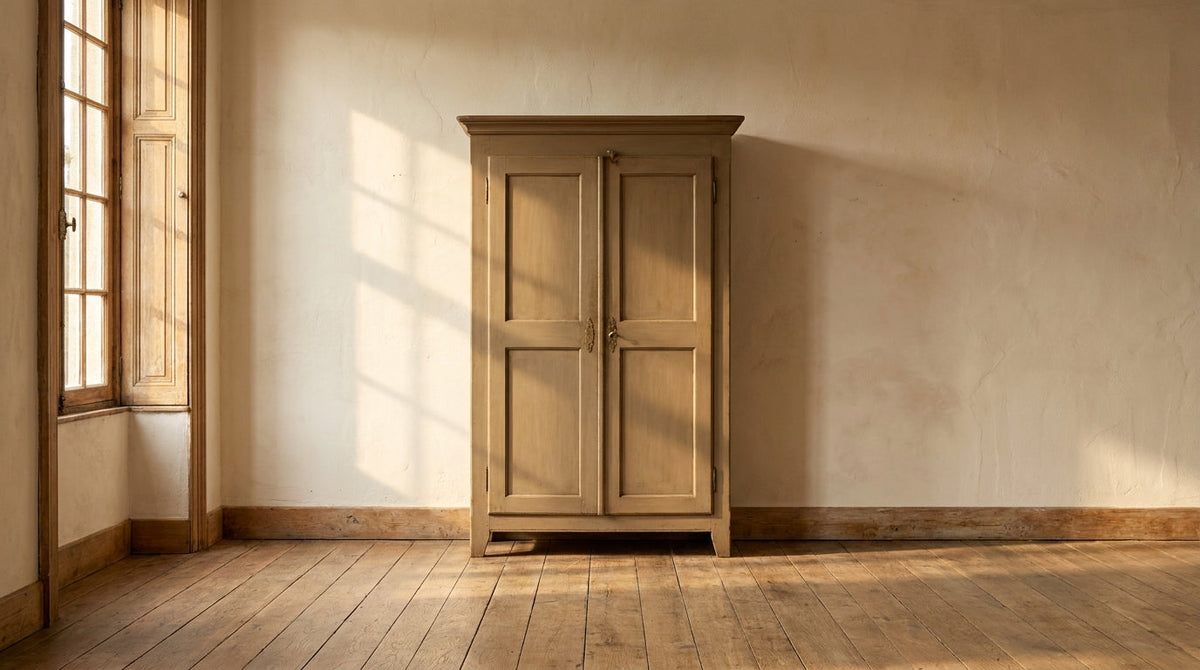
French country is a construction category, not a paint colour: solid wood, a hand-applied wash rather than sprayed paint, turned legs you can wrap a hand around, and end grain left visible. If the end grain is hidden and the legs are hollow-routed, you are looking at veneer over MDF in a painted hat.
The French Country Dining Table Antique Grey isn't a bedroom piece, but it's the clearest example we sell of what "French country" actually means as a construction category. Solid wood, a hand-applied antique grey wash, turned legs you can wrap a hand around, no veneer hiding the end grain. Most of what gets sold as French country bedroom furniture at the $1,500 mark is veneer-over-MDF in a paint color borrowed from the category. This guide is how we tell the difference, what to budget for, and what to skip.
What French Country Bedroom Furniture Actually Is (and What It Is Not)
French country is a construction style first and a finish second. The construction markers are solid wood (oak, pine, or mixed hardwoods), turned or tapered legs, paneled drawer fronts with a recessed centre, visible joinery at the corners, and a painted or limed wash that leaves the grain readable through the finish. The colour vocabulary is muted: antique grey, chalk white, pale blue-green, weathered cream. The wash is hand-applied, which is why no two pieces match exactly.
What it is not: Parisian-modern (lacquered, sharp-edged, gilded), farmhouse-generic (shiplap-flat, distressed-on-purpose with a wire brush), or shabby-chic (sprayed distress over MDF). Those styles borrow the colour palette without the build. Look at the leg of this antique grey French country table. The turning is cut into solid stock, not a moulded sleeve glued around a square post. That's the tell. If the leg looks turned but feels light when you knock it, it's a moulding wrap, and the piece sitting next to it in the catalog is the same build under a different colour.
For a bedroom, the category translates cleanly: a bed frame with paneled headboard, an armoire or tall chest, and a pair of nightstands. The shape vocabulary stays the same. The finish vocabulary stays the same. The construction has to stay the same too, or you've bought a farmhouse-generic set in French country paint.
Four checks before you buy
| Check | The real thing | Veneer in a painted hat |
|---|---|---|
| End grain | Visible at the edges | Hidden under banding |
| Legs | Turned, solid, you can wrap a hand around | Hollow-routed |
| Finish | Hand-applied wash that rubs back | Sprayed paint that chips off |
| Weight | Heavy for its size | Light for its size |
How to Tell a Solid-Wood French Country Piece From a Veneer-Over-MDF One
Four physical checks, in order, before you order anything sight-unseen.

Corner joints. Pull the top drawer out and look at the corner where the front meets the side. Dovetails (interlocking trapezoidal pins) mean solid wood drawer construction. Staples and glue with a thin laminate covering the join mean MDF or particleboard. Cam-lock fittings (the round metal disc you tighten with an Allen key) mean flat-pack engineered wood. There's no painted finish that hides the difference once the drawer is open.
Drawer box material. The sides and back of the drawer should be solid wood, usually pine, poplar, or oak in this category, not melamine-faced board. Run a fingernail across the end of the drawer side. Wood gives a soft drag; melamine board gives a hard, plastic-feeling edge.
Finish depth on end grain. Where the top of the piece meets the side, look for the end grain of the wood — the pattern of tight rings or pores running perpendicular to the surface. On a solid piece, the finish sinks into that end grain and reads slightly darker. On veneer-over-MDF, the end grain is wrapped in a separate edge band, and you can usually see the seam if you look from above. The distressed sideboard shows this clearly: the blue wash settles into the end grain at the top edges and the panel joins, which is only possible because the wood is solid all the way through.
Hardware weight. Pick up a drawer pull or a knob. Solid brass or solid iron has a weight to it that hollow-cast zinc alloy doesn't. A French country chest with featherlight pulls is telling you something about the rest of the build.
What a French Country Bedroom Set Should Include and What You Can Skip
The three anchor pieces worth budgeting for: the bed frame, one tall storage piece (armoire or chest of drawers), and a pair of nightstands. Everything else in a "complete French country bedroom set" is filler designed to lift the ticket.
Skip: the decorative headboard overlay (a separate carved panel sold to bolt onto a plain headboard), the matching mirror sold as a "vanity addition," and the bench-at-foot-of-bed unless the bedroom is large enough to walk around it without turning sideways. None of these hold resale value, and none of them solve a storage or sleep problem. The bench in particular ends up as a laundry shelf in 80% of the rooms we deliver into.
If the budget allows a fourth piece, make it a glass-front cabinet for the corner. The large glass-and-panel cabinet is the format we'd point at: paneled lower doors for closed storage, glass uppers for the things you actually want to see. It earns its footprint in a way a decorative bench doesn't.
Which Textiles and Curtains Pair With French Country Bedroom Furniture
Paneled wood furniture wants quiet textiles. Heavy patterns fight the paneling, and slick fabrics fight the matte wash finish.
Linen in a medium weight (around 200–280 gsm) is the workhorse: bedding, curtains, upholstery on a reading chair, all of it. Washed cotton in a percale or light twill works for sheets and pillowcases. Toile is the one busy pattern that holds up in this category, but only in a single application. Toile curtains OR a toile headboard panel, never both, and never a toile bedskirt as well.
Curtain headings: pinch pleat or pencil pleat, hung from a wooden or wrought-iron rod a few inches above the window frame. Grommet-top curtains read contemporary and fight the rest of the room. Pooled bottoms (curtains that puddle on the floor) read formal-French. Sill-length or trouser-break length reads country-French. Pick one based on the room's ceiling height: pooled needs nine-foot ceilings to look intentional, not accidental.
Combinations that read cheap regardless of price: polyester velvet, anything with a sheen, faux silk in saturated colours, and patterned bedding that matches the curtain fabric exactly. The whole point of the French country furniture range is hand-applied, slightly variable finish. Textiles that come from a single matched set undercut that.
Why Solid Pine and Painted Hardwood Hold Up Better Than Engineered-Wood Alternatives
Three axes a buyer can use to argue the price.
Refinishability after damage. A solid wood piece with a wax or chalk-paint finish can be touched up in place. Sand the chip, feather in matching paint, re-wax the area, done in an afternoon. An MDF piece with a printed paper-foil finish cannot be refinished. Once the foil tears or the corner swells from moisture, the piece is past the point of repair.
Humidity tolerance in bedrooms. Bedrooms run more humid than living rooms because of breath and skin moisture during sleep. MDF swells when it absorbs ambient humidity over a season: drawer fronts puff at the edges, the laminate lifts at the corners, doors stop closing flush. Solid wood moves with the season too, but it moves and comes back. The reclaimed pine in the reclaimed pine furniture collection moves less than kiln-dried new pine because the wood lost most of its movement during fifty-plus years of life in a building before we got to it.
Resale floor after ten years. A solid wood, painted, dovetailed chest holds a resale value somewhere between 40% and 60% of original after a decade in normal use. The same chest in veneer-over-MDF holds essentially nothing. Secondhand buyers pay for solid construction, not for paint colour.
How to Care for Painted and Waxed French Country Bedroom Furniture
The finish on most French country pieces in the bedroom collection is chalk paint sealed with a paste wax. The care routine is simple and seasonal.

Twice a year, re-wax. Use a neutral paste wax — Howard's, Briwax clear, or any furniture-grade paste wax that isn't tinted. Apply a thin coat with a cotton cloth in the direction of the grain, let it sit fifteen minutes, then buff with a clean cloth. This is a fifteen-minute job per piece and it's what keeps the finish from drying out and flaking.
Avoid: spray polish (silicone-based polishes build up over the wax and turn cloudy), vinegar or citrus-based cleaners (acidic, and they cut through the wax), and any wet wipe marketed as a furniture cleaner. A damp cotton cloth handles every cleaning job a bedroom piece will ever need.
Touching up chips. Chalk paint touches up well because the finish is matte and forgiving. Keep a small jar of the original paint colour with the piece; the maker can usually supply one with the order. Dab the chip with the corner of a small artist's brush, let it dry overnight, then re-wax that area. The repair will be invisible at three feet, which is the only distance that matters.
When to call a refinisher. If a leg cracks, a panel splits, or moisture has lifted a section of the paint past what touch-up can handle. A solid wood piece is always worth refinishing. The cost will be less than replacement and the piece is built to take it.
Common questions
What is the difference between French country and farmhouse bedroom furniture?
French country uses turned legs, paneled drawer fronts, and muted hand-applied colour washes (antique grey, pale blue, chalk white). Farmhouse uses square legs, flat plank drawer fronts, and either raw wood or a heavier distressed finish meant to read as reclaimed. The two styles share a love of solid wood and visible grain, but the silhouette is different. French country is curved and panelled; farmhouse is squared and flat. A bedroom in one style doesn't cross-pollinate cleanly with the other without looking unresolved.
Does French country bedroom furniture work in a small room?
Yes, if you skip the bench and the armoire and stick to a bed, a single tall chest, and one nightstand instead of a pair. The paneled detail and turned legs read well at small scale. The issue in small rooms is volume, not style. Pick the chest over the armoire because a chest gives the same storage in a smaller footprint, and use the wall above it for a single mirror instead of a separate dresser.
How do we keep a painted French country finish from chipping?
Re-wax twice a year, keep the piece out of direct afternoon sun (UV breaks down both the paint and the wax), and use felt pads under anything you set on top of it. Most chips happen at the corners of drawer fronts and at the foot of the legs where vacuums hit. Slow the vacuum down near the legs and the chip rate drops to near zero.
Can French country bedroom furniture mix with non-matching pieces?
Yes, and it generally looks better that way. A matched set in this category reads catalog-styled. Pair a painted bed with a raw-wood chest, or two different colour washes (antique grey nightstand, chalk white chest), and the room reads collected instead of ordered. The constant should be the construction style (paneled fronts, turned legs, hand-applied finish), not the colour.
What wood is most common in French country bedroom furniture?
Solid pine and oak are the two most common, with poplar showing up in painted drawer boxes because it takes paint cleanly and resists warping. Reclaimed pine is what we use most often for painted pieces because it's stable, takes a chalk paint finish well, and has the kind of mild surface variation that reads honest under a wash.
Is French country bedroom furniture worth the price over a mass-market set?
If the piece is solid wood with dovetailed drawers, yes, both on the use side (it survives a kid, a dog, and a humid summer) and on the resale side (it holds value where MDF doesn't). If the piece is veneer-over-MDF in French country paint, no. You're paying a category premium for a build that doesn't earn it. The four checks in the second section of this guide separate the two before you commit.


