
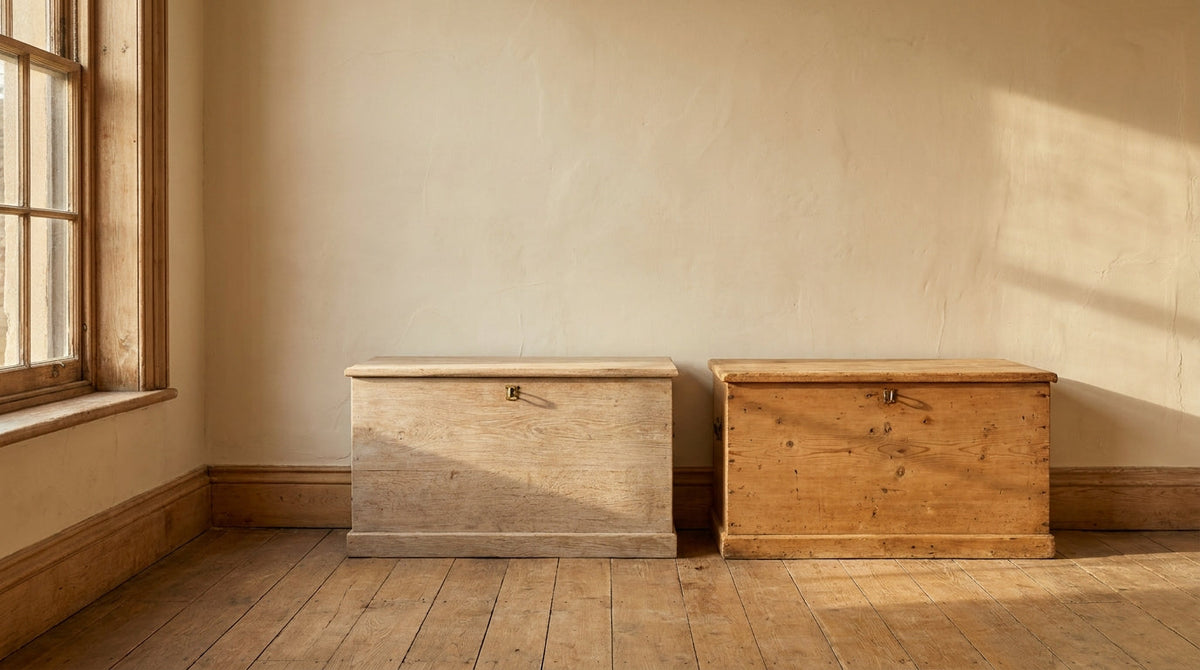
They age in opposite directions. Bleached elm lightens further and shows water marks. Reclaimed pine darkens and absorbs new dents into the wear it already carries. Elm wants a dry cloth and no oil; pine wants wax twice a year. At five years elm looks paler and cleaner, pine looks older and warmer.
The Bleached Elm Cabinet 4 Dr/2drwr is the piece that prompts this question most often. A buyer puts it side by side with one of our reclaimed pine chests at a similar price and asks which one will look better, hold up better, and feel right in their house five years from now. The honest answer is that they age in opposite directions, take a hit differently, and want different care. This is what to expect from each.
What Bleached Elm and Reclaimed Pine Actually Are (and How We Source Each)
Elm is a hardwood with an interlocked grain. Fibers reverse direction as the tree grows, which is why elm splits poorly and holds joinery well (source). Bleached elm starts as that same wood and goes through a two-step chemical pass, caustic soda first, then hydrogen peroxide, to pull the natural reddish-brown out of the heartwood (source). Elm is one of the harder woods to bleach evenly, which is part of why a well-done bleached elm piece costs what it does (source). The grain still reads through. The color sits closer to driftwood than to white-painted.
The Bleached Elm Cabinet and the elm breakfront sideboard both come out of workshops that have run this finish long enough to get the color even across panels. Uneven bleaching is the failure mode, and it shows up as patchy blotches where the peroxide didn't take.
Reclaimed pine is structural softwood pulled out of buildings built between the 1700s and early 1900s: barns, mills, factories that came down (source). The wood we use is old-growth, which matters. Old-growth reclaimed lumber tests 30 to 60 points higher on the Janka scale than new plantation pine of the same species, because the trees grew slowly and laid down tighter rings (source). Reclaimed heart pine specifically scores around 1,225 lbf, harder than a lot of red oak, and well above the 690 lbf you get from new southern yellow pine (source). When we say "reclaimed pine" we mean the old stuff. Not new lumber put through a distress pass.
Two woods ageing in opposite directions
| Trait | Bleached elm | Reclaimed pine |
|---|---|---|
| Direction of ageing | Lightens further | Darkens and warms |
| Water marks | Show | Absorb into the existing wear |
| New dents | Stand out against the pale surface | Blend into what is already there |
| Care | Dry cloth, no oil | Paste wax twice a year |
| At five years | Paler and cleaner | Older and warmer |
How the Grain and Color of Each Wood Change Over the First Five Years
Bleached elm warms. The chemical pass strips color but doesn't lock it out. UV exposure, oxygen, and the oil or wax finish on top all push the wood back toward honey over time. Year one you'll see very little. By year three the panels nearest a window will read a half-shade warmer than the panels in shadow. By year five most bleached elm pieces sit somewhere between fresh driftwood and pale honey, depending on how much direct light the room gets.
Reclaimed pine moves the other way. The amber deepens. A piece that reads warm-tan in the showroom reads warm-amber by year three and something closer to old honey-pine by year five. The rate depends on the finish. Waxed pine deepens faster than oiled pine, and oiled pine deepens faster than a sealed lacquer would.
If you put the Bleached Elm Cabinet next to a reclaimed pine console on day one, they read as a light-and-warm pairing. Five years in, they read as two warm woods at slightly different temperatures. That works in most rooms. It's worth knowing going in.
Dent, Scratch, and Wear: Which Wood Shows Daily Use More
American elm tests at 830 lbf on the Janka scale, a soft hardwood (source). Reclaimed heart pine tests at around 1,225 lbf (source). On the dent-resistance number alone, reclaimed pine wins by about 50%. That surprises people, because pine has a reputation for being soft. New pine is. Old-growth reclaimed pine is not.

What that means in the room: a dining chair dragged across the floor and bumped into this elm dining table will leave a mark that reads as a small bright crescent on the apron. A dog jumping up against the side of a reclaimed pine chest is more likely to leave a scuff than a dent. Corner knocks on bleached elm tend to show because the bleached surface is lighter than the wood underneath, and a chip exposes a hint of the original reddish-brown. Corner knocks on reclaimed pine read as another nick on a piece that already has nail holes and saw marks from 1890.
The practical version: if the room has kids, dogs, and a lot of chair-dragging, reclaimed pine hides the daily wear better. If the room is quieter and the piece will mostly be looked at, bleached elm holds its surface fine and the interlocked grain resists splitting at joints under normal use.
Why Either Wood Holds Its Value Better Than a Veneer Alternative
The case for solid wood at this price point is refinishability. A solid elm or solid pine piece can be sanded down and re-waxed or re-oiled at home with hand tools. Not a perfect factory finish, but a real recovery from a water ring or a deep scratch. The same damage on an MDF-and-veneer piece sands straight through the veneer to the brown board underneath, and there's no repair from there. The piece gets replaced.

That's the buyer math five and ten years out. A solid wood piece at $2,500 that gets re-waxed twice over a decade is a piece you still own and still like. A veneer piece at $1,200 with a sanded-through top is a piece you've already put on the curb. We keep reclaimed pine pieces in stock specifically because the resale floor on solid old-growth wood holds. These pieces show up on secondary markets at meaningful percentages of their original price, and veneer pieces do not.
How to Care for Bleached Elm vs Reclaimed Pine Through the Seasons
Bleached elm. A neutral paste wax twice a year, applied with a cotton cloth and buffed out in the direction of the grain. Avoid anything with a tint. Colored waxes and oil-based stains will undo the bleach. Avoid silicone-based furniture sprays entirely. Keep the piece out of direct south-facing sun if you want the bleach to hold longer. UV will warm the wood whether or not you wax it, but reducing direct exposure slows it. Indoor humidity between 35% and 55% is the safe band. Elm moves less than pine across seasons because of its interlocked grain, but it will still cup if the room runs below 25% all winter.
Reclaimed pine. Wax or Danish oil, your preference. Waxed pine wants a fresh coat twice a year. Danish oil wants a wipe-on coat once a year. Both are forgiving. Pine is absorbent, especially reclaimed pine that's already weathered, so it takes finish well (source). Old-growth reclaimed pine is more dimensionally stable than new pine because the wood lost most of its movement during a hundred years of life in a building, but it still wants the same 35–55% humidity range. Run a humidifier in January. The Bleached Elm Cabinet and a reclaimed pine piece can live in the same room on the same care schedule — the products differ, the cadence doesn't.
Common questions
Does bleached elm stay light or will it yellow over time?
It warms. Bleached elm doesn't yellow the way old polyurethane on maple yellows. It shifts gradually toward honey, driven mostly by UV exposure and the finish on top. Year one you won't notice. Year five you will, especially in rooms with strong south-facing light. The grain pattern stays the same. The base color moves about a half-shade to a full shade warmer over five years in a typical room. If you want it to stay pale, keep it out of direct sun and re-wax with a neutral (untinted) paste wax twice a year.
Is reclaimed pine soft enough to dent easily under normal use?
New pine is. Reclaimed old-growth pine isn't. Reclaimed heart pine tests around 1,225 lbf on the Janka scale, which is harder than red oak and roughly 50% harder than American elm at 830 lbf. The pieces we sell are old-growth reclaimed, not new pine put through a distress pass, so dent resistance is closer to a mid-range hardwood than to the soft pine reputation suggests. Pet claws will scuff before they dent. Chair-leg drags read as scratches, not gouges.
Can you refinish bleached elm if the surface gets scratched?
Light scratches, yes. At home, with fine sandpaper and a fresh coat of neutral wax. Deep scratches that cut below the bleach layer are harder, because the original reddish-brown elm shows through and the repair needs a re-bleach pass to even out. That's a job for a refinisher, not a home repair. The good news is that elm's interlocked grain resists the kind of long-grain splits that make repairs structural. Most damage stays cosmetic.
Which wood is better for a room with direct sunlight?
Reclaimed pine. The amber will deepen faster than it would in a shaded room, but the deepening reads as natural patina. Bleached elm in direct sun warms toward honey faster than most buyers want. If you've chosen bleached elm specifically for the pale color, a south-facing window will work against you. Sheer curtains or UV-filtering film on the window slows it considerably.
Does reclaimed pine have more structural movement than new pine?
Less. Reclaimed pine pulled from a building that stood for a hundred years lost most of its movement during that century. The wood dried, settled, and reached equilibrium long before it ever got to the workshop. New kiln-dried pine is stable enough, but it still has wood-fiber memory that wants to move with the first few seasons in a new house. Reclaimed pine has already done that work. It still wants humidity in the 35–55% range, but it moves less across the year.
How often does waxed reclaimed pine need to be re-waxed?
Twice a year is the cadence we recommend, once in spring, once in fall. A neutral paste wax, applied with a cotton cloth in the direction of the grain, buffed out after fifteen minutes. The signal that it's time is the surface starting to feel dry to the touch instead of softly slick. Pieces in heavy-use rooms (kitchen island, entry console) may want a third light coat in midwinter when indoor humidity drops. If you've gone with Danish oil instead of wax, the cadence drops to once a year.


